

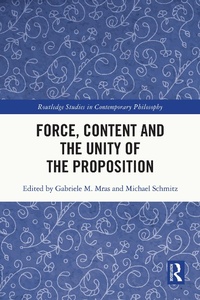
Force, Content and the Unity of the Proposition
1st Edition
Published on 30. December 2021
266 pages
978-1-000-51733-0 (ISBN)
Description

This volume advances discussion between critics and defenders of the force-content distinction and opens up new ways of thinking about force and speech acts in relation to the unity problem.
The force-content dichotomy has shaped the philosophy of language and mind since the time of Frege and Russell. Isn't it obvious that, for example, the clauses of a conditional are not asserted and must therefore be propositions and propositions the forceless contents of forceful acts? But, others have recently asked in response, how can a proposition be a truth value bearer if it is not unified through the forceful act of a subject that takes a position regarding how things are? Can we not instead think of propositions as being inherently forceful, but of force as being cancelled in certain contexts? And what do assertoric, but also directive and interrogative force indicators mean?
Force, Content and the Unity of the Proposition will be of interest to researchers working in philosophy of language, philosophical logic, philosophy of mind and linguistics.
The force-content dichotomy has shaped the philosophy of language and mind since the time of Frege and Russell. Isn't it obvious that, for example, the clauses of a conditional are not asserted and must therefore be propositions and propositions the forceless contents of forceful acts? But, others have recently asked in response, how can a proposition be a truth value bearer if it is not unified through the forceful act of a subject that takes a position regarding how things are? Can we not instead think of propositions as being inherently forceful, but of force as being cancelled in certain contexts? And what do assertoric, but also directive and interrogative force indicators mean?
Force, Content and the Unity of the Proposition will be of interest to researchers working in philosophy of language, philosophical logic, philosophy of mind and linguistics.
More details
Series
Edition
1. Auflage
Language
English
Place of publication
London
United Kingdom
Publishing group
Taylor & Francis Ltd
Target group
College/higher education
Product notice
Reflowable
Illustrations
6 Tables, black and white
ISBN-13
978-1-000-51733-0 (9781000517330)
Copyright in bibliographic data and cover images is held by Nielsen Book Services Limited or by the publishers or by their respective licensors: all rights reserved.
Schweitzer Classification
Other editions
Additional editions
Gabriele M. Mras | Michael Schmitz
Force, Content and the Unity of the Proposition
Book
01/2024
1st Edition
Routledge
€65.50
Shipment within 15-20 days
Gabriele M. Mras | Michael Schmitz
Force, Content and the Unity of the Proposition
Book
12/2021
1st Edition
Routledge
€206.60
Shipment within 15-20 days
Persons
Gabriele M. Mras is a Professor of Philosophy at the Vienna University of Economics, Austria. She has published articles and books on questions in the philosophy of mind and language, including Truth, Thought and Subject. An Essay on Frege (Passagen 2001). She is the co-editor of Wittgenstein, Wollheim and Pictorial Representation, published with Routledge in 2019 and Philosophy of Logic and Mathematics: Proceedings of the 41st International Wittgenstein Symposium, published with De Gruyter, 2019.
Michael Schmitz is Privatdozent at the University of Vienna, Austria and the author of Collective Intentionality (2023) in the Routledge New Problems of Philosophy series. He has also co-edited The Background of Social Reality (Springer, 2013) and Acting Intentionally and its Limits: Individuals, Groups, Institutions (De Gruyter, 2013) and special issues on collective self-awareness (Journal of Social Philosophy, 2018) and group speech acts (Language & Communication, 2019). He works in the philosophy of mind, language and society, and has published numerous articles in these areas.
Michael Schmitz is Privatdozent at the University of Vienna, Austria and the author of Collective Intentionality (2023) in the Routledge New Problems of Philosophy series. He has also co-edited The Background of Social Reality (Springer, 2013) and Acting Intentionally and its Limits: Individuals, Groups, Institutions (De Gruyter, 2013) and special issues on collective self-awareness (Journal of Social Philosophy, 2018) and group speech acts (Language & Communication, 2019). He works in the philosophy of mind, language and society, and has published numerous articles in these areas.
Content
Introduction Michael Schmitz and Gabriele M. Mras
Part I: Force and Unity
1. Force and Content Charles Travis
2. Force, Mood and the Unity of the Proposition Maria van der Schaar
3. Concept, Truth and the Unity of the Proposition Gabriele M. Mras
4. Force, Content and the Varieties of Unity Michael Schmitz
Part II: Force and Cancellation
5. The Varieties of Cancellation Peter Hanks
6. Entertaining as Simulation Francois Recanati
7. Force Cancellation and Force Liberation Eleni Manolakaki
Part III: Force, Content, Truth and Satisfaction
8. Global Expressivism and the Puzzle of Truth-Apt Sentences Stephen Barker
9. Preliminaries for a Speech-Act Theory of Imperative Content Christopher Hom and Jeremy Schwartz
10. Force, Content and Translucent Self-Ascriptions Mitch Green
11. On a Neglected Fregean Motive for Distinguishing Between Content and Force Mark Textor
12. Truthmaking, Satisfaction and the Force-Content Distinction Friederike Moltmann
Part I: Force and Unity
1. Force and Content Charles Travis
2. Force, Mood and the Unity of the Proposition Maria van der Schaar
3. Concept, Truth and the Unity of the Proposition Gabriele M. Mras
4. Force, Content and the Varieties of Unity Michael Schmitz
Part II: Force and Cancellation
5. The Varieties of Cancellation Peter Hanks
6. Entertaining as Simulation Francois Recanati
7. Force Cancellation and Force Liberation Eleni Manolakaki
Part III: Force, Content, Truth and Satisfaction
8. Global Expressivism and the Puzzle of Truth-Apt Sentences Stephen Barker
9. Preliminaries for a Speech-Act Theory of Imperative Content Christopher Hom and Jeremy Schwartz
10. Force, Content and Translucent Self-Ascriptions Mitch Green
11. On a Neglected Fregean Motive for Distinguishing Between Content and Force Mark Textor
12. Truthmaking, Satisfaction and the Force-Content Distinction Friederike Moltmann
