

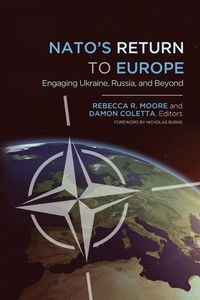
NATO's Return to Europe
Description

NATO's 2010 Strategic Concept officially broadened the alliance's mission beyond collective defense, reflecting a peaceful Europe and changes in alliance activities. NATO had become an international security facilitator, a crisis-manager even outside Europe, and a liberal democratic club as much as a mutual-defense organization. However, Russia's re-entry into great power politics has changed NATO's strategic calculus.
Russia's aggressive annexation of Crimea in 2014 and its ongoing military support for Ukrainian separatists dramatically altered the strategic environment and called into question the liberal European security order. States bordering Russia, many of which are now NATO members, are worried, and the alliance is divided over assessments of Russia's behavior. Against the backdrop of Russia's new assertiveness, an international group of scholars examines a broad range of issues in the interest of not only explaining recent alliance developments but also making recommendations about critical choices confronting the NATO allies. While a renewed emphasis on collective defense is clearly a priority, this volume's contributors caution against an overcorrection, which would leave the alliance too inwardly focused, play into Russia's hand, and exacerbate regional fault lines always just below the surface at NATO. This volume places rapid-fire events in theoretical perspective and will be useful to foreign policy students, scholars, and practitioners alike.
More details
Other editions
Additional editions
Persons
Rebecca R. Moore is a professor of political science at Concordia College. She is the author of NATO's New Mission: Projecting Stability in a Post?Cold War World and coeditor of NATO in Search of a Vision.
Damon Coletta is a professor of political science at the US Air Force Academy. He coedited American Defense Policy, 8th Edition, authored Trusted Guardian: Information Sharing and the Future of the Atlantic Alliance, and is editor of the journal Space & Defense.
Content
List of Illustrations
Foreword by Nicholas Burns
Acknowledgments
Abbreviations
Introduction: Alliance, Identity, and Geopolitics
Rebecca R. Moore and Damon Coletta
1. Force Posture after NATO's Return to Europe: Too Little, Too Late
John R. Deni
2. NATO's Return: Implications for Extended Deterrence
Schuyler Foerster
3. NATO's Enlargement Policy to Ukraine and Beyond: Prospects and Options
Andrew T. Wolff
4. NATO's Territorial Defense: The Global Approach and the Regional Approach
Magnus Petersson
5. Still Learning? NATO's Afghan Lessons beyond the Ukraine Crisis
Sten Rynning
6. European Security at a Crossroads after Ukraine? Institutionalization of Partnerships and Compliance with NATO's Security Policies
Ivan Dinev Ivanov
7. The Purpose of NATO Partnership: Sustaining Liberal Order beyond the Ukraine Crisis
Rebecca R. Moore
8. NATO- Russia Technical Cooperation: Unheralded Prospects
Damon Coletta
9. The Ukraine Crisis and Beyond: Strategic Opportunity or Strategic Dilemma for the China- Russia Strategic Partnership?
Huiyun Feng
Conclusion and Comment: NATO's Ever- Evolving Identity
Stanley R. Sloan
List of Contributors
Index
