

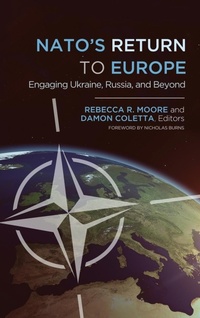
NATO's Return to Europe
Engaging Ukraine, Russia, and Beyond
Published on 11. September 2017
Book
Hardback
290 pages
978-1-62616-487-1 (ISBN)
Description
NATO's 2010 Strategic Concept officially broadened the alliance's mission beyond collective defense, reflecting a peaceful Europe and changes in alliance activities. NATO had become an international security facilitator, a crisis-manager even outside Europe, and a liberal democratic club as much as a mutual-defense organization. However, Russia's re-entry into great power politics has changed NATO's strategic calculus. Russia's aggressive annexation of Crimea in 2014 and its ongoing military support for Ukrainian separatists dramatically altered the strategic environment and called into question the liberal European security order. States bordering Russia, many of which are now NATO members, are worried, and the alliance is divided over assessments of Russia's behavior. Against the backdrop of Russia's new assertiveness, an international group of scholars examines a broad range of issues in the interest of not only explaining recent alliance developments but also making recommendations about critical choices confronting the NATO allies.
While a renewed emphasis on collective defense is clearly a priority, this volume's contributors caution against an overcorrection, which would leave the alliance too inwardly focused, play into Russia's hand, and exacerbate regional fault lines always just below the surface at NATO. This volume places rapid-fire events in theoretical perspective and will be useful to foreign policy students, scholars, and practitioners alike.
While a renewed emphasis on collective defense is clearly a priority, this volume's contributors caution against an overcorrection, which would leave the alliance too inwardly focused, play into Russia's hand, and exacerbate regional fault lines always just below the surface at NATO. This volume places rapid-fire events in theoretical perspective and will be useful to foreign policy students, scholars, and practitioners alike.
Reviews / Votes
Delivers a very robust and updated overview of the Alliance's current strategic situation. . . . Should be of great value and interest both for practitioners and students of transatlantic relations. * Parameters *More details
Language
English
Place of publication
Washington, DC
United States
Target group
Professional and scholarly
US School Grade: College Graduate Student and over
Illustrations
Not illustrated
Dimensions
Height: 229 mm
Width: 152 mm
Weight
599 gr
ISBN-13
978-1-62616-487-1 (9781626164871)
Copyright in bibliographic data and cover images is held by Nielsen Book Services Limited or by the publishers or by their respective licensors: all rights reserved.
Schweitzer Classification
Other editions
Additional editions
E-Book
09/2017
Georgetown University Press
€35.99
Available for download
Persons
Rebecca R. Moore is a professor of political science at Concordia College. She is the author of NATO's New Mission: Projecting Stability in a Post-Cold War World and coeditor of NATO in Search of a Vision. Damon Coletta is a professor of political science at the US Air Force Academy. He coedited American Defense Policy, 8th Edition, authored Trusted Guardian: Information Sharing and the Future of the Atlantic Alliance, and is editor of the journal Space & Defense.
Content
Introduction: Alliance, Identity, and GeopoliticsRebecca R. Moore and Damon Coletta1. Force Posture after NATO's Return to Europe: Too Little, Too LateJohn R. Deni2. NATO's Return: Implications for Extended DeterrenceSchuyler Foerster3. NATO's Enlargement Policy to Ukraine and Beyond: Prospects and OptionsAndrew T. Wolff4. NATO's Territorial Defense: The Global Approach and the Regional ApproachMagnus Petersson5. Still Learning? NATO's Afghan Lessons beyond the Ukraine CrisisSten Rynning6. European Security at a Crossroads after Ukraine? Institutionalization of Partnerships and Compliance with NATO's Security PoliciesIvan Dinev Ivanov7. The Purpose of NATO Partnership: Sustaining Liberal Order beyond the Ukraine CrisisRebecca R. Moore8. NATO- Russia Technical Cooperation: Unheralded ProspectsDamon Coletta9. The Ukraine Crisis and Beyond: Strategic Opportunity or Strategic Dilemma for the China- Russia Strategic Partnership?Huiyun FengConclusion and Comment: NATO's Ever- Evolving Identity