

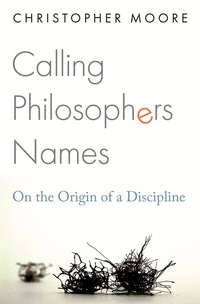
Calling Philosophers Names
On the Origin of a Discipline
1st Edition
Published on 20. January 2020
440 pages
978-0-691-19742-5 (ISBN)
Description

An original and provocative book that illuminates the origins of philosophy in ancient Greece by revealing the surprising early meanings of the word "philosopher"
Calling Philosophers Names provides a groundbreaking account of the origins of the term philosophos or "philosopher" in ancient Greece. Tracing the evolution of the word's meaning over its first two centuries, Christopher Moore shows how it first referred to aspiring political sages and advice-givers, then to avid conversationalists about virtue, and finally to investigators who focused on the scope and conditions of those conversations. Questioning the familiar view that philosophers from the beginning "loved wisdom" or merely "cultivated their intellect," Moore shows that they were instead mocked as laughably unrealistic for thinking that their incessant talking and study would earn them social status or political and moral authority.
Taking a new approach to the history of early Greek philosophy, Calling Philosophers Names seeks to understand who were called philosophoi or "philosophers" and why, and how the use of and reflections on the word contributed to the rise of a discipline. Drawing on a wide range of evidence, the book demonstrates that a word that began in part as a wry reference to a far-flung political bloc came, hardly a century later, to mean a life of determined self-improvement based on research, reflection, and deliberation. Early philosophy dedicated itself to justifying its own dubious-seeming enterprise. And this original impulse to seek legitimacy holds novel implications for understanding the history of the discipline and its influence.
Calling Philosophers Names provides a groundbreaking account of the origins of the term philosophos or "philosopher" in ancient Greece. Tracing the evolution of the word's meaning over its first two centuries, Christopher Moore shows how it first referred to aspiring political sages and advice-givers, then to avid conversationalists about virtue, and finally to investigators who focused on the scope and conditions of those conversations. Questioning the familiar view that philosophers from the beginning "loved wisdom" or merely "cultivated their intellect," Moore shows that they were instead mocked as laughably unrealistic for thinking that their incessant talking and study would earn them social status or political and moral authority.
Taking a new approach to the history of early Greek philosophy, Calling Philosophers Names seeks to understand who were called philosophoi or "philosophers" and why, and how the use of and reflections on the word contributed to the rise of a discipline. Drawing on a wide range of evidence, the book demonstrates that a word that began in part as a wry reference to a far-flung political bloc came, hardly a century later, to mean a life of determined self-improvement based on research, reflection, and deliberation. Early philosophy dedicated itself to justifying its own dubious-seeming enterprise. And this original impulse to seek legitimacy holds novel implications for understanding the history of the discipline and its influence.
More details
Other editions
Additional editions
Book
11/2021
Princeton University Press
€39.50
Shipment within 10-20 days
Book
12/2019
Princeton University Press
€55.80
Shipment within 10-20 days
Person
Christopher Moore is associate professor of philosophy and classics at Pennsylvania State University. He is the author of Socrates and Self-Knowledge.
Content
- Cover
- Contents
- Acknowledgments
- Selected Abbreviations and Editions
- Map of Places Mentioned
- Chapter 1. Introduction: The Origins of Philosophia
- Origins
- Chapter 2. Heraclitus against the Philosophoi
- Chapter 3. What Philosophos Could Have Meant: A Lexical Account
- Chapter 4. Pythagoreans as Philosophoi
- Development
- Chapter 5. Fifth-Century Philosophoi
- Chapter 6. Socrates's Prosecution as Philosophos
- Chapter 7. Non-Academic Philosophia
- Academy
- Chapter 8. Plato's Saving of the Appearances
- Chapter 9. Aristotle's Historiography of Philosophia
- Chapter 10. Ambivalence about Philosophia beyond the Discipline
- Epilogue. Contemporary Philosophy and the History of the Discipline
- Appendix: Versions of the Pythagoras Story
- Classical Uses of Philosoph-Discussed in This Book
- Phil- Prefixed Words Appearing in This Book
- Bibliography
- Index
- Index Locorum
