

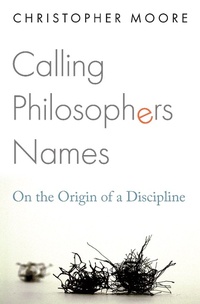
Calling Philosophers Names
On the Origin of a Discipline
Published on 23. November 2021
Book
Paperback/Softback
440 pages
978-0-691-23022-1 (ISBN)
Description
An original and provocative book that illuminates the origins of philosophy in ancient Greece by revealing the surprising early meanings of the word "philosopher"
Calling Philosophers Names provides a groundbreaking account of the origins of the term philosophos or "philosopher" in ancient Greece. Tracing the evolution of the word's meaning over its first two centuries, Christopher Moore shows how it first referred to aspiring political sages and advice-givers, then to avid conversationalists about virtue, and finally to investigators who focused on the scope and conditions of those conversations. Questioning the familiar view that philosophers from the beginning "loved wisdom" or merely "cultivated their intellect," Moore shows that they were instead mocked as laughably unrealistic for thinking that their incessant talking and study would earn them social status or political and moral authority.
Taking a new approach to the history of early Greek philosophy, Calling Philosophers Names seeks to understand who were called philosophoi or "philosophers" and why, and how the use of and reflections on the word contributed to the rise of a discipline. Drawing on a wide range of evidence, the book demonstrates that a word that began in part as a wry reference to a far-flung political bloc came, hardly a century later, to mean a life of determined self-improvement based on research, reflection, and deliberation. Early philosophy dedicated itself to justifying its own dubious-seeming enterprise. And this original impulse to seek legitimacy holds novel implications for understanding the history of the discipline and its influence.
Calling Philosophers Names provides a groundbreaking account of the origins of the term philosophos or "philosopher" in ancient Greece. Tracing the evolution of the word's meaning over its first two centuries, Christopher Moore shows how it first referred to aspiring political sages and advice-givers, then to avid conversationalists about virtue, and finally to investigators who focused on the scope and conditions of those conversations. Questioning the familiar view that philosophers from the beginning "loved wisdom" or merely "cultivated their intellect," Moore shows that they were instead mocked as laughably unrealistic for thinking that their incessant talking and study would earn them social status or political and moral authority.
Taking a new approach to the history of early Greek philosophy, Calling Philosophers Names seeks to understand who were called philosophoi or "philosophers" and why, and how the use of and reflections on the word contributed to the rise of a discipline. Drawing on a wide range of evidence, the book demonstrates that a word that began in part as a wry reference to a far-flung political bloc came, hardly a century later, to mean a life of determined self-improvement based on research, reflection, and deliberation. Early philosophy dedicated itself to justifying its own dubious-seeming enterprise. And this original impulse to seek legitimacy holds novel implications for understanding the history of the discipline and its influence.
Reviews / Votes
"This fascinating scholarly book is a breakthrough study about the origins of the term philosopher in Ancient Greece." * Paradigm Explorer * "What does a philosophos do and what is a philosophos anyway? Christopher Moore explores these questions in his intriguing book, examining the history of the word philosophos and considering the development of the discipline that came to be known as philosophia. . . . Moore's is a rich and stimulating study of an overlooked subject, and very welcome."---Patricia Curd, Journal of the History of Philosophy "Moore operates at the highest levels of honest philological precision: nothing is swept under the rug of abstraction, everycase - indeed every single occurrence of the word group - is picked apart. Meticulous attention to textual evidence, one eye on the apparatus criticus, brightens each page.
"---Richard P. Martin, Polis
More details
Language
English
Place of publication
New Jersey
United States
Product notice
Paperback (trade)
Illustrations
1 map
Dimensions
Height: 231 mm
Width: 152 mm
Thickness: 27 mm
Weight
694 gr
ISBN-13
978-0-691-23022-1 (9780691230221)
Copyright in bibliographic data and cover images is held by Nielsen Book Services Limited or by the publishers or by their respective licensors: all rights reserved.
Schweitzer Classification
Other editions
Additional editions
E-Book
01/2020
1st Edition
Princeton University Press
€38.49
Available for download
Person
Christopher Moore is associate professor of philosophy and classics at Pennsylvania State University. He is the author of Socrates and Self-Knowledge.