

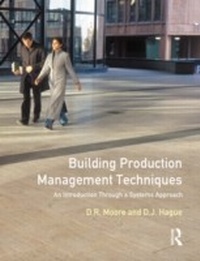
Building Production Management Techniques
An Introduction through a Systems Approach
1st Edition
Published on 30. July 2014
192 pages
978-1-317-87979-4 (ISBN)
Description

Building Production Management Techniques provides an innovative approach to dealing with the universal problems of time, cost and quality of construction projects.
The book provides an introduction to a number of management techniques that can be applied to the problems of production presented by the diverse, heavy, large and geographically distributed products typical of construction everywhere. As well as recognised and tried and tested management techniques, the authors have introduced a number of techniques which may not have been considered by the construction industry to date.
The book provides an introduction to a number of management techniques that can be applied to the problems of production presented by the diverse, heavy, large and geographically distributed products typical of construction everywhere. As well as recognised and tried and tested management techniques, the authors have introduced a number of techniques which may not have been considered by the construction industry to date.
More details
Series
Language
English
Place of publication
London
United Kingdom
Publishing group
Taylor & Francis Ltd
Target group
College/higher education
Product notice
Reflowable
File size
3,17 MB
ISBN-13
978-1-317-87979-4 (9781317879794)
Copyright in bibliographic data and cover images is held by Nielsen Book Services Limited or by the publishers or by their respective licensors: all rights reserved.
Schweitzer Classification
Other editions
Additional editions
David R. Moore | Douglas J. Hague
Building Production Management Techniques
An Introduction through a Systems Approach
Book
06/2017
1st Edition
Routledge
€193.13
Shipment within 10-20 days
David R. Moore | Douglas J. Hague
Building Production Management Techniques
An Introduction through a Systems Approach
Book
08/1999
1st Edition
Routledge
€47.03
Shipment within 10-20 days
Persons
David R. Moore, Douglas J. Hague
Content
Preface vii
Acknowledgements ix
1 Introduction to systems thinking 1
Definitions for key terms 1
Planning, analysis, control (PAC) 2
Imports, conversion, export (ICE) 7
System organisation structures 11
Conclusions 12
Self-test questions 12
2 Planning techniques for defining production systems 13
The value of the planning process 13
Setting the project objectives 15
How many subsystems make a system? 19
Individual system configuration - is it complete? 23
Required system imports 24
Resource scheduling 30
Conclusions 33
Self-test questions 33
3 Analysis techniques for optimising production systems 34
External environmental forces 34
Internal environment forces 37
Buildability 42
Optimisation of the production system 54
Lockstep optimisation 55
Inventory and stock control 73
Implementation 82
Conclusions 83
Self-test questions 84
4 Control techniques for implemented production systems 86
Defining control 86
Budgetary cost control 90
Preface vii
Acknowledgements ix
1 Introduction to systems thinking 1
Definitions for key terms 1
Planning, analysis, control (PAC) 2
Imports, conversion, export (ICE) 7
System organisation structures 11
Conclusions 12
Self-test questions 12
2 Planning techniques for defining production systems 13
The value of the planning process 13
Setting the project objectives 15
How many subsystems make a system? 19
Individual system configuration - is it complete? 23
Required system imports 24
Resource scheduling 30
Conclusions 33
Self-test questions 33
3 Analysis techniques for optimising production systems 34
External environmental forces 34
Internal environment forces 37
Buildability 42
Optimisation of the production system 54
Lockstep optimisation 55
Inventory and stock control 73
Implementation 82
Conclusions 83
Self-test questions 84
4 Control techniques for implemented production systems 86
Defining control 86
Budgetary cost control 90
Interim payments
Standard costing
The Gantt chart
Line of balance
Quality control
Conclusions
Self-test questions
Designing an appropriate organisation structure for production 140
External environment factors
Internal environment factors
Meeting the production objectives
Conclusions
Self-test questions
6 Conclusion
Key considerations
The future
References
Recommended further reading
Glossary of terms
Self-test model answers
Index
Acknowledgements ix
1 Introduction to systems thinking 1
Definitions for key terms 1
Planning, analysis, control (PAC) 2
Imports, conversion, export (ICE) 7
System organisation structures 11
Conclusions 12
Self-test questions 12
2 Planning techniques for defining production systems 13
The value of the planning process 13
Setting the project objectives 15
How many subsystems make a system? 19
Individual system configuration - is it complete? 23
Required system imports 24
Resource scheduling 30
Conclusions 33
Self-test questions 33
3 Analysis techniques for optimising production systems 34
External environmental forces 34
Internal environment forces 37
Buildability 42
Optimisation of the production system 54
Lockstep optimisation 55
Inventory and stock control 73
Implementation 82
Conclusions 83
Self-test questions 84
4 Control techniques for implemented production systems 86
Defining control 86
Budgetary cost control 90
Preface vii
Acknowledgements ix
1 Introduction to systems thinking 1
Definitions for key terms 1
Planning, analysis, control (PAC) 2
Imports, conversion, export (ICE) 7
System organisation structures 11
Conclusions 12
Self-test questions 12
2 Planning techniques for defining production systems 13
The value of the planning process 13
Setting the project objectives 15
How many subsystems make a system? 19
Individual system configuration - is it complete? 23
Required system imports 24
Resource scheduling 30
Conclusions 33
Self-test questions 33
3 Analysis techniques for optimising production systems 34
External environmental forces 34
Internal environment forces 37
Buildability 42
Optimisation of the production system 54
Lockstep optimisation 55
Inventory and stock control 73
Implementation 82
Conclusions 83
Self-test questions 84
4 Control techniques for implemented production systems 86
Defining control 86
Budgetary cost control 90
Interim payments
Standard costing
The Gantt chart
Line of balance
Quality control
Conclusions
Self-test questions
Designing an appropriate organisation structure for production 140
External environment factors
Internal environment factors
Meeting the production objectives
Conclusions
Self-test questions
6 Conclusion
Key considerations
The future
References
Recommended further reading
Glossary of terms
Self-test model answers
Index
