

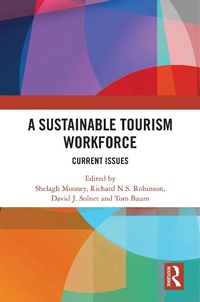
A Sustainable Tourism Workforce
Current issues
1st Edition
Published on 15. February 2024
316 pages
978-1-003-85808-9 (ISBN)
Description

This book brings together issues of social justice and the neglect of a sustainable orientation to the tourism workforce. This has resulted in an impoverished, unsustainable, and transient workforce that does not meet the aims of UN sustainable goals within the sector or indeed the UNTWO Code of ethics towards its employees.
The introductory review and 15 chapters in this volume each make a unique and distinct contribution to knowledge. The opening review presents a critique of current definitions of sustainability in an employment, and specifically in a tourism employment context, acknowledging and critiquing extant literature. It uniquely recognises the themes submitted on the topic of sustainable work in the book, as well as those which comprise the final selection of chapters. These exercises culminate in the presentation of a refreshed conceptualisation of sustainable employment. The chapters were mapped onto a proposed conceptual framework, which recognises the multi-dimensional influences of the evolving Sustainable Development Goals (SDGs), recent Sustainable Human Resource Management (SHRM) and tourism literature, and fresh contributions to theory. Additionally, the introductory review offers concluding remarks that the authors hope will influence and guide future research endeavours.
The book will be invaluable to educators, students and policymakers interested in information and guidance on managing sustainable tourism. Several chapters in this book were originally published as a special issue of the Journal of Sustainable Tourism.
The introductory review and 15 chapters in this volume each make a unique and distinct contribution to knowledge. The opening review presents a critique of current definitions of sustainability in an employment, and specifically in a tourism employment context, acknowledging and critiquing extant literature. It uniquely recognises the themes submitted on the topic of sustainable work in the book, as well as those which comprise the final selection of chapters. These exercises culminate in the presentation of a refreshed conceptualisation of sustainable employment. The chapters were mapped onto a proposed conceptual framework, which recognises the multi-dimensional influences of the evolving Sustainable Development Goals (SDGs), recent Sustainable Human Resource Management (SHRM) and tourism literature, and fresh contributions to theory. Additionally, the introductory review offers concluding remarks that the authors hope will influence and guide future research endeavours.
The book will be invaluable to educators, students and policymakers interested in information and guidance on managing sustainable tourism. Several chapters in this book were originally published as a special issue of the Journal of Sustainable Tourism.
More details
Edition
1. Auflage
Language
English
Place of publication
London
United Kingdom
Publishing group
Taylor & Francis Ebooks
Target group
College/higher education
Professional and scholarly
ISBN-13
978-1-003-85808-9 (9781003858089)
Copyright in bibliographic data and cover images is held by Nielsen Book Services Limited or by the publishers or by their respective licensors: all rights reserved.
Schweitzer Classification
Other editions
Additional editions
Shelagh Mooney | Richard N.S. Robinson | David J. Solnet
A Sustainable Tourism Workforce
Current issues
Book
07/2025
1st Edition
Routledge
€67.60
Shipment within 10-20 days
Shelagh Mooney | Richard N.S. Robinson | David J. Solnet
A Sustainable Tourism Workforce
Current issues
Book
02/2024
1st Edition
Routledge
€206.90
Shipment within 10-20 days
Persons
Shelagh Mooney is Associate Professor at the School of Hospitality and Tourism, Auckland University of Technology, New Zealand. Shelagh's research is focused on diversity and sustainable workforce issues. Shelagh is interested in how gender intersects with other aspects of individual identity and the interactions between individual, organisational and societal levels.
Richard N.S. Robinson is Associate Professor at The University of Queensland Business School, Australia. Richard's research explores tourism and hospitality workforce issues including sustaining employment for disadvantaged groups and culinary workers.
David J. Solnet is Professor at The University of Queensland Business School, Australia. David's research focuses on hospitality and service employees, work and employment, focusing on human resource management, service climate and culture and generation Y and Z.
Tom Baum is Professor at the Department of Work Employment and Organization, University of Strathclyde, Scotland, and Distinguished Visiting Professor in the University of Johannesburg, South Africa. He is interested in the relationship between work and its wider social, cultural and economic context in frontline services.
Richard N.S. Robinson is Associate Professor at The University of Queensland Business School, Australia. Richard's research explores tourism and hospitality workforce issues including sustaining employment for disadvantaged groups and culinary workers.
David J. Solnet is Professor at The University of Queensland Business School, Australia. David's research focuses on hospitality and service employees, work and employment, focusing on human resource management, service climate and culture and generation Y and Z.
Tom Baum is Professor at the Department of Work Employment and Organization, University of Strathclyde, Scotland, and Distinguished Visiting Professor in the University of Johannesburg, South Africa. He is interested in the relationship between work and its wider social, cultural and economic context in frontline services.
Content
Introduction: A critical review of sustainable work and employment in tourism 1. Sustaining Tourism Employment 2. Sustaining precarity: critically examining tourism and employment 3. Rethinking decent work: the value of dignity in tourism employment 4. Employment of the workforce with disabilities in the hospitality industry 5. Seeking justice beyond the platform economy: migrant workers navigating precarious lives 6. Situational analysis as a critical methodology: mapping the tourism system in post-Katrina New Orleans 7. Labour, necessity-induced (im)mobilities, and the hotel industry: a developing country perspective 8. 'Is he going to be sleazy?' Women's experiences of emotional labour connected to sexual harassment in the spa tourism industry 9. The socio-economic impact of regional tourism: an occupation-based modelling perspective from Sweden 10. Identifying a community capital investment portfolio to sustain a tourism workforce 11. The historical structuring of the U.S. tourism workforce: a critical review 12. Gender, work, and tourism in the Guatemalan Highlands 13. Decent work and tourism workers in the age of intelligent automation and digital surveillance 14. From corporatist consensus to neo-liberal revolution: a gendered analysis of the hotel workers union and its impact on (un)sustainable employment practices in the New Zealand hotel sector, 1955-2000 15. The sustainable development goals: the contribution of tourism volunteering
