

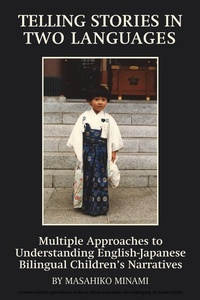
Telling Stories in Two Languages
Multiple Approaches to Understanding English-Japanese Bilingual Children's Narratives
1st Edition
Published on 1. April 2011
251 pages
978-1-61735-356-7 (ISBN)
Description

The topic of bilingualism has aroused considerable interest in research on language acquisition in recent decades. Researchers in various fields, such as developmental psychology and psycholinguistics, have investigated bilingual populations from different perspectives in order to understand better how bilingualism affects cognitive abilities like memory, perception, and metalinguistic awareness. Telling Stories in Two Languages contributes to the general upsurge in linguistically related studies of bilingual children. The book's particular and unique focus is narrative development in a bilingual and multicultural context.
The book is particularly important in an increasingly pluralistic and multicultural United States, where there are large numbers of children from increasingly diverse cultural and linguistic backgrounds. Telling stories is important in the context of language and communication development because it is often by means of this activity that children develop the skill of presenting a series of events both in speech and writing. However, varying concepts of literacy exist in different societies, and literacy has different social and personal implications in different social and cultural contexts. In our schools, teachers are expected to teach what is relevant for students in the dominant cultural framework, but it would benefit those teachers greatly to have an understanding of important differences in, for example, narrative styles of different cultures.
Bilingualism or even multilingualism is all around us. Even in the United States, where a single language is clearly predominant, there are hundreds of languages spoken. Speaking more than one language may not be typical, but is so common in modern times that it would be senseless to ignore its many implications. The study of narratives told by children in both English and Japanese that are presented in this book will provide an important point of reference for research aimed at teasing apart the relative contributions of linguistic abilities and cultural conceptions to bilingual children's narrative development.
All prices
More details
Other editions
Additional editions
Masahiko Minami
Telling Stories in Two Languages
Multiple Approaches to Understanding English-Japanese Bilingual Children's Narratives
Book
03/2011
Information Age Publishing
€61.40
Article not available at the moment
Content
- Cover
- Telling Stories in Two Languages: Multiple Approaches to Understanding English-Japanese Bilingual Children's Narratives
- Telling Stories in Two Languages: Multiple Approaches to Understanding English-Japanese Bilingual Children's Narratives
- Copyright
- CONTENTS
- PREFACE
- ACKNOWLEDGMENTS
- 1: INTRODUCTION
- SOCIAL ISSUES: BACKGROUND
- LANGUAGE ISSUES IN MULTICULTURAL CONTEXTS
- OVERVIEW OF THE CHAPTERS: MULTIPLE APPROACHES TO UNDERSTANDING BILINGUAL CHILDREN'S NARRATIVES
- 2: BILINGUALISM, LITERACY, AND SCHOOLING: A Sociolinguistic Perspective
- INTRODUCTION
- Language Development
- Literacy Development in Non-Western Styles of Discourse, Pragmatics, and Sociolinguistics
- PERSPECTIVES
- Issues in Literacy, Bilingualism, and Bilingual Education
- Connecting Language Development and Literacy Development in Sociocultural Settings
- SUMMARY
- PRACTICES: BACKGROUND INFORMATION OF STUDIES REPORTED IN THIS BOOK
- Ethnographic Study
- Kettering Alternative Elementary School
- Weekend Tutorial Programs
- INTEGRAL PART OF THEORETICAL GROUNDS THAT ARE THE BASIS FOR THIS BOOK
- 3: ASSESSMENT OF VOCABULARY
- INTRODUCTION
- METHODS
- Participants
- Materials
- Data Collection and Procedure
- RESULTS
- Quantitative Analysis
- Qualitative Analysis
- DISCUSSION
- 4: COMPLEXITIES OF BILINGUALISM: Putting Together Vocabulary Building and Storytelling
- INTRODUCTION
- METHODS
- Participants
- Task, Procedure, and Materials
- RESULTS
- Example 4.1
- Example 4.2A
- Example 4.2B
- Example 4.3A
- Example 4.3B
- Example 4.4A
- Example 4.4B
- DISCUSSION
- 5: NARRATIVE DISCOURSESKILLS IN ENGLISH-JAPANESEBILINGUAL CHILDREN: Content-Focus Approach
- INTRODUCTION
- METHODS
- Participants
- Procedure
- Coding
- Reliability
- RESULTS
- Frog Story Narratives: Vocabulary (Lexicon) and Clauses
- Example 5.1 Pattern A: Lexical and Syntactic Correspondence
- Example 5.2 Pattern B: Syntactic Correspondence With Similar (but Slightly Different) Lexical Choices
- Example 5.3 Pattern C: Lexical Correspondence With Different Syntactic Structures
- Example 5.4 Pattern D: No Correspondence (a Particular Scene was not Described in Japanese)
- Frog Stories: Narrative Structure (Content-Based Analysis)
- Example 5.5
- Example 5.6
- Example 5.7
- DISCUSSION
- 6: LINKING BILINGUAL CHILDREN'S CONNECTIVE USE AND NARRATIVE MACROSTRUCTURE
- INTRODUCTION
- METHOD
- Participants
- Connectives
- Example 6.1A English: And, Then
- Example 6.1B Japanese: soshite, suruto, soshitara
- Example 6.2A English: But
- Example 6.2B Japanese: shikashi, demo
- Example 6.3A English: Because, So
- Example 6.3B Japanese: kara
- Example 6.4A English: When
- Example 6.4B Japanese: toki, tara (the past tense form of verb ta + ra)
- Example 6.5A English: Relative Clauses
- Example 6.5B Japanese: Relative Clauses
- Example 6.6 Two Connectives Appearing in One Clause (and Then)
- Example 6.7A English: Complicating Actions [ACT]
- Example 6.7B Japanese: Complicating Actions [ACT]
- Example 6.8A English: Orientation [ORT]
- Example 6.8B Japanese: Orientation [ORT]
- Example 6.9A English: Evaluation [EVL]
- Example 6.9BJapanese: Evaluation [EVL]
- RESULTS
- Comparisons of Connectives Between English and Japanese
- DISCUSSION
- 7: UNIVERSALS AND LANGUAGE-SPECIFIC ASPECTS OF NARRATIVE DEVELOPMENT: Form/Function Relations
- INTRODUCTION
- METHODS
- Participants
- Coding
- Reliability
- RESULTS
- Frog Stories: Initial Analyses
- Example 7.1A
- Example 7.1B
- Example 7.2A
- Example 7.2B
- Example 7.2C
- Example 7.3A
- Example 7.3B
- Example 7.3C
- Detailed Analyses
- Example 7.4
- Example 7.5
- Example 7.6
- Example 7.7
- Example 7.8
- Example 7.9
- Developmental Changes and Cross-linguistic Differences
- Example 7.10A
- Example 7.10B
- DISCUSSION
- 8: REFERENTIAL TOPIC MANAGEMENT IN ENGLISH-JAPANESE BILINGUAL CHILDREN'S NARRATIVES
- INTRODUCTION
- (A) FROG STORY
- METHODS
- Coding System and Its Background: Theoretical Rationale
- RESULTS
- First Mention
- Example 8.1A (English)
- Example 8.1B (Japanese)
- Example 8.1C
- Second Mention
- Example 8.2A (English)
- Example 8.2B (Japanese)
- Example 8.2C
- Example 8.2D
- Reintroduction
- Example 8.3A (English)
- Example 8.3B (Japanese)
- Example 8.3C
- Example 8.3D
- Continuous Mention
- Example 8.4A (English)
- Example 8.4B (Japanese)
- Example 8.4C
- DISCUSSION
- 9: TELLING GOOD STORIES IN DIFFERENT LANGUAGES: Linguistic and Educational Implications of Bilingual Children's Narrative Adaptations
- INTRODUCTION
- METHODS
- Measures
- RESULTS
- Story Length, Word-Tokens, and Word-Types
- Age, Year in School, and Use of "Sophisticated" Words (Only Available in English Stories)
- Example 9.1
- Content-Focus Analysis
- Uses of Connectives
- Form/Function Relations (Temporal and Causal Relations Between Events)
- Example 9.2
- Example 9.3
- Subject Referencing Strategies
- Concurrent Predictions of Adult Ratings: Multiple Regression Analyses
- DISCUSSION
- OVERALL CONCLUSION
- REFERENCES
- SUBJECT INDEX
- AUTHOR INDEX
- ABOUT THE AUTHOR

