

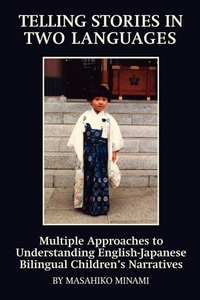
Telling Stories in Two Languages
Multiple Approaches to Understanding English-Japanese Bilingual Children's Narratives
Will be published approx. on 14. March 2011
Book
Paperback/Softback
250 pages
978-1-61735-354-3 (ISBN)
Description
The topic of bilingualism has aroused considerable interest in research on language acquisition in recent decades. Researchers in various fields, such as developmental psychology and psycholinguistics, have investigated bilingual populations from different perspectives in order to understand better how bilingualism affects cognitive abilities like memory, perception, and metalinguistic awareness. Telling Stories in Two Languages contributes to the general upsurge in linguistically related studies of bilingual children. The book's particular and unique focus is narrative development in a bilingual and multicultural context.
The book is particularly important in an increasingly pluralistic and multicultural United States, where there are large numbers of children from increasingly diverse cultural and linguistic backgrounds. Telling stories is important in the context of language and communication development because it is often by means of this activity that children develop the skill of presenting a series of events both in speech and writing. However, varying concepts of literacy exist in different societies, and literacy has different social and personal implications in different social and cultural contexts. In our schools, teachers are expected to teach what is relevant for students in the dominant cultural framework, but it would benefit those teachers greatly to have an understanding of important differences in, for example, narrative styles of different cultures.
Bilingualism or even multilingualism is all around us. Even in the United States, where a single language is clearly predominant, there are hundreds of languages spoken. Speaking more than one language may not be typical, but is so common in modern times that it would be senseless to ignore its many implications. The study of narratives told by children in both English and Japanese that are presented in this book will provide an important point of reference for research aimed at teasing apart the relative contributions of linguistic abilities and cultural conceptions to bilingual children's narrative development.
The book is particularly important in an increasingly pluralistic and multicultural United States, where there are large numbers of children from increasingly diverse cultural and linguistic backgrounds. Telling stories is important in the context of language and communication development because it is often by means of this activity that children develop the skill of presenting a series of events both in speech and writing. However, varying concepts of literacy exist in different societies, and literacy has different social and personal implications in different social and cultural contexts. In our schools, teachers are expected to teach what is relevant for students in the dominant cultural framework, but it would benefit those teachers greatly to have an understanding of important differences in, for example, narrative styles of different cultures.
Bilingualism or even multilingualism is all around us. Even in the United States, where a single language is clearly predominant, there are hundreds of languages spoken. Speaking more than one language may not be typical, but is so common in modern times that it would be senseless to ignore its many implications. The study of narratives told by children in both English and Japanese that are presented in this book will provide an important point of reference for research aimed at teasing apart the relative contributions of linguistic abilities and cultural conceptions to bilingual children's narrative development.
More details
Language
English
Place of publication
Charlotte
United States
Publishing group
Emerald Publishing Inc
Target group
Professional and scholarly
Dimensions
Height: 234 mm
Width: 156 mm
Thickness: 14 mm
Weight
386 gr
ISBN-13
978-1-61735-354-3 (9781617353543)
Copyright in bibliographic data and cover images is held by Nielsen Book Services Limited or by the publishers or by their respective licensors: all rights reserved.
Schweitzer Classification
Other editions
Additional editions
Masahiko Minami
Telling Stories in Two Languages
Multiple Approaches to Understanding English-Japanese Bilingual Children's Narratives
E-Book
04/2011
1st Edition
Information Age Publishing
from
€62.33
Available for download
Content
Preface
Chapter 1. Introduction
Chapter 2. Bilingualism, Literacy, and Schooling: A Sociolinguistic Perspective
Chapter 3. Assessment of Vocabulary
Chapter 4. Complexities of Bilingualism: Putting Together Vocabulary Building and Storytelling
Chapter 5. Narrative Discourse Skills in English-Japanese Bilingual Children: Content-Focus Approach
Chapter 6. Linking Bilingual Children's Connective Use and Narrative Macrostructure
Chapter 7. Universals and Language-Specific Aspects of Narrative Development: Form/Function Relations
Chapter 8. Referential Topic Management in English-Japanese Bilingual Children's Narratives
Chapter 9. Telling Good Stories in Different Languages: Linguistic and Educational Implications of Bilingual Children's Narrative Adaptations
Overall Conclusion
References
Subject Index
Author Index
About the Author
Chapter 1. Introduction
Chapter 2. Bilingualism, Literacy, and Schooling: A Sociolinguistic Perspective
Chapter 3. Assessment of Vocabulary
Chapter 4. Complexities of Bilingualism: Putting Together Vocabulary Building and Storytelling
Chapter 5. Narrative Discourse Skills in English-Japanese Bilingual Children: Content-Focus Approach
Chapter 6. Linking Bilingual Children's Connective Use and Narrative Macrostructure
Chapter 7. Universals and Language-Specific Aspects of Narrative Development: Form/Function Relations
Chapter 8. Referential Topic Management in English-Japanese Bilingual Children's Narratives
Chapter 9. Telling Good Stories in Different Languages: Linguistic and Educational Implications of Bilingual Children's Narrative Adaptations
Overall Conclusion
References
Subject Index
Author Index
About the Author