

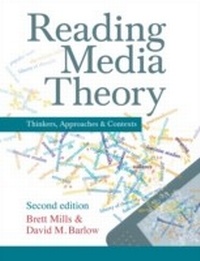
Reading Media Theory
Thinkers, Approaches and Contexts
2nd Edition
Published on 11. June 2014
704 pages
978-1-317-86048-8 (ISBN)
Description

What does the Frankfurt School have to say about the creative industries? Does the spread of Google prove we now live in an information society? How is Madonna an example of postmodernism? How new is new media? Does the power of Facebook mean we're all media makers now?
This groundbreaking volume - part reader, part textbook - helps you to engage thoroughly with some of the major voices that have come to define the landscape of theory in media studies, from the public sphere to postmodernism, from mass communication theory to media effects, from production to reception and beyond. But much more than this, by providing assistance and questions directly alongside the readings, it crucially helps you develop the skills necessary to become a critical, informed and analytical reader.
Each reading is supported on the facing page by author annotations which provide comments, dissect the arguments, explain key ideas and terminology, make references to other relevant material, and pose questions that emerge from the text.
Key features:
Opening chapters: 'What is theory?' and 'What is reading?' bring alive the importance of both as key parts of media scholarship
Pre-reading: substantial Introductory sections set each text and its author in context and show the relevance of the reading to contemporary culture
Post-reading: Reflection sections summarise each reading's key points and suggests further areas to explore and think about
4 types of annotations help you engage with the reading - context, content, structure, and writing style .... as well as questions to provoke further thought
Split into 4 sections - Reading theory, Key thinkers and schools, Approaches and Media Theory in context
New to the second edition:
New chapters on New Media, and Audiences as Producers
Reading Media Theory will assist you in developing close-reading and analytic skills. It will also increase your ability to outline key theories and debates, assess different case studies critically, link theoretical approaches to a particular historical context, and to structure and present an argument. As such, it will be essential reading for undergraduate and postgraduate students of media studies, cultural studies, communication studies, the sociology of the media, popular culture and other related subjects.
This groundbreaking volume - part reader, part textbook - helps you to engage thoroughly with some of the major voices that have come to define the landscape of theory in media studies, from the public sphere to postmodernism, from mass communication theory to media effects, from production to reception and beyond. But much more than this, by providing assistance and questions directly alongside the readings, it crucially helps you develop the skills necessary to become a critical, informed and analytical reader.
Each reading is supported on the facing page by author annotations which provide comments, dissect the arguments, explain key ideas and terminology, make references to other relevant material, and pose questions that emerge from the text.
Key features:
Opening chapters: 'What is theory?' and 'What is reading?' bring alive the importance of both as key parts of media scholarship
Pre-reading: substantial Introductory sections set each text and its author in context and show the relevance of the reading to contemporary culture
Post-reading: Reflection sections summarise each reading's key points and suggests further areas to explore and think about
4 types of annotations help you engage with the reading - context, content, structure, and writing style .... as well as questions to provoke further thought
Split into 4 sections - Reading theory, Key thinkers and schools, Approaches and Media Theory in context
New to the second edition:
New chapters on New Media, and Audiences as Producers
Reading Media Theory will assist you in developing close-reading and analytic skills. It will also increase your ability to outline key theories and debates, assess different case studies critically, link theoretical approaches to a particular historical context, and to structure and present an argument. As such, it will be essential reading for undergraduate and postgraduate students of media studies, cultural studies, communication studies, the sociology of the media, popular culture and other related subjects.
More details
Edition
2nd edition
Language
English
Place of publication
London
United Kingdom
Publishing group
Taylor & Francis Ltd
Target group
College/higher education
Edition type
Revised edition
File size
2,49 MB
ISBN-13
978-1-317-86048-8 (9781317860488)
Copyright in bibliographic data and cover images is held by Nielsen Book Services Limited or by the publishers or by their respective licensors: all rights reserved.
Schweitzer Classification
Other editions
Additional editions
Book
10/2015
2nd Edition
Routledge
€207.20
Shipment within 10-20 days
Book
05/2012
2nd Edition
Pearson Education Limited
€98.90
Shipment within 3-4 weeks
Persons
Brett Mills is Head of the School of Film and Television Studies, University of East Anglia. He is the author of Television Sitcom (BFI, 2005) and The Sitcom (Edinburgh, 2009). He is the principal investigator on the 3-year AHRC-funded research project, 'Make Me Laugh: Creativity in the British Television Comedy Industry'.
David Barlow was Lecturer in Media, Culture and Communication in the Cardiff School of Creative and Cultural Industries at the University of Glamorgan and Director of the Centre for the Study of Media and Culture in Small Nations. He is a joint author (with Philip Mitchell and Tom O'Malley) of The Media in Wales: Voices of a Small Nation (UWP, 2005) and co-editor (with Vian Bakir) of Communication in the Age of Suspicion: Trust and the Media (Palgrave Macmillan, 2007).
David Barlow was Lecturer in Media, Culture and Communication in the Cardiff School of Creative and Cultural Industries at the University of Glamorgan and Director of the Centre for the Study of Media and Culture in Small Nations. He is a joint author (with Philip Mitchell and Tom O'Malley) of The Media in Wales: Voices of a Small Nation (UWP, 2005) and co-editor (with Vian Bakir) of Communication in the Age of Suspicion: Trust and the Media (Palgrave Macmillan, 2007).
Content
1. Introduction Part I: Reading theory 2. What is theory? 3. What is reading? Part II: Key thinkers and schools of thought 4. Liberal press theory 5. F.R. Leavis 6. The Frankfurt school 7. Harold D. Lasswell 8. The Columbia school 9. C. Wright Mills: Mass society theory 10. The Toronto school 11. The Centre for Contemporary Cultural Studies Part III: Approaches to media theory 12. Political economy. 13. Public sphere 14. Media effects 15. Structuralism 16. Feminist media theory 17. Cultural theory 18. New Media 19. Postmodernism. 20. The information society Part IV: Media theory in context 21. Production 22. Texts 23. Audiences 24. Audiences as producers
