

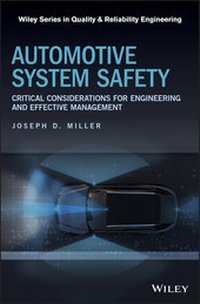
Automotive System Safety
Description

Functional Safety has become important and mandated in the automotive industry by inclusion of ISO 26262 in OEM requirements to suppliers. This unique and practical guide is geared toward helping small and large automotive companies, and the managers and engineers in those companies, improve automotive system safety. Based on the author's experience within the field, it is a useful tool for marketing, sales, and business development professionals to understand and converse knowledgeably with customers and prospects.
Automotive System Safety: Critical Considerations for Engineering and Effective Management teaches readers how to incorporate automotive system safety efficiently into an organization. Chapters cover: Safety Expectations for Consumers, OEMs, and Tier 1 Suppliers; System Safety vs. Functional Safety; Safety Audits and Assessments; Safety Culture; and Lifecycle Safety. Sections on Determining Risk; Risk Reduction; and Safety of the Intended Function are also presented. In addition, the book discusses causes of safety recalls; how to use metrics as differentiators to win business; criteria for a successful safety organization; and more.
* Discusses Safety of the Intended Function (SOTIF), with a chapter about an emerging standard (SOTIF, ISO PAS 21448), which is for handling the development of autonomous vehicles
* Helps safety managers, engineers, directors, and marketing professionals improve their knowledge of the process of FS standards
* Aimed at helping automotive companies--big and small--and their employees improve system safety
* Covers auditing and the use of metrics
Automotive System Safety: Critical Considerations for Engineering and Effective Management is an excellent book for anyone who oversees the safety and development of automobiles. It will also benefit those who sell and market vehicles to prospective customers.
More details
Other editions
Additional editions
Person
JOSEPH D. MILLER of J. D. Miller Consulting, Inc, USA, was Chief Engineer of System Safety where he established and directed the system safety process for TRW Automotive worldwide. He led the US Technical Advisory Committee (USTAG) for Functional Safety (ISO26262) for 12 years and served as an ISO expert voting the US position. He also led the US delegation for the Safety of the Intended Function (SOTIF) ISO PAS 21448.
Content
Series Editor's Foreword ix
Preface xi
Abbreviations xv
1 Safety Expectations for Consumers, OEMs, and Tier 1 Suppliers 1
Trustworthiness 1
Consumer Expectations 3
OEM Expectations 4
Supplier Expectations 6
2 Safety Organizations 11
The Need for a System Safety Organization 11
Functions of a Safety Organization 12
Critical Criteria for Organizational Success 13
Talent to Perform the Safety Tasks 14
Integral to Product Engineering 14
Career Path for Safety Personnel 15
Safety Process Owned by Program Management 15
Executive Review 16
Pillars of a Safety Process 18
Alternatives, Advantages, and Disadvantages 26
3 System Safety vs. Functional Safety in Automotive Applications 41
Safety Terminology 41
Functional Safety Standards vs. System Safety 42
Background 42
Application of Functional Safety Standards 42
Safety of the Intended Function (e.g. SOTIF, ISO PAS 21448) 44
Triggering Event Analyses 45
Background 45
Systematic Analyses 46
Validation 49
Validation Targets 49
Requirements Verification 50
Release for Production 53
Integration of SOTIF and Functional Safety and Other Considerations 55
Background 55
Analyses and Verification 57
Validation 58
4 Safety Audits and Assessments 61
Background 61
Audits 61
Audit Format 63
Use of External Auditors 65
Assessments 67
System Safety Assessment 67
Work Product Assessment 67
5 Safety Culture 71
Background 71
Characteristics of a Safety Culture 71
Central Safety Organization 72
Safety Managers 74
Joint Development 75
Enterprise Leadership 75
Liability 75
Customers 77
Safety Culture vs. Organization 77
6 Safety Lifecycle 79
Background 79
Concept Phase Safety 80
Preliminary Hazard Analysis 80
Preliminary Architecture 81
Requirements 83
Design Phase Safety 84
Design-Level Safety Requirements 84
Verification 86
Manufacturing
Phase Safety 86
Safety in Use 87
Safety in Maintenance 88
Safety in Disposal 90
7 Determining Risk in Automotive Applications 91
Analyze What the Actuator Can Do 91
Analyze Communication Sent and Received 93
Determine Potential for Harm in Different Situations and Quantify 94
Exposure 95
Priority 96
Consider Fire, Smoke, and Toxicity 97
8 Risk Reduction for Automotive Applications 99
History 99
Analysis of Architecture 99
System Interfaces 100
Internal Interfaces 101
Requirements Elicitation and Management 102
Three Sources of Requirements 102
Cascading Requirements 104
Conflicts with Cybersecurity 105
Determination of Timing Risks in an Automotive Application 106
Milestones 106
Samples 107
Program Management 108
Design and Verification 109
Sample Evaluation 109
Verification 111
9 Other Discussion and Disclaimer 113
Background 113
Three Causes of Automotive Safety Recalls - Never "Random" Failures 114
Failure Rates 114
Recalls Due to Random Hardware Failures 115
Causes of Recalls 116
Completeness of Requirements 117
Timing Risk 118
"But It's Not in the 'Standard'" 118
Competing Priorities 119
Audits and Assessments 120
Disclaimer and Motivation for Continuous Improvement 121
Policy Statement 122
Governance 122
Metrics 123
Process Documentation 124
Tiered Metric Reporting 125
Use of Metrics 126
10 Summary and Conclusions 131
Background 131
System Safety is More than Functional Safety 131
Safety Requirements 132
Safety Process 133
Five Criteria for a Successful Safety Organization are Key 134
Auditing and the Use of Metrics 135
Auditing 135
Metrics 135
Future Considerations for SOTIF 137
Machine Learning 138
Appendix A IEC 51508 Compared to Typical Automotive Practices 139
Appendix B ISO 26262 - Notes on Automotive Implementation 167
References 215
Index 217
