

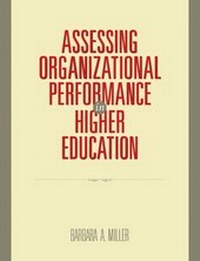
Assessing Organizational Performance in Higher Education
Description

Reviews / Votes
"Dr. Miller brings a wealth of experience, a depth of research,consultation at both private and public universities. . ."(Journal of College Student Development, 09-10/2007) "The release of Assessing Organizational Performance inHigher Education by Barbara A. Miller could not be better timedin light of the need for greater accountability from publicentities... Dr. Miller brings a wealth of experience, a depth ofresearch, consultation at both private and public universities, andextensive knowledge of systems to each chapter of thispublication.... Assessing Organizational Performance in HigherEducation is a useful tool for those who are seeking meaningfulways to evaluate the effectiveness of their organization. Inaddition, graduate students and entry-level staff will find this aworthy primer to understanding the complexity of organizations andthe necessity for measurement." -- Narbeth R. Emmanuel, SouthernIllinois University Edwardsville, in Journal of CollegeStudent Development, September/October 2007.More details
Other editions
Additional editions
Person
Content
PREFACE
I wrote this book to meet the needs of two important groups associated with assessment in higher education: assessors and assessment users. The first group, assessors, consists of persons engaged in day-to-day assessment work. They are faculty, staff, and administrators with part-time or full-time, temporary or permanent responsibilities for assessment. The second group, assessment users, are persons who evaluate or judge performance results measured and conveyed by assessors. I see assessment users as the end users or customers of assessment programs.
Assessors seek avenues for measuring performance required of assessment users; assessment users seek appropriate contexts for evaluating assessment findings measured and conveyed by assessors. Often assessors and assessment users are actually the same persons. However, I choose to differentiate the roles for purposes of discussion, assessor referring exclusively to persons exploring matters of measurement, and assessment user referring exclusively to persons engaged in evaluation. I describe various groups of external and internal assessment users and explain how each group uses assessment findings to support a wide range of decisions that have a potential impact on an organization's capacity to perform.
My purpose in writing this book is to strengthen the knowledge, skills, and abilities of assessors and assessment users in higher education whether they are novices or experts. I define assessment as the measurement of organizational performance that assessment users evaluate in relation to reference points for the purpose of supporting their requirements and expectations.
The premise of this book is that assessors in higher education must go beyond assessment of student learning outcomes and institutional effectiveness and into assessment of performance of whole organizations, programs, and processes. This raises two questions: why? and how?
Why assess performance at the organization, program, and process levels? For a variety of reasons:
- Colleges and universities are open, interdependent systems in which the performance of one organization depends on and affects the performance of other organizations.
- Colleges and universities account for performance at the organizational level to many powerful external assessment users, including governing boards, governmental agencies, and organizations that affirm accreditation, rank, and classification.
- All aspects of performance should be assessed within the context of an organization's mission, goals, and requirements and the expectations of the people it serves.
- Performance at the organization, program, and process levels is complex and requires a holistic view of how one area of performance affects another area of performance within the same unit of analysis.
How is performance assessed at the organizational level?
- Performance is assessed for a designated unit of analysis whose boundaries, mission, and goals are clearly defined. For example, a unit of analysis can be the institution as a whole, a college such as the College of Arts and Sciences, a school such as the Law School or Medical School, a department such as the Chemistry Department, a program such as General Education or Writing Across the Curriculum, or an administrative office such as the Admissions Office, Development Office, or Registrar's Office. A unit of analysis can also be a key work process (such as teaching or research) or a cross-functional process (such as payroll).
- Performance is measured through performance indicators in seven interrelated areas of organizational performance, each of which is linked to specific organizational elements. The seven areas of organizational performance are effectiveness, productivity, quality (including quality of leadership systems, of inputs, of key work processes, of programs and services, and of worklife), customer and stakeholder satisfaction, efficiency, innovation, and financial durability.
- Performance is measured in selected areas of performance deemed critical to the unit's performance success.
- Performance is evaluated within the context of the unit's mission and goals.
- Performance is evaluated against specific performance requirements and expectations of the organization's powerful external and internal assessment users, other important stakeholders, and the people the unit serves.
The book's focus on performance at the organization, program, and process levels complements and advances the many published works available today on assessment of student learning outcomes and institutional effectiveness. This focus helps readers understand the interdependence of organizations in higher education and complexities inherent in organizational performance. I believe that this understanding is fundamental to the practice and scholarship of assessment.
For assessors, the book offers a conceptual framework to guide the measurement of organizational performance in all seven areas of organizational performance. The conceptual framework applies to both academic and administrative units of analysis at any level within the hierarchical structure of educational institutions; it also applies to important programs and key work processes that operate within single organizations or across several organizations or functions within an institution.
What is most exciting about this book is its examination of assessment in several new and different areas of organizational performance-areas that include but go beyond institutional effectiveness, student learning outcomes, and input quality. The following are some of the new areas of performance that assessors can measure:
- Quality of an organization's leadership system as a measure of quality of direction and support it provides to the unit under review
- Quality of organizational structure as a measure of how organizational design and governance hinders or enhances organizational performance
- Quality assurance of partnerships with important upstream systems that supply, constrain, and serve the units under review
- Quality of worklife as a measure of employee attitudes and perceptions about the quality of their work experiences and workplace
- Quality of key work processes as a measure of cycle time, cost, rework, waste, and scrap that characterize key work processes
- Organizational innovation as a measure of an organization's learning culture and a measure of creative changes put in place to improve organizational performance
- Efficiency as a measure of how well organizations use their scarce and critical resources, as well as a measure of the costs and benefits of quality management
- Customer and stakeholder satisfaction as a measure of the extent to which organizations meet the needs of the people they serve
- Financial durability as a measure of the financial health and well-being of the units under review.
For external assessment users such as governing boards, governmental agencies, and organizations that affirm accreditation, classification, rank, and eligibility, the book is designed to expand knowledge of the nature and complexity of organizational performance in higher education-knowledge that will, ideally, enhance the ability to frame appropriate accountability questions of educational leaders.
For internal assessment users, such as senior leaders, administrators, and faculty and staff, the book is designed to expand knowledge of the internal workings and interdependence of organizations both inside and outside the institution, complexities inherent in organizational performance, and important links among organizational system elements, areas of organizational performance, and assessment. This knowledge will enhance their ability, as assessment users, to frame better performance questions that lead to better assessments of organizational performance.
Finally, the book offers educational leaders specific recommendations on how to build, deploy, and evaluate assessment programs in ways that provide the right information, at the right time, in the right format to meet ever-changing needs of important external and internal assessment users. The book presents many examples and worksheets to help assessors describe their unit's organizational system elements and measure complex and interdependent areas of organizational performance using performance indicators and reference points appropriate to the organization's mission, vision, strategic goals, and critical success factors.
Organization of the Book
The book is organized into six chapters. Chapter One describes external and internal assessment user groups in higher education. It explains what types of organizational performance results assessment users want to know, how they typically use assessment findings in their decision-making processes, and what is at stake for organizations whose performance is under review. A worksheet is provided to help assessors identify assessment information required of important external and internal assessment users groups.
Chapter Two introduces systems thinking and explains the benefits of viewing organizations as open, living, unique systems with a purpose. It begins with a discussion of interdependent system elements that make up organizations, programs, and processes in higher education and explains how each system element presents opportunities for assessment. Chapter Two describes five internal system elements: leadership systems, inputs, key work processes, outputs, and outcomes. Many examples are...
