

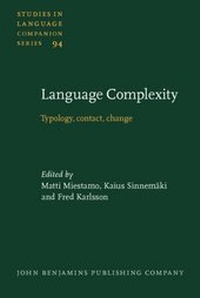
Language Complexity
Typology, contact, change
1st Edition
Published on 6. February 2008
XIV, 356 pages
978-90-272-9135-6 (ISBN)
Description

Language complexity has recently attracted considerable attention from linguists of many different persuasions. This volume - a thematic selection of papers from the conference Approaches to Complexity in Language, held in Helsinki, August 2005 - is the first collection of articles devoted to the topic. The sixteen chapters of the volume approach the notion of language complexity from a variety of perspectives. The papers are divided into three thematic sections that reflect the central themes of the book: Typology and theory, Contact and change, Creoles and pidgins. The book is mainly intended for typologists, historical linguists, contact linguists and creolists, as well as all linguists interested in language complexity in general. As the first collective volume on a very topical theme, the book is expected to be of lasting interest to the linguistic community.
More details
Other editions
Additional editions
Book
02/2008
John Benjamins Publishing Co
€116.60
Shipment within 10-15 days
Persons
Content
- Language Complexity
- Editorial page
- Title page
- LCC data
- Table of contents
- Introduction
- Language complexity
- An overview of the contributions in this volume
- Acknowledgements
- References
- Part I Typology and theory
- Complexity in linguistic theory, language learning and language change
- Introduction
- Absolute and relative complexity
- Definition of complexity
- Points of relativity
- Objections against outsider complexity
- Methodology
- Three aspects and three dimensions
- From the individual to the social
- Case study: Bolivian, Argentinean and Ecuadorean Quechua
- Social history of three Quechua varieties
- Quechua inflection
- Conclusions and interpretations
- Conclusions
- Abbreviations
- References
- Grammatical complexity in a cross-linguistic perspective
- Introduction
- Absolute complexity and (relative) cost/difficulty
- Global vs. local complexity
- Criteria for complexity
- Complexity and cross-linguistic rarity
- Summary
- Abbreviations
- References
- Complexity trade-offs between the subsystems of language
- Hierarchy and complexity in the language system
- Cross-linguistic correlations
- Previous results
- New assumptions
- Evaluation and results
- Discussion
- A short excursion into diachrony
- Where the trade-offs happen and why they do not indicate an equal overall complexity of languages
- Conceptualizations of "semantic complexity" and a look at pidgin languages
- Low complexity in word structure - high semantic complexity and idiomatic speech?
- English as an example
- English phrasal verbs - monosyllabic and idiomatic
- A short comparison between English and Russian
- Final discussion
- Concluding remarks
- References
- Complexity trade-offs in core argument marking
- Introduction
- Sampling
- The definition of complexity
- Hypothesis for the statistical tests
- Coding strategies: Definitions and constraints
- Measuring functional load - and complexity
- Results and discussion
- Conclusions
- Abbreviations
- References
- Assessing linguistic complexity
- Introduction
- Information theory basics
- Zipf and Shannon
- Kolmogorov and other complexity definitions
- Linguistic Experiments
- Information and language
- Validating complexity measurements
- Further compression analyses: Translation
- Complexity via distortion: Preliminary experiments
- Complexity via distortion: Subsequent experiments
- Discussion
- Future work and conclusions
- References
- How complex are isolating languages?
- Introduction
- Associational semantics
- Measuring complexity: The association experiment
- Experimental design
- Running the experiment
- Results
- But doesn't the pragmatics compensate"
- Summary
- Abbreviations
- References
- Complexity in isolating languages: Lexical elaboration versus grammatical economy*
- Introduction
- Some typological characteristics of highly analytic languages
- Complexity in HMT
- Classifiers
- Verb Serialization
- Compounding
- Elaborate expressions
- Complexity in language learning
- Conclusion
- Abbreviations
- References
- Corpus references
- Grammatical resources and linguistic complexity
- Background notions: System complexity, structural complexity resources vs. regulations
- Sirionó, a language without syntactic coordination
- How to manage without syntactic coordination: Three strategies
- The 'with' strategy
- The 'also' strategy
- The list strategy
- Discussion and conclusions
- Abbreviations
- Text source
- References
- Part II Contact and change
- Why does a language undress?
- Introduction
- Why would a language undress?
- Riau Indonesian
- There are no varieties of Indonesian's relatives that are reduced like Riau Indonesian
- The grammar of Riau Indonesian gives no concrete indication of transfer from other languages
- Theories of grammar-internal change do not predict the fate of voice markers in colloquial Indonesians
- Summary
- Timor
- Tetun Terik vs. Tetun Dili
- Tetun Terik vs. its relatives
- Things just happen? The Papuan factor
- Just chance?
- What happened in Timor?
- Flores
- Complexity without affixation
- A phonological explanation?
- A Wave of Simplification?
- Applying the Hypothesis
- Abbreviations
- References
- Morphological complexity as a parameter of linguistic typology
- Introduction and the aim of the paper
- Linguistic complexity
- Morphology
- Modality
- Reflexive
- Causative
- Compounding
- Multiply derived forms
- Syntax
- Language change by contact
- Typology
- Morphological complexity as a parameter
- Rivalry between parameters
- Chicken or egg: Post-nominal modification inHO
- Conclusions
- Abbreviations
- References
- Language complexity and interlinguistic difficulty
- Background
- Complexity and difficulty
- Counting difficulty
- The verb phrase
- Pronominal systems
- Nominal morphology and noun phrases
- Discussion
- Evasion
- Mismatches: Category content and cooccurrence restrictions
- Form transparency
- Vocabulary
- Popular judgment of difficulty
- Extra-linguistic factors
- Conclusions
- Abbreviations
- References
- Appendix I. Verb phrase
- Appendix II. Pronominal forms
- Appendix III. Kuot verbs and adjectives, and their affixation orders
- Complexity in nominal plural allomorphy
- Introduction
- Defining and analysing morphological complexity
- Illustration of the complexity metric
- Number of plural allomorphs across Germanic languages
- Three dimensions of complexity in plural exponency and assignment
- Complexity of formal techniques
- Complexity in allomorph assignment
- Direction of determination between stem and suffix
- Results
- Remarks on validation and conclusion
- Abbreviations
- References
- Part III Creoles and pidgins
- The simplicity of creoles in a cross-linguistic perspective
- Introduction
- The relationship between expressiveness and complexity
- Material and method
- Results
- The special case of creoles
- What are creoles?
- Adding more contact languages
- Creoles and other groups compared
- Conclusion
- Abbreviations
- References
- Complexity in numeral systems with an investigation into pidgins and creoles
- Numerals
- What are numerals?
- Why study numerals?
- Complexity
- Complexity as irregularity
- Complexity as global ordering constraints
- Complexity vs. economy
- Overall complexity
- Complexity in numeral systems of pidgin and creole languages
- Discussion
- References
- Appendix: Logically possible numeral systems without base
- Explaining Kabuverdianu nominal plural formation
- Introduction
- Kabuverdianu or Cape Verdean Creole Portuguese
- The 4-M model and creolization
- Nominal plural marking in Portuguese and restructured varieties of Portuguese
- Previous descriptions of nominal plural marking in CVC
- CVC plural marking in our data
- Discussion
- Epilogue: the cross-linguistic picture
- References
- References for the corpus
- Complexity and simplicity in minimal lexica
- Introduction
- Chinook Jargon
- The data
- Lexical processes in a CJ text: The Story of Moola John
- Recycling meaning in a CJ text: the multifunctionality of lexical items
- The lexicon of Chinook Jargon - simple and efficient
- Abbreviations
- References
- Index of languages
- Index of authors
- Index of subjects
- Studies in Language Companion Series
