

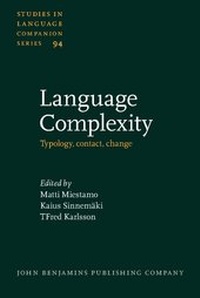
Language Complexity
Typology, contact, change
Published on 6. February 2008
Book
Hardback
356 pages
978-90-272-3104-8 (ISBN)
Description
Language complexity has recently attracted considerable attention from linguists of many different persuasions. This volume - a thematic selection of papers from the conference Approaches to Complexity in Language, held in Helsinki, August 2005 - is the first collection of articles devoted to the topic. The sixteen chapters of the volume approach the notion of language complexity from a variety of perspectives. The papers are divided into three thematic sections that reflect the central themes of the book: Typology and theory, Contact and change, Creoles and pidgins. The book is mainly intended for typologists, historical linguists, contact linguists and creolists, as well as all linguists interested in language complexity in general. As the first collective volume on a very topical theme, the book is expected to be of lasting interest to the linguistic community.
More details
Series
Language
English
Place of publication
Amsterdam
Netherlands
Target group
Professional and scholarly
Dimensions
Height: 245 mm
Width: 164 mm
Weight
825 gr
ISBN-13
978-90-272-3104-8 (9789027231048)
Copyright in bibliographic data and cover images is held by Nielsen Book Services Limited or by the publishers or by their respective licensors: all rights reserved.
Schweitzer Classification
Other editions
Additional editions
E-Book
02/2008
1st Edition
John Benjamins Publishing Company
€136.99
Available for download
Persons
Content
1. Introduction: The problem of language complexity (by Karlsson, Fred); 2. I. Typology and theory; 3. Complexity in linguistic theory, language learning and language change (by Kusters, Wouter); 4. Grammatical complexity in cross-linguistic perspective (by Miestamo, Matti); 5. Complexity trade-offs between the subsystems of language (by Fenk-Oczlon, Gertraud); 6. Complexity trade-offs in core argument marking (by Sinnemaki, Kaius); 7. Assessing linguistic complexity (by Juola, Patrick); 8. How complex are isolating languages? (by Gil, David); 9. Complexity in isolating languages: Lexical elaboration versus grammatical economy (by Riddle, Elizabeth M.); 10. Grammatical resources and linguistic complexity: Siriono as a language without NP coordination (by Dahl, Osten); 11. II. Contact and change; 12. Why does a language undress? Strange cases in Indonesia (by McWhorter, John); 13. Morphological complexity as a parameter of linguistic typology: Hungarian as a contact language (by Groot, Casper de); 14. Language complexity and interlinguistic difficulty (by Lindstrom, Eva); 15. Complexity in nominal plural allomorphy: A contrastive survey of ten Germanic languages (by Dammel, Antje); 16. III. Creoles and pidgins; 17. The simplicity of creoles in a cross-linguistic perspective (by Parkvall, Mikael); 18. Complexity in numeral systems with an investigation into pidgins and creoles (by Hammarstrom, Harald); 19. Explaining Kabuverdianu nominal plural formation (by Bartens, Angela); 20. Complexity and simplicity in minimal lexica: The lexicon of Chinook Jargon (by Juvonen, Paivi); 21. Index of languages; 22. Index of authors; 23. Index of subjects