

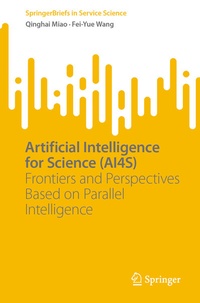
Artificial Intelligence for Science (AI4S)
Description

This book presents a comprehensive framework for analyzing, evaluating, and guiding AI for Sciences (AI4Sci) research, offering a unified approach that facilitates analysis across various academic fields through a shared set of dimensions and indicators. It provides a systematic overview of recent AI4Sci advances in various disciplines and offers insights into the latest issues in and prospects of AI4Sci. The book is based on the theory of Parallel Intelligence (PI), which forms the foundation for the general AI4Sci framework. By analyzing multiple cases in various academic fields, this framework integrates key elements of AI4Sci, such as real scientific problems, datasets, virtual systems, AI methods, human roles, and organizational mechanisms, from a multidimensional perspective. It also assesses and summarizes the limitations of AI4Sci, incorporating the latest advances in AI for fundamental models. Lastly, it explores the impact of DeSci and DAO, as well as TAO, on AI4Sci ecosystem development and prospects. Through its balanced approach, the book offers readers a goal-oriented perspective, focusing on a concise presentation of the core ideas and reducing detailed descriptions of specific AI4Sci cases to a minimum.
Reviews / Votes
"This booklet looks at state-of-the-art AI in the sciences. A positive aspect is its consideration of human expert knowledge and human control of the outcome. In this respect, it can be considered as a helpful introduction to AI applications for science." (D. Grigoras, Computing Reviews, March 21, 2025)
More details
Other editions
Additional editions
Persons
Qinghai Miao is an Associate Professor at the School of Artificial Intelligence, University of the Chinese Academy of Sciences, China. His research interests include parallel intelligence, machine learning, and intelligent systems.
Fei-Yue Wang received his Ph.D. in Computer and Systems Engineering from Rensselaer Polytechnic Institute, Troy, New York, USA. He is the Director of the State Key Laboratory for Management and Control of Complex Systems at the Institute of Automation, Chinese Academy of Sciences (CASIA, China); Editor in Chief of both IEEE Trans. on Intelligent Vehicles and China's Journal of Intelligent Science and Technology; and President of the CAA Supervisory Council. His current research focuses on methods and applications for parallel intelligence, social computing, and knowledge automation.
Content
AI4S based on Parallel Intelligence.- AI for Mathematics.- AI for Physics.- AI for Biology.- AI for Health and Medicine.- AI for Chemistry.- AI for Material Science.- AI for Astronomy.- Toward a Sustainable AI4S Ecosystem.
