

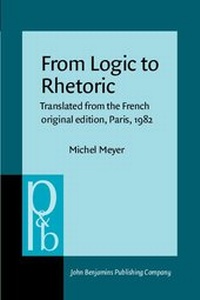
From Logic to Rhetoric
Translated from the French original edition, Paris, 1982
1st Edition
Published on 1. January 1986
IX, 147 pages
978-90-272-7931-6 (ISBN)
Description

What is language, and how has it been conceived since Frege? How did the development of thought about language lead to a renewed interest in rhetoric in the twentieth century and ultimately to the 'problematological synthesis'? These are the main questions treated in this book. A constant intertwining of historical and topical viewpoints characterizes the author's approach.
More details
Other editions
Additional editions
Book
01/1986
John Benjamins Publishing Co
€72.08
Shipment within 10-15 days
Content
- FROM LOGIC TO RHETORIC
- Editorial page
- Title page
- Copyright page
- Dedication
- Table of contents
- INTRODUCTION
- PART ONE: LANGUAGE AND LOGIC
- 1. FREGE OR THE RECOURSE TO FORMALIZATION
- 1.1. Logic before Frege
- 1.2. Function and concept
- 1.3. The ideography and the principles of Fregean language theory
- 1.4. Sense and reference
- 1.5. Sense and meaning
- 1.6. Conclusion
- 2. RUSSELL'S SYNTHESIS
- 2.1. Formalization and natural language
- 2.2. Definite descriptions
- 2.3. Propositional functions
- 2.3.1. The ambiguity of the concept o f propositional function
- 2.3.2. The ambiguity in quantification
- 2.4. The theory of types and the axiom of reducibility
- 2.5. Conclusion
- 3. WITTGENSTEIN: FROM TRUTH TABLES TO ORDINARY LANGUAGE AND THE IMPLICATIONS OF GENERALIZED ANALYTICITY
- 3.1. The Russellian heritage and its contradictions
- 3.2. The immanence of logic in language
- 3.3. Sense and reference
- 3.4. The picture theory of language
- 3.5. Negation and the other logical constants
- 3.6. The Tractatus as initiation into silence
- 3.7. Ordinary language and its rules
- 3.8. Conclusion: Russell vs. Wittgenstein, a heritage
- 4. HINTIKKA OR THE THEORY OF POSSIBLE WORLDS
- 4.1. Introduction
- 4.2. Referential opacity
- 4.3. The ontological commitment and the elimination of singular terms with Quine
- 4.4. Possible worlds and propositional attitudes
- 4.5. The implications of the alternativeness relation and the theory of models
- 4.6. Ontological commitment
- 4.7. The interpretation of quantification as a question and answer game
- a) Names and descriptions
- b) Natural language and interrogatives
- c) Interrogatives and quantification
- d) The rules of the game
- e) Remarks
- 4.8. Wittgenstein and Hintikka: A concluding comparison
- PART TWO: LANGUAGE AND CONTEXT
- 5. SYNTAX, SEMANTICS, PRAGMATICS AND ARGUMENTATION
- 5.1. The three levels of language
- 5.2. Logical syntax
- 5.3. Formalization and natural language
- 5.4. The renewal of argumentation
- 5.5. Perelman's new rhetoric
- 5.6. Argumentation in language or the 'new linguistics' of Anscombre and Ducrot
- 5.7. Conclusion
- 6. DIALECTIC AND QUESTIONING
- 6.1. Dialectic Socrates
- 6.2. The Middle Dialogues: Dialectic and the hypothetical method
- 6.3. The Late Period: The question of being or the shift from the question to being
- 7. ARGUMENTATION IN THE LIGHT OF A THEORY OF QUESTIONING
- 7.1. Why language?
- 7.2. The two major categories of forms
- 7.3. What is to be understood by 'question' and 'problem'?
- 7.4. The autonomization of the spoken and the written
- 7.5. The proposition as proposition of an answer
- 7.6. What is meaning?
- 7.7. Meaning as the locus of dialectic
- 7.8. Argumentation
- 7.9. Literal and figurative meaning: The origin of messages "between the lines
- FOOTNOTES
- REFERENCES
