

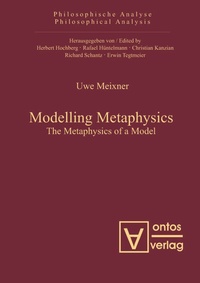
Modelling Metaphysics
The Metaphysics of a Model
1st Edition
Published on 2. May 2013
274 pages
978-3-11-032608-6 (ISBN)
Description

This book models and simulates metaphysics by presenting the metaphysics of a model. The small size of the model makes it possible to treat metaphysical matters with a more than usual systematicity and comprehensiveness. In the mirror of sustained analogy, simulation-metaphysics offers a wealth of insights on the real thing: on the doctrines, the methods, and the epistemology of metaphysics.
More details
Other editions
Additional editions
Book
12/2009
1st Edition
De Gruyter
€149.95
Shipment within 7-9 days
Content
1 - 1 Preface and introduction [Seite 9]
2 - 2 The basic description of Model T [Seite 15]
2.1 - 2.1 Mathematical representation [Seite 21]
3 - 3 Ontological categories for T [Seite 23]
3.1 - 3.1 Basic universals [Seite 23]
3.2 - 3.2 Individuals which are basic or immediately derivative [Seite 26]
3.2.1 - 3.2.1 Spatial configurations [Seite 26]
3.2.1.1 - 3.2.1.1 Spatial parthood for spatial configurations [Seite 29]
3.2.2 - 3.2.2 Temporal configurations [Seite 30]
3.2.2.1 - 3.2.2.1 Direction and relative position for temporal configurations [Seite 33]
3.3 - 3.3 States of affairs [Seite 39]
3.3.1 - 3.3.1 Time-dependent but not time-thematic states of affairs [Seite 40]
3.3.1.1 - 3.3.1.1 Additional perspectives on not time-dependent, but time-thematic states of affairs [Seite 47]
3.3.2 - 3.3.2 Time-dependent and time-thematic states of affairs - and the nature of indexical time-thematicness [Seite 48]
3.4 - 3.4 Events as sequences of momentary states [Seite 52]
3.4.1 - 3.4.1 Events and states of affairs [Seite 55]
3.5 - 3.5 Basic tropes [Seite 58]
3.5.1 - 3.5.1 Basic spatiotemporal tropes as fundamental or derivative entities [Seite 60]
3.6 - 3.6 Worlds and modal positions [Seite 64]
4 - 4 Uniformity and diversiformity of histories and of maximally composite momentary states [Seite 67]
4.1 - 4.1 Regularities of histories [Seite 73]
4.1.1 - 4.1.1 Regularities and laws (of nature) [Seite 77]
4.2 - 4.2 Uniformity, regularities, laws, and actuality [Seite 81]
5 - 5 Actuality and other modalities for T [Seite 83]
5.1 - 5.1 Temporal and historical relativization of statements about T [Seite 83]
5.1.1 - 5.1.1 The varieties of historical relativization [Seite 89]
5.2 - 5.2 The plurality of actuality-predicates, basic and defined [Seite 93]
5.2.1 - 5.2.1 Actuality - in two ways non-relativized [Seite 98]
5.2.2 - 5.2.2 Actualization** and what is behind it [Seite 108]
5.3 - 5.3 Possibility and necessity for T [Seite 116]
5.3.1 - 5.3.1 History-relative and/or time-relative necessity and possibility for T [Seite 124]
5.4 - 5.4 The immanent and transcendent perspective on modality and time [Seite 132]
6 - 6 The physics of H* [Seite 137]
6.1 - 6.1 The first two of the laws for T/the laws of H* [Seite 139]
6.2 - 6.2 The Third Law for T and the supervenience of atomic higher continuants relative to H* [Seite 142]
6.3 - 6.3 Democriteanism and four-dimensionalism for H* and the transhistorical identity of atomic higher continuants [Seite 153]
6.3.1 - 6.3.1 Four-dimensionalist counterpartism [Seite 163]
6.3.2 - 6.3.2 Four-dimensionalism without counterpartism [Seite 165]
6.4 - 6.4 Final determinations on atomic material objects [Seite 166]
6.4.1 - 6.4.1 The strong essentiality of origin for atomic material objects [Seite 169]
6.5 - 6.5 Candidates for further laws for T, and more on the laws for T [Seite 171]
6.5.1 - 6.5.1 The Candidate Fifth Law for T [Seite 179]
6.5.2 - 6.5.2 The regulation of collision [Seite 186]
6.5.3 - 6.5.3 The Candidate Sixth Law for T [Seite 194]
6.6 - 6.6 The canon of the laws for T [Seite 199]
6.7 - 6.7 The initial state [Seite 204]
7 - 7 Five T-metaphysical issues and the metaphysics of Reality [Seite 211]
7.1 - 7.1 The completion of the rules of ACTUHIST [Seite 211]
7.2 - 7.2 Physicalism and dualism with regard to Model T [Seite 219]
7.3 - 7.3 T-immanent and T-transcendent causation [Seite 229]
7.4 - 7.4 Composite T-material objects [Seite 246]
7.4.1 - 7.4.1 Typical material objects in Reality and their T-analogues [Seite 258]
7.4.2 - 7.4.2 Objections to taking the sequential T-material* objects as the Tanalogues of the typical material objects [Seite 264]
7.4.3 - 7.4.3 The transtemporal and transhistorical identity of T-material* objects [Seite 266]
7.5 - 7.5 T-metaphysical teleology [Seite 268]
8 - Index of concepts and principles [Seite 273]
2 - 2 The basic description of Model T [Seite 15]
2.1 - 2.1 Mathematical representation [Seite 21]
3 - 3 Ontological categories for T [Seite 23]
3.1 - 3.1 Basic universals [Seite 23]
3.2 - 3.2 Individuals which are basic or immediately derivative [Seite 26]
3.2.1 - 3.2.1 Spatial configurations [Seite 26]
3.2.1.1 - 3.2.1.1 Spatial parthood for spatial configurations [Seite 29]
3.2.2 - 3.2.2 Temporal configurations [Seite 30]
3.2.2.1 - 3.2.2.1 Direction and relative position for temporal configurations [Seite 33]
3.3 - 3.3 States of affairs [Seite 39]
3.3.1 - 3.3.1 Time-dependent but not time-thematic states of affairs [Seite 40]
3.3.1.1 - 3.3.1.1 Additional perspectives on not time-dependent, but time-thematic states of affairs [Seite 47]
3.3.2 - 3.3.2 Time-dependent and time-thematic states of affairs - and the nature of indexical time-thematicness [Seite 48]
3.4 - 3.4 Events as sequences of momentary states [Seite 52]
3.4.1 - 3.4.1 Events and states of affairs [Seite 55]
3.5 - 3.5 Basic tropes [Seite 58]
3.5.1 - 3.5.1 Basic spatiotemporal tropes as fundamental or derivative entities [Seite 60]
3.6 - 3.6 Worlds and modal positions [Seite 64]
4 - 4 Uniformity and diversiformity of histories and of maximally composite momentary states [Seite 67]
4.1 - 4.1 Regularities of histories [Seite 73]
4.1.1 - 4.1.1 Regularities and laws (of nature) [Seite 77]
4.2 - 4.2 Uniformity, regularities, laws, and actuality [Seite 81]
5 - 5 Actuality and other modalities for T [Seite 83]
5.1 - 5.1 Temporal and historical relativization of statements about T [Seite 83]
5.1.1 - 5.1.1 The varieties of historical relativization [Seite 89]
5.2 - 5.2 The plurality of actuality-predicates, basic and defined [Seite 93]
5.2.1 - 5.2.1 Actuality - in two ways non-relativized [Seite 98]
5.2.2 - 5.2.2 Actualization** and what is behind it [Seite 108]
5.3 - 5.3 Possibility and necessity for T [Seite 116]
5.3.1 - 5.3.1 History-relative and/or time-relative necessity and possibility for T [Seite 124]
5.4 - 5.4 The immanent and transcendent perspective on modality and time [Seite 132]
6 - 6 The physics of H* [Seite 137]
6.1 - 6.1 The first two of the laws for T/the laws of H* [Seite 139]
6.2 - 6.2 The Third Law for T and the supervenience of atomic higher continuants relative to H* [Seite 142]
6.3 - 6.3 Democriteanism and four-dimensionalism for H* and the transhistorical identity of atomic higher continuants [Seite 153]
6.3.1 - 6.3.1 Four-dimensionalist counterpartism [Seite 163]
6.3.2 - 6.3.2 Four-dimensionalism without counterpartism [Seite 165]
6.4 - 6.4 Final determinations on atomic material objects [Seite 166]
6.4.1 - 6.4.1 The strong essentiality of origin for atomic material objects [Seite 169]
6.5 - 6.5 Candidates for further laws for T, and more on the laws for T [Seite 171]
6.5.1 - 6.5.1 The Candidate Fifth Law for T [Seite 179]
6.5.2 - 6.5.2 The regulation of collision [Seite 186]
6.5.3 - 6.5.3 The Candidate Sixth Law for T [Seite 194]
6.6 - 6.6 The canon of the laws for T [Seite 199]
6.7 - 6.7 The initial state [Seite 204]
7 - 7 Five T-metaphysical issues and the metaphysics of Reality [Seite 211]
7.1 - 7.1 The completion of the rules of ACTUHIST [Seite 211]
7.2 - 7.2 Physicalism and dualism with regard to Model T [Seite 219]
7.3 - 7.3 T-immanent and T-transcendent causation [Seite 229]
7.4 - 7.4 Composite T-material objects [Seite 246]
7.4.1 - 7.4.1 Typical material objects in Reality and their T-analogues [Seite 258]
7.4.2 - 7.4.2 Objections to taking the sequential T-material* objects as the Tanalogues of the typical material objects [Seite 264]
7.4.3 - 7.4.3 The transtemporal and transhistorical identity of T-material* objects [Seite 266]
7.5 - 7.5 T-metaphysical teleology [Seite 268]
8 - Index of concepts and principles [Seite 273]
