

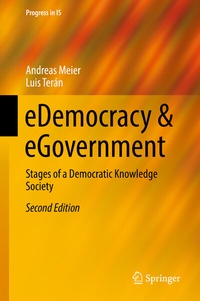
eDemocracy & eGovernment
Description

This textbook reviews and systematically presents the use of the Internet in public administration and politics. Further, it employs a process-oriented layer model to define the opportunities for exchange and participation for all stakeholder groups, covering the following topics: eAssistance, eProcurement, eService, eContracting, eSettlement, eCollaboration, eDemocracy, and eCommunity. In turn, real-world case studies demonstrate the practical applications in industry, administration and research.
The second edition of this book has been completely revised and extended, and includes several new case studies. It offers a valuable asset for students in Business, Economics and Political Sciences courses, as well as practitioners interested in emerging opportunities for digital exchange and participation in the knowledge society.
Reviews / Votes
"The book is well written and well organized, and the style is light and easy to read. In addition, the many case studies make it a valuable reference for students and educators." (Stefka Tzanova, Computing Reviews, February 10, 2021)
More details
Other editions
Additional editions
Persons
Luis Terán is currently working as assistant lecturer at the Information Systems research group at the University of Fribourg, Switzerland and academic guest at the University of Zurich. Additionally he is a full professor at the Universidad de Las Fuerzas Armadas (ESPE), Ecuador. He obtained a PhD and a habilitation in computer science from the University of Fribourg. In2009, he finished a MSc in communication systems from the Federal Institute of Technology (EPFL), Lausanne, Switzerland. In 2004, he received a BSc in electronics and telecommunications from Escuela Politécnica Nacional, Quito, Ecuador. His research interests include eGovernment, eParticipation, eCollaboration, eDemocracy, eElection, eVoting, eCommunities, ePassports, recommender systems and fuzzy classification. He is currently a global chair for the IEEE e-Government Special Technical Community, program chair and main organizer for the International Conference on eDemocracy and eGovernment (ICEDEG), guest editor at IEEE Transactions on Emerging Topics in Computing, and distinguished exhibitor at IEEE Ecuador Section.
