

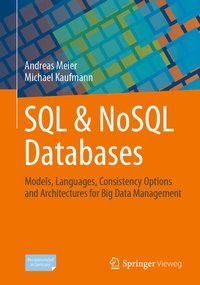
SQL & NoSQL Databases
Description

This book offers a comprehensive introduction to relational (SQL) and non-relational (NoSQL) databases. The authors thoroughly review the current state of database tools and techniques, and examine coming innovations.
The book opens with a broad look at data management, including an overview of information systems and databases, and an explanation of contemporary database types:
-
SQL and NoSQL databases, and their respective management systems
-
The nature and uses of Big Data
-
A high-level view of the organization of data management
Chapter-length treatment is afforded Data Modeling in both relational and graph databases, including enterprise-wide data architecture, and formulas for database design. Coverage of languages extends from an overview of operators, to SQL and and QBE (Query by Example), to integrity constraints and more.
A full chapter probes the challenges of Ensuring Data Consistency, covering:
-
Multi-User Operation
-
Troubleshooting
-
Consistency in Massive Distributed Data
-
Comparison of the ACID and BASE consistency models, and more
System Architecture also gets from its own chapter, which explores Processing of Homogeneous and Heterogeneous Data; Storage and Access Structures; Multi-dimensional Data Structures and Parallel Processing with MapReduce, among other topics.
Post-Relational and NoSQL Databases
The chapter on post-relational databases discusses the limits of SQL - and what lies beyond, including Multi-Dimensional Databases, Knowledge Bases and and Fuzzy Databases.
A final chapter covers NoSQL Databases, along with
-
Development of Non-Relational Technologies,
-
Key-Value, Column-Family and Document Stores
-
XML Databases and Graphic Databases, and more
SQL & NoSQL Databases conveys the strengths and weaknesses of relational and non-relational approaches, and shows how to undertake development for big data applications. The book benefits readers including students and practitioners working across the broad field of applied information technology.
This textbook has been recommended and developed for university courses in Germany, Austria and Switzerland.
More details
Other editions
New editions
Additional editions
Persons
Andreas Meier is a former member of the Faculty of Economics and Social Science and was a professor of Information Technology at the University of Fribourg. He specializes in electronic business, electronic government, and information management. He is member of the GI (Gesellschaft für Informatik), IEEE Computer Society, and ACM. After studying music in Vienna, he graduated with a degree in mathematics at the Federal Institute of Technology (ETH) in Zurich, studied his doctorate, and qualified as a university lecture at the Institute of Computer Science. He was a systems engineer at the IBM research lab in San Jose´, California, director of an international bank, and a member of the executive board of an insurance company.
Michael Kaufmann
is a Professor of Data Science and Big Data at the School of Information Technology, Lucerne University of Applied Sciences and Arts. He is also the coordinator of the university´s DataIntelligence research team, which develops and studies methods and technologies for intelligent data management. Michael Kaufmann studied computer science, law and psychology at the University of Fribourg. With extra-occupational doctoral studies, he received his Ph.D. in computer science on the topic of inductive fuzzy classification in marketing analytics. He worked at PostFinance as a data warehouse poweruser in corporate development; Later on at Mobiliar Insurance as a data architect in the enterprise architecture unit; and as a business analyst at FIVE Informatik AG, where he initiated and led a research project and started teaching as a part time lecturer at Kalaidos University of Applied Science. Since 2014 he has been working at the Lucerne University of Applied Sciences and Arts in teaching and research as a lecturer for databases, where he founded and successfully funded the research team data intelligence.
