

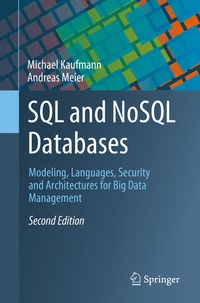
SQL and NoSQL Databases
Modeling, Languages, Security and Architectures for Big Data Management
2nd Edition
Published on 29. June 2023
XIV, 254 pages
978-3-031-27908-9 (ISBN)
Description

This textbook offers a comprehensive introduction to relational (SQL) and non-relational (NoSQL) databases. The authors thoroughly review the current state of database tools and techniques and examine upcoming innovations.
In the first five chapters, the authors analyze in detail the management, modeling, languages, security, and architecture of relational databases, graph databases, and document databases. Moreover, an overview of other SQL- and NoSQL-based database approaches is provided. In addition to classic concepts such as the entity and relationship model and its mapping in SQL database schemas, query languages or transaction management, other aspects for NoSQL databases such as non-relational data models, document and graph query languages (MQL, Cypher), the Map/Reduce procedure, distribution options (sharding, replication) or the CAP theorem (Consistency, Availability, Partition Tolerance) are explained.
This 2nd English edition offers a new in-depth introduction to document databases with a method for modeling document structures, an overview of the document-oriented MongoDB query language MQL as well as security and architecture aspects. The topic of database security is newly introduced as a separate chapter and analyzed in detail with regard to data protection, integrity, and transactions. Texts on data management, database programming, and data warehousing and data lakes have been updated. In addition, the book now explains the concepts of JSON, JSON schema, BSON, index-free neighborhood, cloud databases, search engines and time series databases.
The book includes more than 100 tables, examples and illustrations, and each chapter offers a list of resources for further reading. It conveys an in-depth comparison of relational and non-relational approaches and shows how to undertake development for big data applications. This way, it benefits students and practitioners working across the broad field of data science and applied information technology.
In the first five chapters, the authors analyze in detail the management, modeling, languages, security, and architecture of relational databases, graph databases, and document databases. Moreover, an overview of other SQL- and NoSQL-based database approaches is provided. In addition to classic concepts such as the entity and relationship model and its mapping in SQL database schemas, query languages or transaction management, other aspects for NoSQL databases such as non-relational data models, document and graph query languages (MQL, Cypher), the Map/Reduce procedure, distribution options (sharding, replication) or the CAP theorem (Consistency, Availability, Partition Tolerance) are explained.
This 2nd English edition offers a new in-depth introduction to document databases with a method for modeling document structures, an overview of the document-oriented MongoDB query language MQL as well as security and architecture aspects. The topic of database security is newly introduced as a separate chapter and analyzed in detail with regard to data protection, integrity, and transactions. Texts on data management, database programming, and data warehousing and data lakes have been updated. In addition, the book now explains the concepts of JSON, JSON schema, BSON, index-free neighborhood, cloud databases, search engines and time series databases.
The book includes more than 100 tables, examples and illustrations, and each chapter offers a list of resources for further reading. It conveys an in-depth comparison of relational and non-relational approaches and shows how to undertake development for big data applications. This way, it benefits students and practitioners working across the broad field of data science and applied information technology.
More details
Series
Edition
Second Edition 2023
Language
English
Place of publication
Cham
Switzerland
Publishing group
Springer International Publishing
Product notice
Reflowable
Illustrations
XIV, 254 p. 110 illus., 109 illus. in color.
File size
7,93 MB
ISBN-13
978-3-031-27908-9 (9783031279089)
DOI
10.1007/978-3-031-27908-9
Schweitzer Classification
Other editions
Additional editions
Michael Kaufmann | Andreas Meier
SQL and NoSQL Databases
Modeling, Languages, Security and Architectures for Big Data Management
Book
06/2023
2nd Edition
Springer
€69.54
Shipment within 15-20 days
Previous edition
Andreas Meier | Michael Kaufmann
SQL & NoSQL Databases
Models, Languages, Consistency Options and Architectures for Big Data Management
E-Book
07/2019
1st Edition
Springer Vieweg
€53.49
Available for download
Persons
Michael Kaufmann
is a professor at the Lucerne University of Applied Sciences and Arts. He teaches database systems and researches technologies for intelligent data management. Michael studied computer science, law and psychology at the University of Fribourg. He worked at PostFinance as a data warehouse power user in enterprise development, later at Mobiliar Insurance as a data architect in enterprise architecture and as a business analyst at FIVE Informatik AG. Parallel to his industrial activities, he earned a doctorate in computer science on the topic of inductive fuzzy classification in marketing analytics. Subsequently, he first taught at the Kalaidos University of Applied Sciences Zurich before moving to the Lucerne School of Engineering & Architecture. Since 2016, he has been working at the Lucerne School of Computer Science.
Andreas Meier is a former member of the Faculty of Economics and Social Science and was a professor of Information Technology at the University of Fribourg. He specializes in electronic business, electronic government, and information management. He is member of the GI (Gesellschaft für Informatik), IEEE Computer Society, and ACM. After studying music in Vienna, he graduated with a degree in mathematics at the Federal Institute of Technology (ETH) in Zurich, studied his doctorate, and qualified as a university lecture at the Institute of Computer Science. He was a systems engineer at the IBM research lab in San José, California, director of an international bank, and a member of the executive board of an insurance company.
Andreas Meier is a former member of the Faculty of Economics and Social Science and was a professor of Information Technology at the University of Fribourg. He specializes in electronic business, electronic government, and information management. He is member of the GI (Gesellschaft für Informatik), IEEE Computer Society, and ACM. After studying music in Vienna, he graduated with a degree in mathematics at the Federal Institute of Technology (ETH) in Zurich, studied his doctorate, and qualified as a university lecture at the Institute of Computer Science. He was a systems engineer at the IBM research lab in San José, California, director of an international bank, and a member of the executive board of an insurance company.
Content
- 1. Database Management. - 2. Database Modeling. - 3. Database Languages. - 4. Database Security. - 5. System Architecture. - 6. Post-relational Databases. - 7. NoSQL Databases.
