

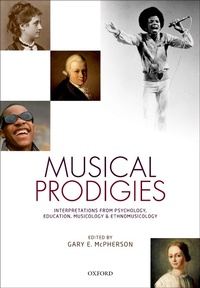
Musical Prodigies
Interpretations from Psychology, Education, Musicology, and Ethnomusicology
Published on 26. August 2016
704 pages
978-0-19-150925-4 (ISBN)
Description

Child prodigies have been observed in a range of disciplines - particularly music, mathematics, chess, and art. The question of what makes a prodigy has long been controversial. Some have dismissed the notion of giftedness, arguing that most famous prodigies had strong parental, cultural, and environmental influences that helped them develop their extraordinary abilities. One recent theory suggested that anyone could achieve outstanding success in whatever endeavour they wanted with a minimum of 10,000 hours of practice. Nevertheless, many studies of prodigies have suggested that there might be strong underlying cognitive differences, regarding their use of short-term versus long-term memory, spatial memory, imagery, and language. Whatever the arguments - for those interested in child development - prodigies remain a fascinating subject of study when considering questions about creativity, intelligence, development, and the impact of nature versus nurture.
This books breaks new ground in presenting the first scientific exploration on the topic of musical prodigies. It brings together research from a range of disciplines, including psychology, neurobiology, and genetics, to provide a thorough exploration of prodigious talent. In addition, the book includes fascinating case studies of prodigies and also looks at their long-term development into adulthood - many child prodigies have had problems making the transition into adolescence and adulthood.
Musical prodigies will be required reading for anyone interested in child development, music, and the arts
More details
Other editions
Additional editions
Gary E. McPherson
Musical Prodigies
Interpretations from Psychology, Education, Musicology, and Ethnomusicology
Book
09/2016
Oxford University Press
€173.90
Shipment within 15-20 days

Gary E. McPherson
Musical Prodigies
Interpretations from Psychology, Education, Musicology, and Ethnomusicology
Software
08/2015
Oxford University Press, USA
€122.77
Article exhausted; check different version
Person
Gary E. McPherson studied music education at the Sydney Conservatorium of Music, before completing a master of music education at Indiana University, a doctorate of philosophy at the University of Sydney and a Licentiate and Fellowship in trumpet performance through Trinity College, London. He is the Ormond Professor and Director of the Melbourne Conservatorium of Music at the University of Melbourne, and previously held a position as the Marilyn Pflederer Zimmerman endowed chair in music education at the University of Illinois at Urbana Champaign. He has served as National President of the Australian Society for Music Education and President of the International Society for Music Education. His research interests are broad and his approach interdisciplinary. His most important research examines the acquisition and development of musical competence, and motivation to engage and participate in music from novice to expert levels.
Content
- Section One: Theoretical Frameworks
- 1: Françoys Gagné and Gary E. McPherson: Music prodigies within the DMGT/EMTD perspective
- 2: David Henry Feldman: Two Roads Diverged in the Music Wood: A Co-incidence Approach to the Lives and Careers of Nyiregyhazi and Menuhin
- 3: Robert Faulkner and Jane W. Davidson: Syzygies, social worlds and exceptional achievement in music
- 4: Miriam Anna Mosing and Fredrik Ullén: Genetic influences on musical giftedness, talent and practice
- 5: Reinhard Kopiez and Andreas C. Lehmann: Musicological Reports on Early 20th-Century Musical Prodigies: The Beginnings of an Objective Assessment
- 6: Dean Keith Simonton: Early and Late Bloomers among 120 Classical Composers: Were the Greatest Geniuses also Prodigies?
- 7: Barry Cooper: The Wunderkind Composer
- Section Two: Aspects of Development
- 8: Larry Vandervert: Working Memory in Musical Prodigies: A 10,000 Year-Old Story, One Million Years in the Making
- 9: Larry Vandervert: The collaboration of the cerebellum (rapid encoding) and the cerebral cortex: A Case Analysis of Tiffany Poon
- 10: Larisa V. Shavinina: On the Cognitive-Developmental Theory of the Child Prodigy Phenomenon
- 11: Rena Subotnik, Linda Jarvin, Andrew Thomas, and Geesoo Maie Lee: Transitioning Musical Abilities into Expertise and Beyond: The Role of Psychosocial Skills in Developing Prodigious Talent
- 12: Jeanne Bamberger: Growing-Up Prodigies: The Midlife Crisis
- 13: Andrew J. Martin: Musical Prodigies and Motivation
- 14: Aine MacNamara, Dave Collins, and Patricia Holmes: Musical Prodigies: Does Talent Need Trauma?
- 15: Lena Quinto, Paolo Ammirante, Michael H. Connors, and William Forde Thompson: Prodigies of Music Composition: Cognitive Abilities and Developmental Antecedents
- 16: Thenille Braun Janzen, William Forde Thompson, and Paolo Ammirante: Development of timing skills
- 17: Simone Dalla Bella, Jakub Sowi?ski, Nicolas Farrugia, and Magdalena Berkowska: Igor: a case study of a child drummer prodigy
- 18: Jae Yup Jung and Paul Evans: The career decisions of musical prodigies
- 19: Freya de Mink and Gary E. McPherson: Musical Prodigies Within the Virtual Stage of YouTube
- 20: Solange Glasser: Synaesthesia and Child Prodigiousness: The Case of Olivier Messiaen
- 21: Adam Ockelford: The development and nurture of prodigious musical talent in blind children with autism and learning difficulties: identifying and educating potential musical savants
- 22: Laurent Mottron and Lucie Bouvet: Veridical mapping in the development of autistic musical prodigies
- Section Three: Individual Examples
- 23: Rachel Cowgill: Proofs of genius: Wolfgang Amadeus Mozart and the construction of musical prodigies in early Georgian London
- 24: Simon P. Keefe: Mozart the Child Performer-Composer: New Musical-Biographical Perspectives on the Early Years to 1766
- 25: Siân Derry: Beethoven: An Understated Prodigy
- 26: R. Larry Todd: The 'Second Mozart': Mendelssohn and Precocity Revisited
- 27: Anna E. Kijas: Teresa Carreno: "Such gifts are of God, and ought not to be prostituted for mere gain"
- 28: Dan Bendrups: A folk song prodigy? Considering the exceptional musical childhood of Chilean folklorist Margot Loyola
- 29: S. Timothy Maloney: Glenn Gould: Conventional Prodigy, Unconventional Professional
- 30: Danick Trottier: André Mathieu (1929-1968): The Emblematic Case of the "Young Canadian Mozart"
- 31: Alex W. Rodriguez: Jack Teagarden's Southwestern Sound: A Musical Prodigy and His Field
- 32: Gabriel Solis: "Little" Stevie Wonder: Motown Musical Prodigy
- 33: Jacqueline Warwick: "You can't win, child, but you can't get out of the game": Michael Jackson's transition from child star to superstar.
- 34: Mike Heffley: Jason Becker: Musicality Begets Musicianship in a Heavy Metal Guitar Prodigy
- 35: Tyler Bickford: Justin Bieber, YouTube, and New Media Celebrity: The Tween Prodigy at Home and Online
