

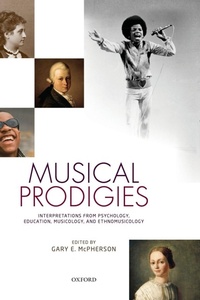
Musical Prodigies
Interpretations from Psychology, Education, Musicology, and Ethnomusicology
Published on 8. September 2016
Book
Hardback
832 pages
978-0-19-968585-1 (ISBN)
Description
Child prodigies have been observed in a range of disciplines - particularly music, mathematics, chess, and art. The question of what makes a prodigy has long been controversial. Some have dismissed the notion of giftedness, arguing that most famous prodigies had strong parental, cultural, and environmental influences that helped them develop their extraordinary abilities. One recent theory suggested that anyone could achieve outstanding success in whatever endeavour
they wanted with a minimum of 10,000 hours of practice. Nevertheless, many studies of prodigies have suggested that there might be strong underlying cognitive differences, regarding their use of short-term versus long-term memory, spatial memory, imagery, and language. Whatever the arguments - for
those interested in child development - prodigies remain a fascinating subject of study when considering questions about creativity, intelligence, development, and the impact of nature versus nurture.
This books breaks new ground in presenting the first scientific exploration on the topic of musical prodigies. It brings together research from a range of disciplines, including psychology, neurobiology, and genetics, to provide a thorough exploration of prodigious talent. In addition, the book includes fascinating case studies of prodigies and also looks at their long-term development into adulthood - many child prodigies have had problems making the transition into adolescence and adulthood.
Musical prodigies will be required reading for anyone interested in child development, music, and the arts
they wanted with a minimum of 10,000 hours of practice. Nevertheless, many studies of prodigies have suggested that there might be strong underlying cognitive differences, regarding their use of short-term versus long-term memory, spatial memory, imagery, and language. Whatever the arguments - for
those interested in child development - prodigies remain a fascinating subject of study when considering questions about creativity, intelligence, development, and the impact of nature versus nurture.
This books breaks new ground in presenting the first scientific exploration on the topic of musical prodigies. It brings together research from a range of disciplines, including psychology, neurobiology, and genetics, to provide a thorough exploration of prodigious talent. In addition, the book includes fascinating case studies of prodigies and also looks at their long-term development into adulthood - many child prodigies have had problems making the transition into adolescence and adulthood.
Musical prodigies will be required reading for anyone interested in child development, music, and the arts
More details
Other editions
Additional editions
Gary E. McPherson
Musical Prodigies
Interpretations from Psychology, Education, Musicology, and Ethnomusicology
E-Book
11/2016
1st Edition
OUP eBook
€66.49
Available for download
Gary E. McPherson
Musical Prodigies
Interpretations from Psychology, Education, Musicology, and Ethnomusicology
E-Book
08/2016
OUP eBook
€76.49
Available for download
Person
Gary E. McPherson studied music education at the Sydney Conservatorium of Music, before completing a master of music education at Indiana University, a doctorate of philosophy at the University of Sydney and a Licentiate and Fellowship in trumpet performance through Trinity College, London. He is the Ormond Professor and Director of the Melbourne Conservatorium of Music at the University of Melbourne, and previously held a position as the Marilyn Pflederer Zimmerman
endowed chair in music education at the University of Illinois at Urbana Champaign. He has served as National President of the Australian Society for Music Education and President of the International Society for Music Education. His research interests are broad and his approach interdisciplinary.
His most important research examines the acquisition and development of musical competence, and motivation to engage and participate in music from novice to expert levels.
endowed chair in music education at the University of Illinois at Urbana Champaign. He has served as National President of the Australian Society for Music Education and President of the International Society for Music Education. His research interests are broad and his approach interdisciplinary.
His most important research examines the acquisition and development of musical competence, and motivation to engage and participate in music from novice to expert levels.
Content
SECTION ONE: THEORETICAL FRAMEWORKS; SECTION TWO: ASPECTS OF DEVELOPMENT; SECTION THREE: INDIVIDUAL EXAMPLES