

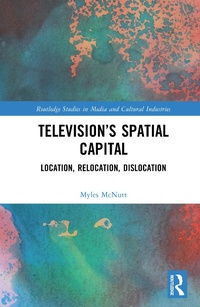
Television's Spatial Capital
Location, Relocation, Dislocation
1st Edition
Published on 30. December 2021
200 pages
978-1-000-51565-7 (ISBN)
Description

This book launches a comprehensive detailing of the dramatic expansion of the geography of television production into new cities, states, provinces, and countries, and how those responsible for shaping the "landscape" of television have been forced to adapt, taking established strategies for engaging with space and place through mediated representation and renegotiating them to account for the new map of television production.
Modeling media studies research that considers the intersection of production, textuality, distribution, and reception, Myles McNutt identifies how the expansion of where television is produced has intersected with the kinds of places represented on television, and how shifts in the production, distribution, and consumption of television content have shifted the burden of representing cities and countries both locally and internationally. Through a combination of industry interviews, textual analysis, and in-depth consideration of industry and audience discourse, the book argues that where television takes place matters more today than it ever has, but that the current system of spatial capital remains constrained by traditional industry logics that limit the depth of engagement with place identity even as the expectation of authenticity grows significantly.
Representing a cross section of media industry studies, television studies, and cultural geography, this book will appeal to scholars and students within multiple areas of media studies, including production studies and audience studies, in addition to television studies broadly.
Modeling media studies research that considers the intersection of production, textuality, distribution, and reception, Myles McNutt identifies how the expansion of where television is produced has intersected with the kinds of places represented on television, and how shifts in the production, distribution, and consumption of television content have shifted the burden of representing cities and countries both locally and internationally. Through a combination of industry interviews, textual analysis, and in-depth consideration of industry and audience discourse, the book argues that where television takes place matters more today than it ever has, but that the current system of spatial capital remains constrained by traditional industry logics that limit the depth of engagement with place identity even as the expectation of authenticity grows significantly.
Representing a cross section of media industry studies, television studies, and cultural geography, this book will appeal to scholars and students within multiple areas of media studies, including production studies and audience studies, in addition to television studies broadly.
More details
Series
Edition
1. Auflage
Language
English
Place of publication
London
United Kingdom
Publishing group
Taylor & Francis Ltd
Target group
College/higher education
Illustrations
16 Halftones, black and white; 16 Illustrations, black and white
ISBN-13
978-1-000-51565-7 (9781000515657)
Copyright in bibliographic data and cover images is held by Nielsen Book Services Limited or by the publishers or by their respective licensors: all rights reserved.
Schweitzer Classification
Other editions
Additional editions
Book
01/2024
1st Edition
Routledge
€63.00
Shipment within 15-20 days
Book
12/2021
1st Edition
Routledge
€206.10
Shipment within 15-20 days
Person
Myles McNutt is Associate Professor of Communication and Theatre Arts at Old Dominion University.
Content
Introduction 1. Spatial Capital in the Era of Mobile Production: Here, There, and Everywhere 2. The Textual Burden of Spatial Capital: Strategies for Dropping the Pin 3. Distributional Limits of Spatial Capital: Not There, But Anywhere 4. Discursive Hierarchies of Spatial Capital: "Like A Character in the Show" 5. Spatial Capital and Social Media: Amplifiers, Arbiters, and the Mountains of North Dakota 6. Conclusion - Location, Relocation, Dislocation
