

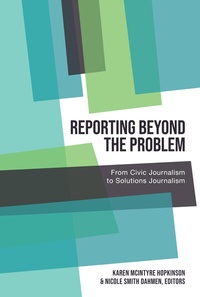
Reporting Beyond the Problem
Description

Americans say that reading, watching, or listening to the news is a leading cause of stress. Of course journalists, as watchdogs and public informants, must disseminate information that is inherently negative, but experts argue that the news media's emphasis on the problem has had a negative effect on the public, the press itself, and democracy. At the same time, the past sixty years have seen a rise of journalistic practices that purport to cover the news beyond the typical problem-based narrative. These genres of journalistic reporting are not positive news or fluff reporting: They are rigorous reporting philosophies and practices that share a common goal-reporting beyond the problem-based narrative, thereby exemplifying a commitment to the social responsibility theory of the press, which asserts that journalists have a duty to consider society's best interests. However, there is little academic or professional understanding of these journalistic approaches. As such, this book provides an in-depth examination of socially-responsible news reporting practices, such as constructive journalism, solutions journalism, and peace journalism. Each chapter focuses on one reporting form, defining it and detailing its evolution and status among scholars and practitioners, as well as discussing its known effects and future direction. This edited volume is the first academic book published on these forms of reporting in the United States. It provides a comprehensive resource that explores the theoretical underpinnings of these journalistic genres that grounds these approaches and allows for a coherent line of research to follow as these approaches evolve.
Reviews / Votes
"Reporting Beyond the Problem explores the key ways journalism can- and should- improve its relationship with the public. In doing so, the book offers an invaluable resource not only for those researching and teaching journalism, but for anyone working to make the profession better."- Jacob L. Nelson, Assistant Professor, Walter Cronkite School of Journalism & Mass Communication, Arizona State UniversityMore details
Other editions
Additional editions
Persons
Content
List of Tables - List of Figures - Acknowledgments - Sir Martyn Lewis: Foreword - Karen McIntyre Hopkinson/Nicole Smith Dahmen: Introduction: The Case for Productive and Socially Responsible Reporting - Jack Rosenberry: Civic Journalism: Current Journalism Innovations Can Trace Their Ancestry to Civic Journalism - Peter Bro/Cathrine Gyldensted: Constructive Journalism: Portraying the World Accurately through Positive Psychology Reporting - Kathryn Their: Solutions Journalism: Reporting on the Response Is Just as Newsworthy as Reporting on the Problem - John P. Wihbey: Explanatory Journalism: Bringing Greater Interpretation and Depth to Complex Issues - Mark Poepsel: Participatory Journalism: Looking on the Bright Side without Discounting the Dark Side - Andrew DeVigal/Sumita Louis: Engaged Journalism: Shifting Power Dynamics to Increase Public Participation - Steven Youngblood: Peace Journalism: Reporting Nonviolent Resolutions to Conflict - Peter Laufer/John V. Pavlik/Christopher St. Louis: Slow Journalism: Synthesizing Digital Journalism and Slow News - Karen McIntyre Hopkinson/Nicole Smith Dahmen: Moving Forward: Bringing Clarity to Productive and Socially Responsible Reporting - Contributors.
