

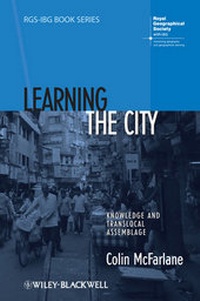
Learning the City
Knowledge and Translocal Assemblage
Published on 15. June 2011
232 pages
978-1-4443-4340-3 (ISBN)
Description

Learning the City: Translocal Assemblage and Urban Politicscritically examines the relationship between knowledge, learning,and urban politics, arguing both for the centrality of learning forpolitical strategies and developing a progressive internationalurbanism.
* Presents a distinct approach to conceptualising the citythrough the lens of urban learning
* Integrates fieldwork conducted in Mumbai's informal settlementswith debates on urban policy, political economy, anddevelopment
* Considers how knowledge and learning are conceived and createdin cities
* Addresses the way knowledge travels and opportunities forlearning about urbanism between North and South
Reviews / Votes
"Learning the City makes an exhaustive case for framingour studies of knowledge and power through the optic of thelearning assemblage. Its revelatory power is arguably profound forMcFarlane, it promises nothing short of understanding the power toforge a different kind of city." (Antipode, 1September 2013) "This book is a significant step in bringing learning tothe core of urban study... This volume's detailedfieldwork effectively supports its desire to see learning occupy acentral place in the production of more socially justurbanisms." (Area, 1 May 2013) "Learning the Cityis a critical academic contributionuseful for scholars of the field. found it particularlyuseful for my research on policy circulation of Bus Rapid Transitconcepts through the South African city . . . While Learning theCityis probably too sophisticated for younger readers, it is sureto become indispensable for academics of thediscipline." (Geography Helvitica, 1 December 2012)"Through Learning the City McFarlane has made a majorcontribution to our understandings of the urban. In its commitmentto the diverse and lively practices through which the city islearned and known, in its engagement with the diverse forms ofagency and political practices through which agency is assembledand re-assembled the book enlivens understandings of spatialpolitics. It is also a text that is animated by a powerful sense ofhope that cities might come to bere-assembled in different waysthat are more equitable and more open to different agentic forcesand contributions." (Society and Space, 1 November 2012) "There will certainly be a range of contributors that join in onthe exciting task of making these links. In Learning theCity, McFarlane successfully manages to open the black box ofurban learning in widening the perspective to acknowledge diverseurban learning practices, which may even bear a transformativepotential in certain contexts." (International PlanningStudies, 23 October 2012) "Urbanism, McFarlane believes, needs a theory of learning;throughout his book he builds a very sophisticated one...[he]brings us closer to the material stuff of urban life andpolitics...a kind of urbanism in motion, whereby what we cometo term 'knowledge', 'infrastructure' and'resources' are never simply 'there', butmust be translated, distributed, coordinated, perceived andinhabited". (International Journal of Urban and RegionalResearch, Volume 38.1, January 2014)."Innovative in its approach and rigorous in its coverage, this bookis an important contribution to the field of urban studies andhuman geography. It challenges the standard format of the researchmonograph and introduces new vectors of knowledge and debate to thestudy of cities. In a world where the usual North-South dichotomiesare being disturbed, McFarlane's emphasis on a postcolonialapproach to practices of learning is a valuable framework." --Ananya Roy, University of California "McFarlane's work stands out in that it tells us how residentsfrom various walks of life actually learn to operate inheterogeneous and often volatile urban environments. Insteadof assuming that urban dwellers walk around with preconceived mapsin their heads, this book provides a comprehensive account of thevarious practices, mobilizations and tools they use over time sothat the city becomes a staging area for new capacities andpotentials." --AbdouMaliq Simone, Goldsmith College, University ofLondonMore details
Other editions
Additional editions
Book
08/2011
Wiley
€41.00
Shipment within 3-4 weeks
Book
08/2011
Wiley
€87.00
Article not available at the moment
Colin McFarlane
Learning the City - Translocal Assemblages and Urban Politics
Software
07/2011
Wiley-Blackwell
€95.73
No shipping information available
Person
Colin McFarlane is Lecturer in Human Geography at Durham University, UK. His research focuses on urban geography, especially theorising the intersections between urban inequality, materiality, and knowledge.
Content
Series Editors' Preface ix
Acknowledgements x
Introduction 1
1 Learning Assemblages 15
Introduction 15
Translation: Distribution, Practice and Comparison 17
Coordinating Learning 19
Dwelling and Perception 21
Assemblage Space 23
Conclusion 30
2 Assembling the Everyday: Incremental Urbanism and TacticalLearning 32
Introduction 32
Incremental Urbanism 33
Learning the Unknown City: Street Children in Mumbai 43
Learning, Rhythm, Space 47
Tactical Learning 54
Conclusion 59
3 Learning Social Movements: Tactics, Urbanism and Politics62
Introduction 62
Knowing Social Movements 63
Global Slumming 66
The Housing Assemblage: Materializing Learning 69
Learning and Representation: Counting the Poor 74
Entrepreneurial Learning 85
Conclusion 90
4 Urban Learning Forums 92
Introduction 92
Uncertain Forums 93
Dialogic Urban Forums 98
Translocalism and Translation 105
Conclusion 113
5 Travelling Policies, Ideological Assemblages 115
Introduction 115
Translating Policy 117
Comparative Learning: Translation and Colonial Urbanism 122
Ideology and Postwar Urban Planning 128
Neoliberal Urban Learning Assemblages 134
Ideology and Explanation: Beyond Diffusionist Story-Making145
Conclusion 151
6 A Critical Geography of Urban Learning 153
Introduction 153
The Actual and the Possible 155
Agency and Critical Learning 160
Assemblage and the Critical Learning Imaginary 164
Postcolonial Urban Learning? 167
Conclusion 172
Conclusion 174
References 185
Index 205
