

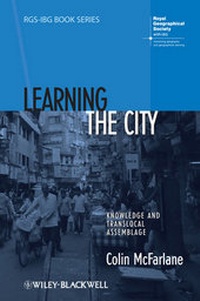
Learning the City
Knowledge and Translocal Assemblage
Published on 5. August 2011
Book
Paperback/Softback
230 pages
978-1-4051-9281-1 (ISBN)
Description
Learning the City: Translocal Assemblage and Urban Politics critically examines the relationship between knowledge, learning, and urban politics, arguing both for the centrality of learning for political strategies and developing a progressive international urbanism.
* Presents a distinct approach to conceptualising the city through the lens of urban learning
* Integrates fieldwork conducted in Mumbai's informal settlements with debates on urban policy, political economy, and development
* Considers how knowledge and learning are conceived and created in cities
* Addresses the way knowledge travels and opportunities for learning about urbanism between North and South
Reviews / Votes
"Readers who have ever puzzled over the movement of particular discourses or knowledge systems from one urban context to another, or between otherwise disparate groups, will find in this volume an exhaustive and compelling effort to theorize the development, movement, and effects of learning ... Its revelatory power is arguably profound: for McFarlane, it promises nothing short of understanding the power to forge a different kind of city. In the 21st century city, the material and analytical stakes of learning could not be higher." (Antipode, 1 September 2013)"This book is a significant step in bringing learning to the core of urban study ... This volume's detailed fieldwork effectively supports its desire to see learning occupy a central place in the production of more socially just urbanisms." (Area, 1 May 2013)
"Learning the City is a critical academic contribution useful for scholars of the field ... It is sure to become indispensable for academics of the discipline." (Geography Helvitica, 1 December 2012)
"Through Learning the City McFarlane has made a major contribution to our understandings of the urban. In its commitment to the diverse and lively practices through which the city is learned and known, in its engagement with the diverse forms of agency and political practices through which agency is assembled and re-assembled the book enlivens understandings of spatial politics. It is also a text that is animated by a powerful sense of hope that cities might come to bere-assembled in different ways that are more equitable and more open to different agentic forces and contributions." (Society and Space, 1 November 2012) "In Learning the City, McFarlane successfully manages to open the black box of urban learning in widening the perspective to acknowledge diverse urban learning practices, which may even bear a transformative potential in certain contexts." (International Planning Studies, 23 October 2012)
"Learning the City is an important and theoretically sophisticated piece of work. It is like a good movie: you need to re-view it in your mind several times to position yourself ... McFarlane's innovative theory of urban learning is very helpful to an understanding of contemporary urbanism and of how it can be changed for the better. Its great merit is to make us see cities as complex learning assemblages and milieus." (Urban Geography, 34.1)
"A wonderfully insightful book that rewards careful attention and deserves a wide readership ... A powerful framework for re-thinking issues of poverty, urban informality and development in the Global South." (Singapore Journal of Tropical Geography 34 (2013))
"A rich and perceptive account of how we dwell in and learn about cities and what it takes to live an urban life ... McFarlane's book forces us to review the conceptual tools we have in the planning field for "getting to know" what cities are like and how urban life is experienced." (Patsy Healey, Planning Theory & Practice, 14:2)
"Urbanism, McFarlane believes, needs a theory of learning; throughout his book he builds a very sophisticated one...[he] brings us closer to the material stuff of urban life and politics...a kind of urbanism in motion, whereby what we come to term 'knowledge', 'infrastructure' and 'resources' are never simply 'there', but must be translated, distributed, coordinated, perceived and inhabited". (International Journal of Urban and Regional Research, Volume 38.1, January 2014).
More details
Series
Edition
1. Auflage
Language
English
Place of publication
Hoboken
United Kingdom
Publishing group
John Wiley and Sons Ltd
Target group
Professional and scholarly
Product notice
Paperback (trade)
Unsewn / adhesive bound
Dimensions
Height: 229 mm
Width: 152 mm
Thickness: 13 mm
Weight
343 gr
ISBN-13
978-1-4051-9281-1 (9781405192811)
Schweitzer Classification
Other editions
Additional editions
E-Book
09/2011
Wiley-Blackwell
€25.99
Available for download
Book
08/2011
Wiley
€87.00
Article not available at the moment
E-Book
06/2011
Wiley-Blackwell
€25.99
Available for download
Person
Colin McFarlane is Lecturer in Human Geography at Durham University, UK. His research focuses on urban geography, especially theorising the intersections between urban inequality, materiality, and knowledge.
Content
Series Editors' Preface
Acknowledgements
Introduction
1. Learning Assemblages
2. Assembling the Everyday: Incremental Urbanism and Tactical Learning
3. Learning Social Movements: Tactics, Urbanism and Politics
4.Urban Learning Forums
5. Travelling Policies, Ideological Assemblages
6.A Critical Geography of Urban Learning
Conclusion
References
Index