

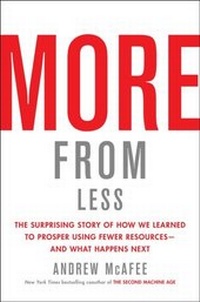
More from Less
The Surprising Story of How We Learned to Prosper Using Fewer Resources-and What Happens Next
1st Edition
Published on 8. October 2019
352 pages
978-1-9821-0359-0 (ISBN)
Description

From the coauthor of the New York Times bestseller The Second Machine Age, a paradigm-shifting argument "full of fascinating information and provocative insights" (Publishers Weekly, starred review)?demonstrating that we are increasing prosperity while using fewer natural resources.
Throughout history, the only way for humanity to grow was by degrading the Earth: chopping down forests, polluting the air and water, and endlessly using up resources. Since the first Earth Day in 1970, the focus has been on radically changing course: reducing our consumption, tightening our belts, and learning to share and reuse. Is that argument correct?
Absolutely not. In More from Less, McAfee argues that to solve our ecological problems we should do the opposite of what a decade of conventional wisdom suggests. Rather than reduce and conserve, we should rely on the cost-consciousness built into capitalism and the streamlining miracles of technology to create a more efficient world.
America?a large, high-tech country that accounts for about 25% of the global economy?is now generally using less of most resources year after year, even as its economy and population continue to grow. What's more, the US is polluting the air and water less, emitting fewer greenhouse gases, and replenishing endangered animal populations. And, as McAfee shows, America is not alone. Other countries are also transforming themselves in fundamental ways.
What has made this turnabout possible? One thing, primarily: the collaboration between technology and capitalism, although good governance and public awareness have also been critical. McAfee does warn of issues that haven't been solved, like global warming, overfishing, and communities left behind as capitalism and tech progress race forward. But overall, More from Less is a revelatory and "deeply engaging" (Booklist) account of how we've stumbled into an unexpectedly better balance with nature?one that holds out the promise of more abundant and greener centuries ahead.
Throughout history, the only way for humanity to grow was by degrading the Earth: chopping down forests, polluting the air and water, and endlessly using up resources. Since the first Earth Day in 1970, the focus has been on radically changing course: reducing our consumption, tightening our belts, and learning to share and reuse. Is that argument correct?
Absolutely not. In More from Less, McAfee argues that to solve our ecological problems we should do the opposite of what a decade of conventional wisdom suggests. Rather than reduce and conserve, we should rely on the cost-consciousness built into capitalism and the streamlining miracles of technology to create a more efficient world.
America?a large, high-tech country that accounts for about 25% of the global economy?is now generally using less of most resources year after year, even as its economy and population continue to grow. What's more, the US is polluting the air and water less, emitting fewer greenhouse gases, and replenishing endangered animal populations. And, as McAfee shows, America is not alone. Other countries are also transforming themselves in fundamental ways.
What has made this turnabout possible? One thing, primarily: the collaboration between technology and capitalism, although good governance and public awareness have also been critical. McAfee does warn of issues that haven't been solved, like global warming, overfishing, and communities left behind as capitalism and tech progress race forward. But overall, More from Less is a revelatory and "deeply engaging" (Booklist) account of how we've stumbled into an unexpectedly better balance with nature?one that holds out the promise of more abundant and greener centuries ahead.
More details
Other editions
Additional editions
Andrew McAfee
More from Less
The Surprising Story of How We Learned to Prosper Using Fewer Resources--And What Happens Next
Book
10/2020
Scribner Book Company
€18.50
Shipment within 10-20 days
Andrew McAfee
More from Less
The Surprising Story of How We Learned to Prosper Using Fewer Resources--And What Happens Next
Book
10/2019
Scribner Book Company
€26.50
Shipment within 10-20 days
Person
Andrew McAfee
Content
- Intro
- Title Page
- Dedication
- Epigraph
- Introduction: Readme
- Chapter 1: All the Malthusian Millennia
- Chapter 2: Power over the Earth: The Industrial Era
- Chapter 3: Industrial Errors
- Chapter 4: Earth Day and Its Debates
- Chapter 5: The Dematerialization Surprise
- Chapter 6: CRIB Notes
- Chapter 7: What Causes Dematerialization? Markets and Marvels
- Chapter 8: Adam Smith Said That: A Few Words about Capitalism
- Chapter 9: What Else Is Needed? People and Policies
- Chapter 10: The Global Gallop of the Four Horsemen
- Chapter 11: Getting So Much Better
- Chapter 12: Powers of Concentration
- Chapter 13 Stressed Be the Tie That Binds: Disconnection
- Chapter 14: Looking Ahead: The World Cleanses Itself This Way
- Chapter 15: Interventions: How to Be Good
- Conclusion: Our Next Planet
- Acknowledgments
- About the Author
- Notes
- Index
- Copyright
