

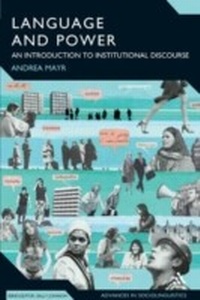
Language and Power
An Introduction to Institutional Discourse
1st Edition
Published on 21. August 2008
216 pages
978-0-8264-3817-1 (ISBN)
Description

How language is used in institutions and how institutions generate language is a key concern of both sociolinguistics and social theory. This readable and comprehensive introduction to language and power in institutions combines theoretical reflection with a strong analytical focus. Covering a range of institutional discourses and settings, each chapter in Language and Power closely examines institutional discourse practices and provides detailed steps to the critical analysis of institutional discourse both linguistic and multimodal.
This book is a long overdue contribution to the analysis of the way that institutions have the power to shape our thinking and understanding of the world and to construct identities.
Key Features:
*This book contains fascinating examples from a variety of institutional contexts, including academia, prison, media and the military
*It brings together insights from (multimodal) critical discourse analysis, social theory, media studies and corpus analysis
*It is essential reading for advanced undergraduates and postgraduates doing sociolinguistics, media studies, communication and cultural studies
This book is a long overdue contribution to the analysis of the way that institutions have the power to shape our thinking and understanding of the world and to construct identities.
Key Features:
*This book contains fascinating examples from a variety of institutional contexts, including academia, prison, media and the military
*It brings together insights from (multimodal) critical discourse analysis, social theory, media studies and corpus analysis
*It is essential reading for advanced undergraduates and postgraduates doing sociolinguistics, media studies, communication and cultural studies
Reviews / Votes
"Students of CDA with an interest in multimodal analysis will find this book specially useful. Its broad treatment of discourse to include all aspects of semiotic activity, from the use of photos in news stories to the visual design of war monuments, provides concrete case studies that help introduce key concepts in the study of language and power." "Language and Power offers an innovative and intriguing blend of socio-historical criticism and textual analysis. Applying critical discourse analysis to a range of discourse types the authors display its potential to the full with a series of thought-provoking and illuminating readings. All serious students of institutional discourse will want to engage with this book." Mention -Book News, February 2009 Briefly reviewed in the Year's work in English Studies journal, vol 89, No. 1 Language and Power is a collection of case studies investigating language and power in four institutional settings in "new capitalism": the university, the prison, the media and the military... The book achieves its aim of providing a "readable and comprehensive introduction to language and power in institutions"... It touches on novel institutional contexts, introduces a broad set of analytical tools and is sure to stimulate controversial discussions and interesting student research if used as seminar reading. * Journal of Language and Politics *More details
Series
Edition
1. Auflage
Language
English
Place of publication
New York
United States
ISBN-13
978-0-8264-3817-1 (9780826438171)
Copyright in bibliographic data and cover images is held by Nielsen Book Services Limited or by the publishers or by their respective licensors: all rights reserved.
Schweitzer Classification
Other editions
Additional editions
Book
08/2008
Continuum International Publishing Group Ltd.
€62.50
Shipment within 15-20 days

Book
08/2008
Continuum International Publishing Group Ltd.
€178.27
Article exhausted; check different version
Person
Andrea Mayr is Lecturer in the School of English at Queen's University, Belfast, Northern Ireland, UK.
Her books include Prison Discourse (Palgrave, 2004), Language
and Power (Continuum, 2008), and Language and
Power: A Resourcebook for Students (Routledge, 2010).
Her books include Prison Discourse (Palgrave, 2004), Language
and Power (Continuum, 2008), and Language and
Power: A Resourcebook for Students (Routledge, 2010).
Content
Notes on Contributors
1. Introduction: Power, discourse and institutions, Andrea Mayr
2. Discourses of higher education: Enterprise and
institutional change in the university, Andrea Mayr
3. Prison discourse: Enterprising managerialism
in a total institution, Andrea Mayr
4. News discourse I: Understanding the social
goings-on behind news texts, David Machin
5. News discourse II: Anti-racism and neo-liberalism
in the British Regional Press, David Machin and Andrea Mayr
6. Defence discourse I: The visual institutionalization
of discourses in war monuments, Gill Abousnnouga and David Machin
7. Defence discourse II: A corpus perspective
on routine and rhetoric in defence discourse, Tony Bastow
8. Conclusion: Researching institutional discourse, Andrea Mayr with Tony Bastow
Appendix
References
Index
1. Introduction: Power, discourse and institutions, Andrea Mayr
2. Discourses of higher education: Enterprise and
institutional change in the university, Andrea Mayr
3. Prison discourse: Enterprising managerialism
in a total institution, Andrea Mayr
4. News discourse I: Understanding the social
goings-on behind news texts, David Machin
5. News discourse II: Anti-racism and neo-liberalism
in the British Regional Press, David Machin and Andrea Mayr
6. Defence discourse I: The visual institutionalization
of discourses in war monuments, Gill Abousnnouga and David Machin
7. Defence discourse II: A corpus perspective
on routine and rhetoric in defence discourse, Tony Bastow
8. Conclusion: Researching institutional discourse, Andrea Mayr with Tony Bastow
Appendix
References
Index
