

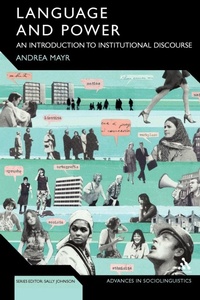
Language and Power
An Introduction to Institutional Discourse
Published on 21. August 2008
Book
Paperback/Softback
216 pages
978-0-8264-8744-5 (ISBN)
Description
How language is used in institutions and how institutions generate language is a key concern of both sociolinguistics and social theory. This readable and comprehensive introduction to language and power in institutions combines theoretical reflection with a strong analytical focus. Covering a range of institutional discourses and settings, each chapter in Language and Power closely examines institutional discourse practices and provides detailed steps to the critical analysis of institutional discourse both linguistic and multimodal. This book is a long overdue contribution to the analysis of the way that institutions have the power to shape our thinking and understanding of the world and to construct identities. Key Features: *This book contains fascinating examples from a variety of institutional contexts, including academia, prison, media and the military *It brings together insights from (multimodal) critical discourse analysis, social theory, media studies and corpus analysis *It is essential reading for advanced undergraduates and postgraduates doing sociolinguistics, media studies, communication and cultural studies.
Reviews / Votes
Students of CDA with an interest in multimodal analysis will find this book specially useful. Its broad treatment of discourse to include all aspects of semiotic activity, from the use of photos in news stories to the visual design of war monuments, provides concrete case studies that help introduce key concepts in the study of language and power. -- Adam Hodges, Department of Linguistics, University of Colorado, USA Language and Power offers an innovative and intriguing blend of socio-historical criticism and textual analysis. Applying critical discourse analysis to a range of discourse types the authors display its potential to the full with a series of thought-provoking and illuminating readings. All serious students of institutional discourse will want to engage with this book. -- Dr Martin Montgomery, Department of English Studies, University of Strathclyde, UK Mention -Book News, February 2009 Briefly reviewed in the Year's work in English Studies journal, vol 89, No. 1 Language and Power is a collection of case studies investigating language and power in four institutional settings in "new capitalism": the university, the prison, the media and the military... The book achieves its aim of providing a "readable and comprehensive introduction to language and power in institutions"... It touches on novel institutional contexts, introduces a broad set of analytical tools and is sure to stimulate controversial discussions and interesting student research if used as seminar reading. -- Felicitas Macgilchrist, Georg Eckert Institute for International Textbook Research * Journal of Language and Politics *More details
Series
Language
English
Place of publication
London
United Kingdom
Publishing group
Bloomsbury Publishing PLC
Target group
College/higher education
Dimensions
Height: 234 mm
Width: 156 mm
Thickness: 12 mm
Weight
330 gr
ISBN-13
978-0-8264-8744-5 (9780826487445)
Copyright in bibliographic data and cover images is held by Nielsen Book Services Limited or by the publishers or by their respective licensors: all rights reserved.
Schweitzer Classification
Other editions
Additional editions
E-Book
08/2008
1st Edition
Continuum Publishing Corporation
€47.49
Available for download
E-Book
08/2008
1st Edition
Bloomsbury Continuum
€47.49
Available for download
Person
Dr Andrea Mayr is Lecturer in the School of English at Queen's University, Belfast.
Content
1. Introduction; 2. Institutional Discourse / Approaches to the analysis of institutional discourse; 3. University Discourse; 4. Prison Discourse; 5. News as Institutional Discourse: Commercialization in the Press; 6. Multiculturalism in the Regional Press through the Language of Capitalism; 7. War memorials; 8. Defense Speeches; 9. How to Analyse Institutional Discourse.