

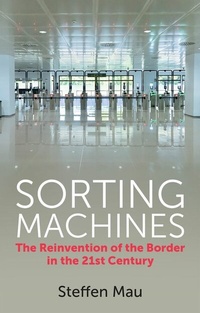
Sorting Machines
Description

It is commonly thought that, thanks to globalization, nation-state borders are becoming increasingly porous. Steffen Mau shows that this view is misleading: borders are not getting more permeable today, but rather are being turned into powerful sorting machines. Supported by digitalization, they have been upgraded to smart borders, and border control has expanded spatially on a massive scale. Mau shows how the new sorting machines create mobility and immobility at the same time: for some travellers, borders open readily, but for others they are closed more firmly than ever. While a small circle of privileged people can travel almost anywhere today, the vast majority of the world's population continues to be systematically excluded. Nowhere is the Janus nature of globalization more evident than at the borders of the 21st century.
More details
Other editions
Additional editions
Persons
Content
1. Borders are back!
2. Statehood, territoriality and border control
3. Opening and Closing: The Dialectic of Globalization
4. Fortification: Border walls as bulwarks of globalization
5. Filtering borders: Granting unequal opportunities for mobility
6. Smart borders: Informational and biometric control
7. Macroterritories: Dismantling internal borders, upgrading external borders
8. Extraterritorializing control: The expansion of the border zone
9. Globalized borders
Notes
