

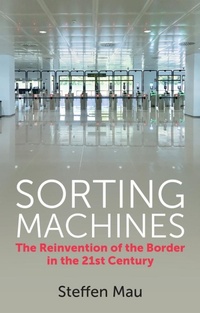
Sorting Machines: The Reinvention of the Border in the 21st Century
The Reinvention of the Border in the 21st Century
1st Edition
Published on 13. October 2022
Book
Paperback/Softback
174 pages
978-1-5095-5435-5 (ISBN)
Description
It is commonly thought that, thanks to globalization, nation-state borders are becoming increasingly porous. Steffen Mau shows that this view is misleading: borders are not getting more permeable in the era of globalization, but rather are being turned into powerful sorting machines. Today they fulfil their separation function better and more effectively than ever.
While the cross-border movement of people has steadily increased in recent decades, a counter-development has taken place at the same time: in many places, new deterrent walls and militarized border crossings are being created. Borders have also become increasingly selective. Supported by digitalization, they have been upgraded to smart borders, and border control has expanded spatially on a massive scale, even becoming a global enterprise that is detached from territory. Steffen Mau shows how the new sorting machines create mobility and immobility at the same time: for some travellers, borders open like department-store doors, but for others they remain closed more firmly than ever. While a small circle of privileged people are allowed to travel almost everywhere today, the vast majority of the world's population continues to be systematically excluded. Nowhere is the Janus face of globalization more evident than at the borders of the 21st century.
While the cross-border movement of people has steadily increased in recent decades, a counter-development has taken place at the same time: in many places, new deterrent walls and militarized border crossings are being created. Borders have also become increasingly selective. Supported by digitalization, they have been upgraded to smart borders, and border control has expanded spatially on a massive scale, even becoming a global enterprise that is detached from territory. Steffen Mau shows how the new sorting machines create mobility and immobility at the same time: for some travellers, borders open like department-store doors, but for others they remain closed more firmly than ever. While a small circle of privileged people are allowed to travel almost everywhere today, the vast majority of the world's population continues to be systematically excluded. Nowhere is the Janus face of globalization more evident than at the borders of the 21st century.
More details
Language
English
Place of publication
Oxford
United Kingdom
Target group
Professional and scholarly
Dimensions
Height: 213 mm
Width: 135 mm
Thickness: 16 mm
Weight
262 gr
ISBN-13
978-1-5095-5435-5 (9781509554355)
Copyright in bibliographic data and cover images is held by Nielsen Book Services Limited or by the publishers or by their respective licensors: all rights reserved.
Schweitzer Classification
Other editions
Additional editions
E-Book
01/2023
1st Edition
Wiley
€16.99
Available for download
S Mau
Sorting Machines: The Reinvention of the Border in the 21st Century
The Reinvention of the Border in the 21st Century
Book
10/2022
1st Edition
Polity Press
€60.50
Shipment within 15-20 days
E-Book
10/2022
1st Edition
Wiley
€16.99
Available for download
Person
Steffen Mau is Professor of Macrosociology at the Humboldt University of Berlin
Content
Acknowledgements
1. Borders are back!
2. Statehood, territoriality and border control
3. Opening and Closing: The Dialectic of Globalization
4. Fortification: Border walls as bulwarks of globalization
5. Filtering borders: Granting unequal opportunities for mobility
6. Smart borders: Informational and biometric control
7. Macroterritories: Dismantling internal borders, upgrading external borders
8. Extraterritorializing control: The expansion of the border zone
9. Globalized borders
Notes
1. Borders are back!
2. Statehood, territoriality and border control
3. Opening and Closing: The Dialectic of Globalization
4. Fortification: Border walls as bulwarks of globalization
5. Filtering borders: Granting unequal opportunities for mobility
6. Smart borders: Informational and biometric control
7. Macroterritories: Dismantling internal borders, upgrading external borders
8. Extraterritorializing control: The expansion of the border zone
9. Globalized borders
Notes