

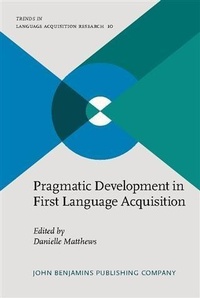
Pragmatic Development in First Language Acquisition
1st Edition
Published on 26. June 2014
VI, 394 pages
978-90-272-7044-3 (ISBN)
Description

Pragmatic development is increasingly seen as the foundation stone of language acquisition more generally. From very early on, children demonstrate a strong desire to understand and be understood that motivates the acquisition of lexicon and grammar and enables ever more effective communication. In the 35 years since the first edited volume on the topic, a flourishing literature has reported on the broad set of skills that can be called pragmatic. This volume aims to bring that literature together in a digestible format. It provides a series of succinct review chapters on 19 key topics ranging from preverbal skills right up to irony and argumentative discourse. Each chapter equips the reader with an overview of current theories, key empirical findings and questions for new research. This valuable resource will be of interest to scholars of psychology, linguistics, speech therapy, and cognitive science.
More details
Other editions
Additional editions
Danielle Matthews
Pragmatic Development in First Language Acquisition
Book
06/2014
John Benjamins Publishing Co
€111.30
Shipment within 10-15 days
Person
Content
- Pragmatic Development in First Language Acquisition
- Editorial page
- Title page
- LCC data
- Table of contents
- Introduction: An overview of research on pragmatic development
- Pragmatic foundations
- Moving to the conventional
- A focus on reference
- Non-literal language use
- Organising and marking information
- Perspectives on pragmatic development
- Discussion
- Directions for future research
- References
- The communicative infant from 0-18 months: The social-cognitive foundations of pragmatic development
- Introduction
- Birth to nine months: Dancing the tango with a hat stand?
- The caregiver's contribution: Scaffolding in dyadic communication
- The infant's contribution: Early behaviours and preferences
- Imitative behaviour
- A preference for affect
- A preference for contingency
- A preference for eye contact
- The nine month revolution?
- Joint Attention
- Responding to Joint Attention: Gaze following
- Initiating Joint Attention: Pointing and vocalizing
- Understanding intentions
- Future directions
- References
- The development of speech acts
- 1. Introduction
- 2. The origins of Speech Act Theory
- 3. The emergence of speech act repertoires
- 3.1 Speech acts and the transition from the pre-linguistic to linguistic stage
- 3.2 Longitudinal analysis of speech act emergence
- 3.3 Later emerging speech acts and associated features
- 4. The relationship between form and function
- 4.1 Direct and indirect speech acts
- 4.2 The interaction between form and function in early child speech
- 5. Future research
- 6. Conclusion
- References
- Turn-taking
- Introduction
- Conversation with children
- Contingency
- Asking and answering questions
- Question and answer types
- Repairs
- Timely turn-taking
- Summary
- References
- Conversation Analysis and pragmatic development
- Introduction
- The essence of CA: Turn-taking and sequence organisation
- Method, data and analytic approach
- Analysis and discussion
- General discussion
- References
- Appendix
- Ontogenetic constraints on Grice's Theory of Communication
- 1. What is a theory of communication?
- 1.1 What is a communicative intention?
- 2. Grice's Theory of Communication and pragmatic development
- 3. Representing communicative intentions
- 3.1 The problem of higher-order thoughts
- 3.2 The problem of belief
- 3.3 The problem of inferring goals
- 4. Potential solutions to the problem of grasping communicative intent
- 4.1 Modular approaches to communication: Relevance and Pedagogy
- 4.1.1 Relevance Theory
- 4.1.2 Pedagogy
- 4.2 Non-modular approaches to the cognition of communicative intent
- 4.3 Expressive Communication
- 5. The anti-cognitivist complaint
- References
- Two pragmatic principles in language use and acquisition
- Pragmatic principles
- Convention, contrast, and children
- Playing the original word game
- Conclusion
- References
- Learning conventions and conventionality through conversation
- What is meant by conventionality?
- Research on children's understanding of conventional labels, object uses, and behavioral rules
- Cues to conventionality in parents' speech to children
- Suggestions for future research
- References
- The pragmatics of word learning
- 1. Introduction
- 2. Theories of word learning
- 3. Pragmatic information children use in word learning
- The speaker's gaze and joint attention
- Pointing gestures
- Iconic gestures
- Action, emotion, and intonation
- Context, common ground, and information structure
- Contrast and conventionality
- The speaker's verbal behavior: Sentence frame, discourse topic, and the speaker's reliability
- The speaker's knowledge state: Reliability, ignorance and false beliefs
- 4. Current debates and future research
- How to weight associative learning versus pragmatic information in word learning?
- What are children learning when learning a word?
- References
- The production and comprehension of referring expressions
- 1. The problem of referential choice: Theoretical background
- 1.1 Linguistic frameworks
- 1.2 Psychological/psycholinguistic frameworks
- 2. Comprehending referring expressions
- 2.1 Anaphoric pronouns
- 2.2 Definiteness
- 2.3 Complex noun phrases
- 2.4 Implicit versus explicit comprehension
- 3. Producing referring expressions
- 3.1 Producing versus omitting referring expressions in the first two years of life
- 3.2 How pre-schoolers take their interlocutors perspective: Methodological challenges
- 3.3 The referential communication paradigm
- 4. The development of reference in autism
- 5. Developmental trajectory of the development of referring expressions
- 6. Conclusions and future directions
- References
- Scalar implicature
- 1. Scalar implicature and development
- 2. Accounts of the development of scalar implicature
- 2.1 Processing accounts
- 2.2 Lexicalist accounts
- 2.3 Contrast accounts
- 3. Binary judgment tasks and pragmatic tolerance
- 3.1 Binary judgments in question format
- 4. Overview and outlook
- References
- Children's pragmatic use of prosodic prominence
- Introduction
- Prosodic prominence: Children's production
- Prosodic prominence: Children's comprehension
- Future research directions
- References
- The pragmatic development of humor
- Humor and pragmatics
- Humor theories
- Humor appreciation
- Humor production
- Origins of humor
- Autism and Asperger syndrome
- Future directions
- Acknowledgments
- References
- "The elevator's buttocks": Metaphorical abilities in children
- 1. Introduction
- What is metaphor?
- Adult understanding and processing of metaphor
- The development of metaphor
- 2. A first review of the evidence
- Early metaphor production
- Early metaphor comprehension
- 3. Impeding factors
- Context
- Conceptual knowledge
- Mixing tropes
- Task complexity
- 4. A new look at early metaphorical abilities
- Recipe for early metaphor understanding
- Early metaphor production revisited
- 5. Conclusion
- References
- Irony production and understanding
- Discourse irony
- Definition challenge
- Research traditions and methodological challenges
- Situational irony
- Children's production
- Children's comprehension
- Conclusions and further directions
- Acknowledgments
- References
- Narrative development across cultural contexts: Finding the pragmatic in parent-child reminiscing
- Narrative practices in white, middle-class, Anglo families
- Narrative practices in Latino families
- The pragmatics of narrative development across cultural contexts: Some final remarks
- References
- Children's understanding of linguistic expressions of certainty and evidentiality
- 1. Introduction
- 2. Cross-linguistic variations in children's production and comprehension of epistemic and evidential markers
- 2.1 Naturalistic data
- 2.2 Experimental data
- 3. Language-cognition interface
- 3.1 Information/speaker reliability
- 3.2 Source monitoring and suggestibility
- 4. Suggestions for future research
- 4.1 We need denser and longer longitudinal data
- 4.2 Older children are also needed for experiments
- 5. Final remarks
- References
- Crosslinguistic and crosscultural approaches to pragmatic development
- Nonverbal interaction
- Development of referential communication
- Politeness and speech acts
- Extended discourse
- Language socialization
- Conclusion
- References
- Atypical pragmatic development
- 1. Introduction
- 2. A note on terminology
- 3. Assessment of pragmatic language and social communication skills
- 3.1 Parent / teacher report of children's communication
- 3.2 Conversational analysis
- 3.3 Structured assessment of pragmatic language
- 4. PLI and SCD in autism spectrum disorder
- 4.1 Social-cognitive deficit
- 4.2 Weak central coherence
- 4.3 Executive dysfunction
- 5. Pragmatic language impairments in other neurodevelopmental disorders
- 6. Is social-communication disorder a valid diagnostic category?
- 7. Conclusions and future directions for research
- References
- Assessing pragmatic language functioning in young children: Its importance and challenges
- 1. The growing importance of assessing pragmatics
- 1.1 Findings revealing the existence of pragmatic language difficulties among many, varied clinical groups
- 1.2 Shift away from rule-based conceptions of pragmatics and greater emphasis on understanding the types of knowledge underlying pragmatic competence
- 1.3 Prominence of functionalist and usage-based approaches to language acquisition and competence
- 1.4 Increased attention to children's developing theory of mind within the field of speech-language pathology
- 1.5 Increased focus on issues of school readiness and social-emotional competence
- 1.6 The World Health Organization's International Classification of Functioning, Disability and Health - Children and Youth (ICY-CY)
- 1.7 Distinct long-term outcomes of pragmatic language impairment
- 2. Challenges related to the development of pragmatic measures and the assessment of pragmatics
- 2.1 Differing definitions and approaches to pragmatics
- 2.2 Limited ecological validity of structured tests
- 2.3 Beyond appropriate as an outcome measure
- 2.4 Aspects of pragmatics and cross-cultural variation
- 2.5 There remains much to learn about many pragmatic competencies in children
- 2.6 Establishing concurrent validity
- Conclusion
- References
- Developmental pragmatics: Interdisciplinary perspectives on complex learning in everyday practice
- Has the field made progress?
- Next steps
- Closing comments
- References
- Index
