

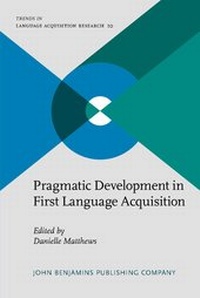
Pragmatic Development in First Language Acquisition
Published on 26. June 2014
Book
Hardback
394 pages
978-90-272-3480-3 (ISBN)
Description
Pragmatic development is increasingly seen as the foundation stone of language acquisition more generally. From very early on, children demonstrate a strong desire to understand and be understood that motivates the acquisition of lexicon and grammar and enables ever more effective communication. In the 35 years since the first edited volume on the topic, a flourishing literature has reported on the broad set of skills that can be called pragmatic. This volume aims to bring that literature together in a digestible format. It provides a series of succinct review chapters on 19 key topics ranging from preverbal skills right up to irony and argumentative discourse. Each chapter equips the reader with an overview of current theories, key empirical findings and questions for new research. This valuable resource will be of interest to scholars of psychology, linguistics, speech therapy, and cognitive science.
Reviews / Votes
An excellent collection of up-to-date papers on pragmatic competence as the root of language acquisition - and as its fullest flowering as well. -- Michael Tomasello, Max Planck Institute for Evolutionary AnthropologyMore details
Series
Language
English
Place of publication
Amsterdam
Netherlands
Target group
Professional and scholarly
Illustrations
+ index
Dimensions
Height: 245 mm
Width: 164 mm
Weight
840 gr
ISBN-13
978-90-272-3480-3 (9789027234803)
Copyright in bibliographic data and cover images is held by Nielsen Book Services Limited or by the publishers or by their respective licensors: all rights reserved.
Schweitzer Classification
Other editions
Additional editions
Danielle Matthews
Pragmatic Development in First Language Acquisition
E-Book
06/2014
1st Edition
John Benjamins Publishing Company
€130.99
Available for download
Person
Content
1. Introduction: An overview of research on pragmatic development (by Matthews, Danielle); 2. The communicative infant from 0-18 months: The social-cognitive foundations of pragmatic development (by Stephens, Gemma); 3. The development of speech acts (by Cameron-Faulkner, Thea); 4. Turn-taking (by Casillas, Marisa); 5. Conversation Analysis and pragmatic development (by Filipi, Anna); 6. Ontogenetic Constraints on Grice's Theory of Communication (by Moore, Richard); 7. Two Pragmatic Principles in Language Use and Acquisition (by Clark, Eve V.); 8. Learning conventions and conventionality through conversation (by Callanan, Maureen A.); 9. The pragmatics of word learning (by Grassmann, Susanne); 10. The production and comprehension of referring expressions (by Graf, Eileen); 11. Scalar Implicature (by Katsos, Napoleon); 12. Children's pragmatic use of prosodic prominence (by Ito, Kiwako); 13. The Pragmatic Development of Humor (by Hoicka, Elena); 14. "The elevator's buttocks": Metaphorical abilities in children (by Pouscoulous, Nausicaa); 15. Irony production and comprehension (by Filippova, Eva); 16. Narrative Development across Cultural Contexts: Finding the Pragmatic in Parent-Child Reminiscing (by Carmiol, Ana M.); 17. Children's understanding of linguistic expressions of certainty and evidentiality (by Matsui, Tomoko); 18. Crosslinguistic and crosscultural approaches to pragmatic development (by Kuntay, Aylin C.); 19. Atypical pragmatic development (by Norbury, Courtenay Frazier); 20. Assessing pragmatic language functioning in young children: Its importance and challenges (by O'Neill, Daniela K.); 21. Developmental pragmatics: Interdisciplinary perspectives on complex learning in everyday practice (by Budwig, Nancy); 22. Index