

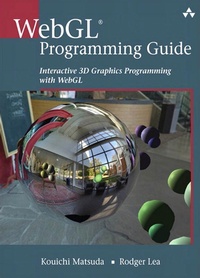
WebGL Programming Guide
Interactive 3D Graphics Programming with WebGL
1st Edition
Published on 4. July 2013
552 pages
978-0-13-336492-7 (ISBN)
Description

Using WebGL (R), you can create sophisticated interactive 3D graphics inside web browsers, without plug-ins. WebGL makes it possible to build a new generation of 3D web games, user interfaces, and information visualization solutions that will run on any standard web browser, and on PCs, smartphones, tablets, game consoles, or other devices. WebGL Programming Guide will help you get started quickly with interactive WebGL 3D programming, even if you have no prior knowledge of HTML5, JavaScript, 3D graphics, mathematics, or OpenGL.
You'll learn step-by-step, through realistic examples, building your skills as you move from simple to complex solutions for building visually appealing web pages and 3D applications with WebGL. Media, 3D graphics, and WebGL pioneers Dr. Kouichi Matsuda and Dr. Rodger Lea offer easy-to-understand tutorials on key aspects of WebGL, plus 100 downloadable sample programs, each demonstrating a specific WebGL topic.
You'll move from basic techniques such as rendering, animating, and texturing triangles, all the way to advanced techniques such as fogging, shadowing, shader switching, and displaying 3D models generated by Blender or other authoring tools. This book won't just teach you WebGL best practices, it will give you a library of code to jumpstart your own projects.
Coverage includes:
* WebGL's origin, core concepts, features, advantages, and integration with other web standards
* How and basic WebGL functions work together to deliver 3D graphics
* Shader development with OpenGL ES Shading Language (GLSL ES)
* 3D scene drawing: representing user views, controlling space volume, clipping, object creation, and perspective
* Achieving greater realism through lighting and hierarchical objects
* Advanced techniques: object manipulation, heads-up displays, alpha blending, shader switching, and more
* Valuable reference appendixes covering key issues ranging from coordinate systems to matrices and shader loading to web browser settings
This is the newest text in the OpenGL Technical Library, Addison-Wesley's definitive collection of programming guides an reference manuals for OpenGL and its related technologies. The Library enables programmers to gain a practical understanding of OpenGL and the other Khronos application-programming libraries including OpenGL ES and OpenCL. All of the technologies in the OpenGL Technical Library evolve under the auspices of the Khronos Group, the industry consortium guiding the evolution of modern, open-standards media APIs.
You'll learn step-by-step, through realistic examples, building your skills as you move from simple to complex solutions for building visually appealing web pages and 3D applications with WebGL. Media, 3D graphics, and WebGL pioneers Dr. Kouichi Matsuda and Dr. Rodger Lea offer easy-to-understand tutorials on key aspects of WebGL, plus 100 downloadable sample programs, each demonstrating a specific WebGL topic.
You'll move from basic techniques such as rendering, animating, and texturing triangles, all the way to advanced techniques such as fogging, shadowing, shader switching, and displaying 3D models generated by Blender or other authoring tools. This book won't just teach you WebGL best practices, it will give you a library of code to jumpstart your own projects.
Coverage includes:
* WebGL's origin, core concepts, features, advantages, and integration with other web standards
* How and basic WebGL functions work together to deliver 3D graphics
* Shader development with OpenGL ES Shading Language (GLSL ES)
* 3D scene drawing: representing user views, controlling space volume, clipping, object creation, and perspective
* Achieving greater realism through lighting and hierarchical objects
* Advanced techniques: object manipulation, heads-up displays, alpha blending, shader switching, and more
* Valuable reference appendixes covering key issues ranging from coordinate systems to matrices and shader loading to web browser settings
This is the newest text in the OpenGL Technical Library, Addison-Wesley's definitive collection of programming guides an reference manuals for OpenGL and its related technologies. The Library enables programmers to gain a practical understanding of OpenGL and the other Khronos application-programming libraries including OpenGL ES and OpenCL. All of the technologies in the OpenGL Technical Library evolve under the auspices of the Khronos Group, the industry consortium guiding the evolution of modern, open-standards media APIs.
More details
Series
Edition
1. Auflage
Language
English
Place of publication
Boston
United States
Publishing group
Pearson Education (US)
Target group
College/higher education
File size
48,39 MB
ISBN-13
978-0-13-336492-7 (9780133364927)
Copyright in bibliographic data and cover images is held by Nielsen Book Services Limited or by the publishers or by their respective licensors: all rights reserved.
Schweitzer Classification
Other editions
Additional editions
Book
07/2013
Addison Wesley
€45.79
Shipment within 10-20 days
Persons
Dr. Kouichi Matsuda has a broad background in user interface and user experience design and its application to novel multimedia products. His work has taken him from product development, through research, and back to development, having spent time at NEC, Sony Corporate Research, and Sony Computer Science Laboratories. He is currently a chief distinguished researcher focused on user experience and human computer interaction across a range of consumer electronics. He was the designer of the social 3D virtual world called "PAW" (personal agent-oriented virtual world), was involved in the development of the VRML97 (ISO/IEC 14772-1:1997) standard from the start, and has remained active in both VRML and X3D communities (precursors to WebGL). He has written 15 books on computer technologies and translated a further 25 into Japanese. His expertise covers user experiences, user interface, human computer interaction, natural language understanding, entertainment-oriented network services, and interface agent systems. Always on the lookout for new and exciting possibilities in the technology space, he combines his professional life with a love of hot springs, sea in summer, wines, and MANGA (at which he dabbles in drawing and illustrations). He received his Ph.D. (Engineering) from the Graduate School of Engineering, University of Tokyo.
Dr. Rodger Lea is an adjunct professor with the Media and Graphics Interdisciplinary Centre at the University of British Columbia, with an interest in systems aspects of multimedia and distributed computing. With more than 20 years of experience leading research groups in both academic and industrial settings, he has worked on early versions of shared 3D worlds, helped define VRML97, developed multimedia operating systems, prototyped interactive digital TV, and led developments on multimedia home networking standards. He has published more than 60 research papers and three books, and he holds 12 patents. His current research explores the growing "Internet of Things," but he retains a passion for all things media and graphics.
Dr. Rodger Lea is an adjunct professor with the Media and Graphics Interdisciplinary Centre at the University of British Columbia, with an interest in systems aspects of multimedia and distributed computing. With more than 20 years of experience leading research groups in both academic and industrial settings, he has worked on early versions of shared 3D worlds, helped define VRML97, developed multimedia operating systems, prototyped interactive digital TV, and led developments on multimedia home networking standards. He has published more than 60 research papers and three books, and he holds 12 patents. His current research explores the growing "Internet of Things," but he retains a passion for all things media and graphics.
Content
1. Overview of WebGL
2. Your First Step with WebGL
3. Drawing and Transforming Triangles
4. More Transformations and Basic Animation
5. Using Colors and Texture Images
6. The OpenGL ES Shading Language (GLSL ES)
7. Toward the 3D World
8. Lighting Objects
9. Hierarchical Objects
10. Advanced Techniques
A. No Need to Swap Buffers in WebGL
B. Built-in Functions of GLSL ES 1.0
C. Projection Matrices
D. WebGL/OpenGL: Left or Right Handed?
E. The Inverse Transpose Matrix
F. Load Shader Programs from Files
G. World Coordinate System Versus Local Coordinate System
H. Web Browser Settings for WebGL
Glossary
References
Index
2. Your First Step with WebGL
3. Drawing and Transforming Triangles
4. More Transformations and Basic Animation
5. Using Colors and Texture Images
6. The OpenGL ES Shading Language (GLSL ES)
7. Toward the 3D World
8. Lighting Objects
9. Hierarchical Objects
10. Advanced Techniques
A. No Need to Swap Buffers in WebGL
B. Built-in Functions of GLSL ES 1.0
C. Projection Matrices
D. WebGL/OpenGL: Left or Right Handed?
E. The Inverse Transpose Matrix
F. Load Shader Programs from Files
G. World Coordinate System Versus Local Coordinate System
H. Web Browser Settings for WebGL
Glossary
References
Index
