

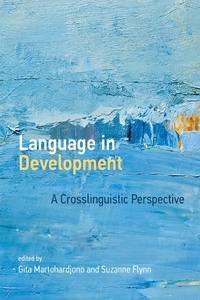
Language in Development
A Crosslinguistic Perspective
Published on 17. August 2021
346 pages
978-0-262-36197-2 (ISBN)
Description

Explorations of language development in different types of learner populations and across various languages.
This volume examines language development in different types of learner populations and across various languages. The contributors analyze experimental studies of child and adult language acquisition, heritage language development, bilingualism, and language disorders. They consider theoretical and methodological issues; language development in children, discussing topics that range from gestures to errors in person and number agreement; and development and attrition of (morpho)syntactic constructions in second language learners, bilinguals, and Alzheimer's patients.
The approach is "crosslinguistic" in three senses of the word: the contributors offer analyses of acquisition phenomena in different languages; they consider "crosslinguistic influence," or the potential effects of multiple languages on one another in the mind of the same speaker; and (in a novel use of the term, proposed by the editors), the chapters bring together theoretical and methodological approaches pertinent to the linguistics of language development in children, adults, and heritage speakers.
This volume examines language development in different types of learner populations and across various languages. The contributors analyze experimental studies of child and adult language acquisition, heritage language development, bilingualism, and language disorders. They consider theoretical and methodological issues; language development in children, discussing topics that range from gestures to errors in person and number agreement; and development and attrition of (morpho)syntactic constructions in second language learners, bilinguals, and Alzheimer's patients.
The approach is "crosslinguistic" in three senses of the word: the contributors offer analyses of acquisition phenomena in different languages; they consider "crosslinguistic influence," or the potential effects of multiple languages on one another in the mind of the same speaker; and (in a novel use of the term, proposed by the editors), the chapters bring together theoretical and methodological approaches pertinent to the linguistics of language development in children, adults, and heritage speakers.
More details
Other editions
Additional editions
Book
08/2021
MIT Press
€112.60
Article exhausted; check different version
Persons
Gita Martohardjono is Associate Professor of Linguistics at Queens College and the Graduate Center of the City University of New York. Suzanne Flynn is Professor of Linguistics in the Department of Linguistics and Philosophy at MIT.
Content
Preface
I Theoretical and Methodological Considerations
1 Five Questions about Language Learning
2 Coordinate Compounds in Theory and Practice
3 Hard Words
4 Elicited Imitation in First Language Acquisition Research: Cognitive Grounding and Crosslinguistic Application
II Children
5 The Development of Person and Number Agreement in Child Heritage Speakers of Spanish Learning English as a Second Language
6 The Role of Gestures in First and Second Language Acquisition: A Case Study of a Hebrew-English Bilingual Child
7 Discourse-Morphosyntax Interaction in the Acquisition of Spanish Finite and Nonfinite Verbs
8 A Hybrid Approach to Infant-Directed Speech
9 Discontinuous Dependent Morphemes in German and English Parental Speech: Input Differences between Two Languages
III Adults
10 Syntactic Ambiguity Resolution in Native and Nonnative Speakers of Chinese
11 The Tense Puzzle in Second Language Acquisition
12 Bilingual Processing of the First-Learned Language: Are Heritage Speakers and Late Bilinguals Really that Different?
13 Identifying Early Language Changes in Alzheimer's Disease: Extrapolating Lessons Learned from Methodologies Used in Investigating First Language Acquisition
Contributors
Index
I Theoretical and Methodological Considerations
1 Five Questions about Language Learning
2 Coordinate Compounds in Theory and Practice
3 Hard Words
4 Elicited Imitation in First Language Acquisition Research: Cognitive Grounding and Crosslinguistic Application
II Children
5 The Development of Person and Number Agreement in Child Heritage Speakers of Spanish Learning English as a Second Language
6 The Role of Gestures in First and Second Language Acquisition: A Case Study of a Hebrew-English Bilingual Child
7 Discourse-Morphosyntax Interaction in the Acquisition of Spanish Finite and Nonfinite Verbs
8 A Hybrid Approach to Infant-Directed Speech
9 Discontinuous Dependent Morphemes in German and English Parental Speech: Input Differences between Two Languages
III Adults
10 Syntactic Ambiguity Resolution in Native and Nonnative Speakers of Chinese
11 The Tense Puzzle in Second Language Acquisition
12 Bilingual Processing of the First-Learned Language: Are Heritage Speakers and Late Bilinguals Really that Different?
13 Identifying Early Language Changes in Alzheimer's Disease: Extrapolating Lessons Learned from Methodologies Used in Investigating First Language Acquisition
Contributors
Index
