

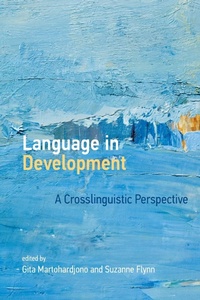
Language in Development
A Crosslinguistic Perspective
Published on 17. August 2021
Book
Paperback/Softback
360 pages
978-0-262-54200-5 (ISBN)
Description
"An edited collection of prominent scholars in the field of language acquisition and development, focusing primarily on syntax and morphosyntax from formalist generative perspective"--
More details
Language
English
Place of publication
Cambridge (Massachusetts)
United States
Publishing group
MIT Press Ltd
Dimensions
Height: 229 mm
Width: 152 mm
Thickness: 20 mm
Weight
562 gr
ISBN-13
978-0-262-54200-5 (9780262542005)
Copyright in bibliographic data and cover images is held by Nielsen Book Services Limited or by the publishers or by their respective licensors: all rights reserved.
Schweitzer Classification
Other editions
Additional editions
E-Book
08/2021
MIT Press
€118.99
Available for download
Persons
edited by Gita Martohardjono and Suzanne Flynn
Content
Preface
I Theoretical and Methodological Considerations
1 Five Questions about Language Learning
2 Coordinate Compounds in Theory and Practice
3 Hard Words
4 Elicited Imitation in First Language Acquisition Research: Cognitive Grounding and Crosslinguistic Application
II Children
5 The Development of Person and Number Agreement in Child Heritage Speakers of Spanish Learning English as a Second Language
6 The Role of Gestures in First and Second Language Acquisition: A Case Study of a Hebrew-English Bilingual Child
7 Discourse-Morphosyntax Interaction in the Acquisition of Spanish Finite and Nonfinite Verbs
8 A Hybrid Approach to Infant-Directed Speech
9 Discontinuous Dependent Morphemes in German and English Parental Speech: Input Differences between Two Languages
III Adults
10 Syntactic Ambiguity Resolution in Native and Nonnative Speakers of Chinese
11 The Tense Puzzle in Second Language Acquisition
12 Bilingual Processing of the First-Learned Language: Are Heritage Speakers and Late Bilinguals Really that Different?
13 Identifying Early Language Changes in Alzheimer's Disease: Extrapolating Lessons Learned from Methodologies Used in Investigating First Language Acquisition
Contributors
Index
I Theoretical and Methodological Considerations
1 Five Questions about Language Learning
2 Coordinate Compounds in Theory and Practice
3 Hard Words
4 Elicited Imitation in First Language Acquisition Research: Cognitive Grounding and Crosslinguistic Application
II Children
5 The Development of Person and Number Agreement in Child Heritage Speakers of Spanish Learning English as a Second Language
6 The Role of Gestures in First and Second Language Acquisition: A Case Study of a Hebrew-English Bilingual Child
7 Discourse-Morphosyntax Interaction in the Acquisition of Spanish Finite and Nonfinite Verbs
8 A Hybrid Approach to Infant-Directed Speech
9 Discontinuous Dependent Morphemes in German and English Parental Speech: Input Differences between Two Languages
III Adults
10 Syntactic Ambiguity Resolution in Native and Nonnative Speakers of Chinese
11 The Tense Puzzle in Second Language Acquisition
12 Bilingual Processing of the First-Learned Language: Are Heritage Speakers and Late Bilinguals Really that Different?
13 Identifying Early Language Changes in Alzheimer's Disease: Extrapolating Lessons Learned from Methodologies Used in Investigating First Language Acquisition
Contributors
Index