

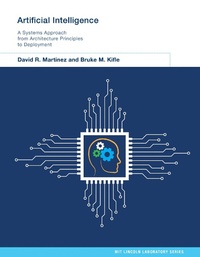
Artificial Intelligence
A Systems Approach from Architecture Principles to Deployment
Published on 11. June 2024
580 pages
978-0-262-37871-0 (ISBN)
Description

The first text to take a systems engineering approach to artificial intelligence (AI), from architecture principles to the development and deployment of AI capabilities.
Most books on artificial intelligence (AI) focus on a single functional building block, such as machine learning or human-machine teaming. Artificial Intelligence takes a more holistic approach, addressing AI from the view of systems engineering. The book centers on the people-process-technology triad that is critical to successful development of AI products and services. Development starts with an AI design, based on the AI system architecture, and culminates with successful deployment of the AI capabilities. Directed toward AI developers and operational users, this accessibly written volume of the MIT Lincoln Laboratory Series can also serve as a text for undergraduate seniors and graduate-level students and as a reference book.
Key features:
- In-depth look at modern computing technologies
- Systems engineering description and means to successfully undertake an AI product or service development through deployment
- Existing methods for applying machine learning operations (MLOps)
- AI system architecture including a description of each of the AI pipeline building blocks
- Challenges and approaches to attend to responsible AI in practice
- Tools to develop a strategic roadmap and techniques to foster an innovative team environment
- Multiple use cases that stem from the authors' MIT classes, as well as from AI practitioners, AI project managers, early-career AI team leaders, technical executives, and entrepreneurs
- Exercises and Jupyter notebook examples
More details
Other editions
Additional editions
David R. Martinez | Bruke Kifle
Artificial Intelligence
A Systems Approach from Architecture Principles to Deployment
Book
06/2024
MIT Press
€136.50
Shipment within 10-20 days
Persons
David R. Martinez is a laboratory fellow at the MIT Lincoln Laboratory and the lead instructor for MIT's "AI Strategies and Roadmap: Systems Engineering Approach to AI Development and Deployment" and "AI and ML: Leading Business Growth" courses.
Bruke Mesfin Kifle is management consultant and former AI product manager at Microsoft Turing. He co-instructs MIT's "AI Strategies and Roadmap " course.
Bruke Mesfin Kifle is management consultant and former AI product manager at Microsoft Turing. He co-instructs MIT's "AI Strategies and Roadmap " course.
Content
- Intro
- Contents
- Preface
- Acknowledgments
- 1. Overview
- 1.1. AI Notable Events in the Past Decades
- 1.2. AI Pipeline: A System Architecture Approach
- 1.3. High-Level Description of AI System Architecture Building Blocks
- 1.4. Effective AI Deployment
- 1.5. AI Horizons: Content-Based Insights, Collaboration-Based Insights, and Context-Based Insights
- 1.6. Chapter Road Map
- 1.7. Main Takeaways
- 1.8. Exercises
- 1.9. References
- Part I. AI System Architecture
- 2. Fundamentals of Systems Engineering
- 2.1. Systems Engineering Common Definitions
- 2.2. Characteristics Espoused within the Systems Engineering Discipline
- 2.3. A Systems Engineering Approach Applied to Artificial Intelligence
- 2.4. Architecture Framework: The What and the How
- 2.5. Leadership: Systems Thinker
- 2.6. Systems Engineering Challenges
- 2.7. Main Takeaways
- 2.8. Exercises
- 2.9. References
- 3. Data Conditioning
- 3.1. Exponential Data Growth
- 3.2. Digital Transformation
- 3.3. Databases: Management and Evolution
- 3.4. Data Quality, Cleaning, and Preparation
- 3.5. Curated Data Set Examples and Attributes
- 3.6. Data Conditioning Challenges
- 3.7. Main Takeaways
- 3.8. Exercises
- 3.9. References
- 4. Machine Learning
- 4.1. Machine Learning Classes
- 4.2. Common Measures of Performance
- 4.3. Introduction to Deep Learning and Neural Nets
- 4.4. Training Neural Networks with Backpropagation
- 4.5. Designing a Neural Network
- 4.6. Introduction to Convolutional Neural Networks
- 4.7. Machine Learning Challenges
- 4.8. Main Takeaways
- 4.9. Exercises
- 4.10. References
- 5. Modern Computing
- 5.1. A Short History of Computing Technologies
- 5.2. Computing at the Enterprise versus Computing at the Edge
- 5.3. Neural Network: Key Computational Kernels
- 5.4. Arithmetic Precision
- 5.5. Confluence of ML Algorithm Improvements and Computing Technology
- 5.6. Domain-Specific Hardware and Software
- 5.7. Contemporary Computing Engines and Integrated Systems
- 5.8. Roofline as a Metric
- 5.9. Securing Modern Computing
- 5.10. Modern Computing Challenges
- 5.11. Main Takeaways
- 5.12. Exercises
- 5.13. References
- 6. Human-Machine Teaming
- 6.1. Augmenting Human Capabilities
- 6.2. AI as a Search-and-Discovery Tool
- 6.3. AI as a Teammate
- 6.4. Autonomy and Near-Term Barriers
- 6.5. Quantitative and Qualitative Performance Metrics
- 6.6. Human-Machine Teaming Challenges
- 6.7. Main Takeaways
- 6.8. Exercises
- 6.9. References
- 7. Robust AI Systems
- 7.1. Systems Perspective on AI Vulnerabilities
- 7.2. Classes of Adversarial Artificial Intelligence
- 7.3. Deepfakes and Examples
- 7.4. Explainable Artificial Intelligence
- 7.5. Mitigation Techniques
- 7.6. Methodology for Testing against Adversarial Attacks
- 7.7. Robust AI System Challenges
- 7.8. Main Takeaways
- 7.9. Exercises
- 7.10. References
- 8. Responsible Artificial Intelligence
- 8.1. AI and Society
- 8.2. Case Studies: Harms from Artificial Intelligence
- 8.3. Considerations for Sociotechnical Systems
- 8.4. Responsible AI Principles
- 8.5. RAI Considerations in the AI Development Life Cycle
- 8.6. RAI Challenges
- 8.7. Main Takeaways
- 8.8. Exercises
- 8.9. References
- Part II. Strategic Principles
- 9. AI Strategy and Road Map
- 9.1. Introduction to Strategic Thinking
- 9.2. AI Strategic Development Model
- 9.3. Mission/Vision and Envisioned Future
- 9.4. Organization Core Values and Strategic Direction
- 9.5. AI Value Proposition
- 9.6. AI Strategic Road Map: A Blueprint
- 9.7. Strategy and Execution: A Complementary Duo
- 9.8. Main Takeaways
- 9.9. Exercises
- 9.10. References
- 10. AI Deployment Guidelines
- 10.1. Challenges in Deploying Artificial Intelligence
- 10.2. Ten Guidelines for Successfully Deploying AI Capabilities
- 10.3. A Process for Applying a Systems Engineering Discipline to AI Deployment
- 10.4. AI Adoption: Four Distinct Organizational Maturity Clusters
- 10.5. The AI Ecosystem
- 10.6. Gold Standard: Test Harness, Performance Metrics, and Benchmarks
- 10.7. AI Platform Characteristics and Benefits
- 10.8. Main Takeaways
- 10.9. Exercises
- 10.10. References
- 11. MLOps: Transitioning from Development to Deployment
- 11.1. Introduction to MLOps Fundamentals
- 11.2. AI System Architecture Implementation Using MLOps
- 11.3. MLOps Enabling Techniques and Contemporary Tools
- 11.4. MLOps Platforms, AutoML, and LCNC Application Development
- 11.5. AI Development and Deployment: Common Pitfalls
- 11.6. Main Takeaways
- 11.7. Exercises
- 11.8. References
- 12. Fostering an Innovative Team Environment
- 12.1. Organizational Culture
- 12.2. Organizational Structure and Innovation
- 12.3. AI Talent and the Future of Work
- 12.4. Preparing You for a Successful Career
- 12.5. AI Technical Depth and Breadth
- 12.6. Metrics for Measuring Progress and Results
- 12.7. AI Leadership and Resilience
- 12.8. Mentoring, Networking, and Recruiting AI Talent
- 12.9. Sustaining High-Performance Teams
- 12.10. Main Takeaways
- 12.11. Exercises
- 12.12. References
- 13. Communicating Effectively
- 13.1. VSN-C for Structuring Communications
- 13.2. Winston Star: Essentials for Being Remembered
- 13.3. Essentials of Outlining
- 13.4. Writing and Presentation Fundamentals
- 13.5. Main Takeaways
- 13.6. Exercises
- 13.7. References
- Part III. Human-Machine Augmentation: Use Cases
- 14. Use-Case Example 1: Misty Companion Robot as Alzheimer's Application
- 14.1. Exercises
- 14.2. References
- 15. Use-Case Example 2: Bose AI-Powered Cycling Coach and Warning System
- 15.1. Exercises
- 15.2. Reference
- 16. Use-Case Example 3: Meal Evaluation and Attainment Logistics System (MEALS)
- 16.1. Exercises
- 17. Use-Case Example 4: Managing Energy for Smart Homes (MESH)
- 17.1. Exercises
- 17.2. References
- 18. Use-Case Example 5: AquaAI, an AI-Powered Modernized Marine Maintenance System
- 18.1. Exercises
- 18.2. Reference
- Appendix
- A.1. Representative AI Industries and Sample Applications
- A.2. Setting Up Your Interactive Development Environment (for Either PC or Mac OS Operating Systems)
- A.3. ML Performance Metrics
- A.4. Multilayer Perceptron Algorithm
- A.5. CNN with MNIST Fashion Data Set
- A.6. Raspberry Pi: Introduction and Setup
- Abbreviations
- Index
