

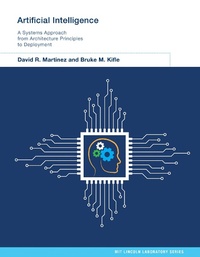
Artificial Intelligence
A Systems Approach from Architecture Principles to Deployment
Published on 11. June 2024
Book
Hardback
576 pages
978-0-262-04898-9 (ISBN)
Description
The first text to take a systems engineering approach to artificial intelligence (AI), from architecture principles to the development and deployment of AI capabilities.
Most books on artificial intelligence (AI) focus on a single functional building block, such as machine learning or human-machine teaming. Artificial Intelligence takes a more holistic approach, addressing AI from the view of systems engineering. The book centers on the people-process-technology triad that is critical to successful development of AI products and services. Development starts with an AI design, based on the AI system architecture, and culminates with successful deployment of the AI capabilities. Directed toward AI developers and operational users, this accessibly written volume of the MIT Lincoln Laboratory Series can also serve as a text for undergraduate seniors and graduate-level students and as a reference book.
Key features:
Most books on artificial intelligence (AI) focus on a single functional building block, such as machine learning or human-machine teaming. Artificial Intelligence takes a more holistic approach, addressing AI from the view of systems engineering. The book centers on the people-process-technology triad that is critical to successful development of AI products and services. Development starts with an AI design, based on the AI system architecture, and culminates with successful deployment of the AI capabilities. Directed toward AI developers and operational users, this accessibly written volume of the MIT Lincoln Laboratory Series can also serve as a text for undergraduate seniors and graduate-level students and as a reference book.
Key features:
- In-depth look at modern computing technologies
- Systems engineering description and means to successfully undertake an AI product or service development through deployment
- Existing methods for applying machine learning operations (MLOps)
- AI system architecture including a description of each of the AI pipeline building blocks
- Challenges and approaches to attend to responsible AI in practice
- Tools to develop a strategic roadmap and techniques to foster an innovative team environment
- Multiple use cases that stem from the authors’ MIT classes, as well as from AI practitioners, AI project managers, early-career AI team leaders, technical executives, and entrepreneurs
- Exercises and Jupyter notebook examples
More details
Language
English
Place of publication
Cambridge (Massachusetts)
United States
Publishing group
MIT Press Ltd
Illustrations
14 COLOR ILLUS., 90 BLACK AND WHITE ILLUS.
Dimensions
Height: 231 mm
Width: 184 mm
Thickness: 40 mm
Weight
1210 gr
ISBN-13
978-0-262-04898-9 (9780262048989)
Copyright in bibliographic data and cover images is held by Nielsen Book Services Limited or by the publishers or by their respective licensors: all rights reserved.
Schweitzer Classification
Other editions
Additional editions
David R. Martinez | Bruke M. Kifle
Artificial Intelligence
A Systems Approach from Architecture Principles to Deployment
E-Book
06/2024
MIT Press
€113.99
Available for download
Persons
David R. Martinez is a laboratory fellow at the MIT Lincoln Laboratory and the lead instructor for MIT’s “AI Strategies and Roadmap: Systems Engineering Approach to AI Development and Deployment” and “AI and ML: Leading Business Growth” courses.
Bruke Mesfin Kifle is management consultant and former AI product manager at Microsoft Turing. He co-instructs MIT’s "AI Strategies and Roadmap " course.
Bruke Mesfin Kifle is management consultant and former AI product manager at Microsoft Turing. He co-instructs MIT’s "AI Strategies and Roadmap " course.
Content
Table of Contents
Preface 3
Acknowledgements 6
1 Overview 17
Part I AI System Architecture 49
2 Fundamentals of Systems Engineering 50
3 Data Conditioning 86
4 Machine Learning 127
5 Modern Computing 181
6 Human-Machine Teaming 258
7 Robust AI Systems 297
8 Responsible AI 343
Part II Strategic Principles 375
9 AI Strategy and Roadmap 376
10 AI Deployment Guidelines 427
11 MLOps: Transitioning from Development into Deployment 473
12 Fostering an Innovative Team Environment 518
13 Communicating Effectively 574
14 Use-Case Example #1: Misty Companion Robot as Alzheimer’s Application 605
15 Use-Case Example #2: Bose AI-Powered Cycling Coach and Warning System 614
16 Use-Case Example #3: Meal Evaluation & Attainment Logistics System (MEALS) 622
17 Use-Case Example #4: Managing Energy for Smart Homes (MESH) 632
18 Use-Case Example #5: AquaAI—An AI-Powered Modernized Marine Maintenance System 641
Appendices 649
Glossary 677
Index 680
Preface 3
Acknowledgements 6
1 Overview 17
Part I AI System Architecture 49
2 Fundamentals of Systems Engineering 50
3 Data Conditioning 86
4 Machine Learning 127
5 Modern Computing 181
6 Human-Machine Teaming 258
7 Robust AI Systems 297
8 Responsible AI 343
Part II Strategic Principles 375
9 AI Strategy and Roadmap 376
10 AI Deployment Guidelines 427
11 MLOps: Transitioning from Development into Deployment 473
12 Fostering an Innovative Team Environment 518
13 Communicating Effectively 574
14 Use-Case Example #1: Misty Companion Robot as Alzheimer’s Application 605
15 Use-Case Example #2: Bose AI-Powered Cycling Coach and Warning System 614
16 Use-Case Example #3: Meal Evaluation & Attainment Logistics System (MEALS) 622
17 Use-Case Example #4: Managing Energy for Smart Homes (MESH) 632
18 Use-Case Example #5: AquaAI—An AI-Powered Modernized Marine Maintenance System 641
Appendices 649
Glossary 677
Index 680