

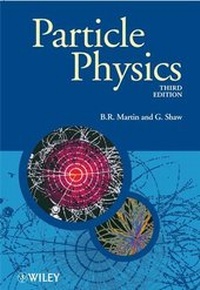
Particle Physics
3rd Edition
Published on 20. November 2008
460 pages
978-0-470-72153-7 (ISBN)
Description

An essential introduction to particle physics, with coverageranging from the basics through to the very latest developments, inan accessible and carefully structured text.
Particle Physics: Third Edition is a revision of a highlyregarded introduction to particle physics. In its two previouseditions this book has proved to be an accessible and balancedintroduction to modern particle physics, suitable for thosestudents needed a more comprehensive introduction to the subjectthan provided by the 'compendium' style physicsbooks.
In the Third Edition the standard model of particlephysics is carefully developed whilst unnecessary mathematicalformalism is avoided where possible. Emphasis is placed on theinterpretation of experimental data in terms of the basicproperties of quarks and leptons.
One of the major developments of the past decade has been theestablishing of the existence of neutrino oscillations. This willhave a profound effect on the plans of experimentalists. Thislatest edition brings the text fully up-to-date, and includes newsections on neutrino physics, as well as expanded coverage ofdetectors, such as the LHC detector.
* End of chapter problems with a full set of hints for theirsolutions provided at the end of the book.
* An accessible and carefully structured introduction to thisdemanding subject.
* Includes more advanced material in optional'starred' sections.
* Coverage of the foundations of the subject, as well as the verylatest developments.
Particle Physics: Third Edition is a revision of a highlyregarded introduction to particle physics. In its two previouseditions this book has proved to be an accessible and balancedintroduction to modern particle physics, suitable for thosestudents needed a more comprehensive introduction to the subjectthan provided by the 'compendium' style physicsbooks.
In the Third Edition the standard model of particlephysics is carefully developed whilst unnecessary mathematicalformalism is avoided where possible. Emphasis is placed on theinterpretation of experimental data in terms of the basicproperties of quarks and leptons.
One of the major developments of the past decade has been theestablishing of the existence of neutrino oscillations. This willhave a profound effect on the plans of experimentalists. Thislatest edition brings the text fully up-to-date, and includes newsections on neutrino physics, as well as expanded coverage ofdetectors, such as the LHC detector.
* End of chapter problems with a full set of hints for theirsolutions provided at the end of the book.
* An accessible and carefully structured introduction to thisdemanding subject.
* Includes more advanced material in optional'starred' sections.
* Coverage of the foundations of the subject, as well as the verylatest developments.
More details
Other editions
Additional editions
Brian Martin | Graham P. Shaw
Particle Physics
Book
10/2008
3rd Edition
Wiley
€162.00
Article exhausted; check for reprint
Brian Martin | Graham Shaw
Particle Physics
Book
10/2008
3rd Edition
Wiley
€53.90
Article exhausted; check for reprint
Persons
Professor Brian R Martin, Department of Physics & Astronomy, University College London, London, UK.
Professor Martin is a highly respected academic in his field and has already co-authored a number of successful books, including two previous editions of Particle Physics. He has recently stepped down as Head of Department at UCL after 10 years in the post.
Dr Graham Shaw, School of Physics & Astronomy, The University of Manchester, Manchester, UK.
Dr Graham Shaw has co-authored the highly regarded Quantum Field Theory as well as the two previous editions of Particle Physics.
Content
Suggested Short Course Inside Front Cover.
Editors' Preface to the Manchester Physics Series.
Authors' Preface.
Notes.
1 SOME BASIC CONCEPTS.
1.1 Introduction.
1.2 Antiparticles.
1.3 Interactions and Feynman Diagrams.
1.4 Particle Exchange.
1.5 Units and Dimensions.
PROBLEMS 1.
2 LEPTONS AND THE WEAK INTERACTION.
2.1 Lepton Multiplets and Lepton Numbers.
2.2 LeptonicWeak Interactions.
2.3 Neutrino Masses and Neutrino Mixing.
PROBLEMS 2.
3 QUARKS AND HADRONS.
3.1 Quarks.
3.2 General Properties of Hadrons.
3.3 Pions and Nucleons.
3.4 Strange Particles, Charm and Bottom.
3.5 Short-Lived Hadrons.
3.6 Allowed Quantum Numbers and Exotics.
PROBLEMS 3.
4 EXPERIMENTAL METHODS.
4.1 Overview.
4.2 Accelerators and Beams.
4.3 Particle Interactions with Matter.
4.4 Particle Detectors.
4.5 Detector Systems and Experiments.
PROBLEMS 4.
5 SPACE-TIME SYMMETRIES.
5.1 Translational Invariance.
5.2 Rotational Invariance.
5.3 Parity.
5.4 Charge Conjugation.
5.5 Positronium.
5.6 Time Reversal.
PROBLEMS 5.
6 THE QUARK MODEL.
6.1 Isospin Symmetry.
6.2 The Lightest Hadrons.
6.3 Colour.
6.4 Charmonium and Bottomium.
PROBLEMS 6.
7 QCD, JETS AND GLUONS.
7.1 Quantum Chromodynamics.
7.2 Electron-Positron Annihilation.
7.3 Elastic Electron Scattering: The size of the proton.
7.4 Inelastic Electron and Muon Scattering.
7.5 Inelastic Neutrino Scattering.
PROBLEMS 7.
8 WEAK INTERACTIONS: QUARKS AND LEPTONS.
8.1 Charged Current Reactions.
8.2 The Third Generation.
PROBLEMS 8.
9 WEAK INTERACTIONS: ELECTROWEAK UNIFICATION.
9.1 Neutral Currents and the Unified Theory.
9.2 Gauge Invariance and the Higgs Boson.
PROBLEMS 9.
10 DISCRETE SYMMETRIES: C, P, CP ANDCPT.
10.1 P Violation, C Violation and CPConservation.
10.2 CP Violation.
10.3 Flavour Oscillations and the CPT Theorem.
10.4 CP Violation in the Standard Model.
PROBLEMS 10.
11 BEYOND THE STANDARD MODEL.
11.1 Grand Unification.
11.2 Supersymmetry.
11.3 Strings and Things.
11.4 Particle Cosmology.
11.5 Neutrino Astronomy.
11.6 Dirac or Majorana Neutrinos?
PROBLEMS 11.
A RELATIVISTIC KINEMATICS.
A.1 The Lorentz Transformation for Energy and Momentum.
A.2 The Invariant Mass.
A.3 Transformation of the Scattering Angle.
PROBLEMS A.
B AMPLITUDES AND CROSS-SECTIONS.
B.1 Rates and Cross-Sections.
B.2 The Total Cross-Section.
B.3 Differential Cross-Sections.
B.4 The Scattering Amplitude.
B.5 The Breit-Wigner Formula.
PROBLEMS B.
C THE ISOSPIN FORMALISM.
C.1 Isospin Operators.
C.2 Isospin States.
C.3 Isospin Multiplets.
C.4 Branching Ratios.
C.5 Spin States.
PROBLEMS C.
D GAUGE THEORIES.
D.1 Electromagnetic Interactions.
D.2 Gauge Transformations.
D.3 Gauge Invariance and the Photon Mass.
D.4 The Gauge Principle.
D.5 The Higgs Mechanism.
D.6 Quantum Chromodynamics.
D.7 Electroweak Interactions.
PROBLEMS D.
E TABLES OF PARTICLE PROPERTIES.
E.1 Gauge Bosons.
E.2 Leptons.
E.3 Quarks.
E.4 Low-lying Baryons.
E.5 Low-lying Mesons.
F SOLUTIONS TO PROBLEMS.
References.
Index.
Physical Constants, Conversion Factors and Natural Units.
Editors' Preface to the Manchester Physics Series.
Authors' Preface.
Notes.
1 SOME BASIC CONCEPTS.
1.1 Introduction.
1.2 Antiparticles.
1.3 Interactions and Feynman Diagrams.
1.4 Particle Exchange.
1.5 Units and Dimensions.
PROBLEMS 1.
2 LEPTONS AND THE WEAK INTERACTION.
2.1 Lepton Multiplets and Lepton Numbers.
2.2 LeptonicWeak Interactions.
2.3 Neutrino Masses and Neutrino Mixing.
PROBLEMS 2.
3 QUARKS AND HADRONS.
3.1 Quarks.
3.2 General Properties of Hadrons.
3.3 Pions and Nucleons.
3.4 Strange Particles, Charm and Bottom.
3.5 Short-Lived Hadrons.
3.6 Allowed Quantum Numbers and Exotics.
PROBLEMS 3.
4 EXPERIMENTAL METHODS.
4.1 Overview.
4.2 Accelerators and Beams.
4.3 Particle Interactions with Matter.
4.4 Particle Detectors.
4.5 Detector Systems and Experiments.
PROBLEMS 4.
5 SPACE-TIME SYMMETRIES.
5.1 Translational Invariance.
5.2 Rotational Invariance.
5.3 Parity.
5.4 Charge Conjugation.
5.5 Positronium.
5.6 Time Reversal.
PROBLEMS 5.
6 THE QUARK MODEL.
6.1 Isospin Symmetry.
6.2 The Lightest Hadrons.
6.3 Colour.
6.4 Charmonium and Bottomium.
PROBLEMS 6.
7 QCD, JETS AND GLUONS.
7.1 Quantum Chromodynamics.
7.2 Electron-Positron Annihilation.
7.3 Elastic Electron Scattering: The size of the proton.
7.4 Inelastic Electron and Muon Scattering.
7.5 Inelastic Neutrino Scattering.
PROBLEMS 7.
8 WEAK INTERACTIONS: QUARKS AND LEPTONS.
8.1 Charged Current Reactions.
8.2 The Third Generation.
PROBLEMS 8.
9 WEAK INTERACTIONS: ELECTROWEAK UNIFICATION.
9.1 Neutral Currents and the Unified Theory.
9.2 Gauge Invariance and the Higgs Boson.
PROBLEMS 9.
10 DISCRETE SYMMETRIES: C, P, CP ANDCPT.
10.1 P Violation, C Violation and CPConservation.
10.2 CP Violation.
10.3 Flavour Oscillations and the CPT Theorem.
10.4 CP Violation in the Standard Model.
PROBLEMS 10.
11 BEYOND THE STANDARD MODEL.
11.1 Grand Unification.
11.2 Supersymmetry.
11.3 Strings and Things.
11.4 Particle Cosmology.
11.5 Neutrino Astronomy.
11.6 Dirac or Majorana Neutrinos?
PROBLEMS 11.
A RELATIVISTIC KINEMATICS.
A.1 The Lorentz Transformation for Energy and Momentum.
A.2 The Invariant Mass.
A.3 Transformation of the Scattering Angle.
PROBLEMS A.
B AMPLITUDES AND CROSS-SECTIONS.
B.1 Rates and Cross-Sections.
B.2 The Total Cross-Section.
B.3 Differential Cross-Sections.
B.4 The Scattering Amplitude.
B.5 The Breit-Wigner Formula.
PROBLEMS B.
C THE ISOSPIN FORMALISM.
C.1 Isospin Operators.
C.2 Isospin States.
C.3 Isospin Multiplets.
C.4 Branching Ratios.
C.5 Spin States.
PROBLEMS C.
D GAUGE THEORIES.
D.1 Electromagnetic Interactions.
D.2 Gauge Transformations.
D.3 Gauge Invariance and the Photon Mass.
D.4 The Gauge Principle.
D.5 The Higgs Mechanism.
D.6 Quantum Chromodynamics.
D.7 Electroweak Interactions.
PROBLEMS D.
E TABLES OF PARTICLE PROPERTIES.
E.1 Gauge Bosons.
E.2 Leptons.
E.3 Quarks.
E.4 Low-lying Baryons.
E.5 Low-lying Mesons.
F SOLUTIONS TO PROBLEMS.
References.
Index.
Physical Constants, Conversion Factors and Natural Units.
