

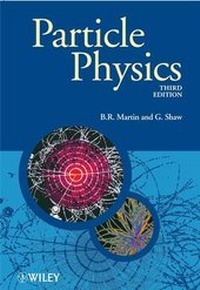
Particle Physics
3rd Edition
Published on 24. October 2008
Book
Hardback
460 pages
978-0-470-03293-0 (ISBN)
Description
Particle Physics is the study of the fundamental constituents of matter and the forces between them.
Particle Physics, Third Edition, provides a short introduction to particle physics, which emphasizes the foundations of the standard model in experimental data, rather than its more formal and theoretical aspects. It is intended for undergraduate students who have previously taken introductory courses in nonrelativistic quantum mechanics and special relativity.
The structure of the book is simple. The first three chapters give a brief overview of the subject. They introduce some of the basic ideas that are used extensively throughout the rest of the book and discuss leptons, quarks and hadrons and the interactions between them. The remaining chapters discuss a wide selection of important topics in more detail. These include experimental methods; space-time symmetries; the quark model of hadrons; quantum chromodynamics and jet physics; the weak interaction, including its unification with the electromagnetic interaction, and CP-violation and related symmetries; and a brief account of some of the important open questions 'beyond the standard model' that are currently being investigated in laboratories around the world. Problems to aid student study are given at the end of each chapter, with solutions given in an Appendix.
Particle Physics 3rd Edition features:
* Expanded coverage of neutrino physics, including recent experimental result on neutrino mixing and neutrino masses.
* A revised and updated discussion of modern particle detectors and experiments.
* A fuller treatment of the Higgs mechanism and experimental searches for the Higgs boson.
* A more extensive discussion of CP violation, including new results B decays their implications for the standard model.
* An updated treatment of physics beyond the standard model, including the expanding field of particle astrophysics and cosmology.
More details
Series
Edition
3. Auflage
Language
English
Place of publication
Hoboken
United Kingdom
Publishing group
John Wiley and Sons Ltd
Target group
College/higher education
Edition type
Revised edition
Illustrations
ill
Dimensions
Height: 24.4 cm
Width: 16.8 cm
Thickness: 3 cm
Weight
926 gr
ISBN-13
978-0-470-03293-0 (9780470032930)
Schweitzer Classification
Other editions
New editions
Brian R. Martin | Graham Shaw
Particle Physics
Book
01/2017
4th Edition
Wiley
€129.00
Shipment within 15-20 days
Additional editions
Brian R. Martin | Graham Shaw
Particle Physics
E-Book
11/2008
3rd Edition
Wiley
€46.99
Available for download
Brian Martin | Graham Shaw
Particle Physics
Book
10/2008
3rd Edition
Wiley
€53.90
Article exhausted; check for reprint
Persons
Content
CONTENTS
Suggested First Course
Editorsâ?(tm) Preface to the Manchester Physics Series
Authorsâ?(tm) Preface
Notes
1. SOME BASIC CONCEPTS
1.1 Introduction
1.2 Antiparticles
1.3 Interactions and Feynman Diagrams
1.4 Particle Exchange
1.5 Units and Dimensions
PROBLEMS 1
2. LEPTONS AND THE WEAK INTERACTION
2.1 Lepton Multiplets and Lepton Numbers
2.2 Leptonic Weak Interactions
2.3 Neutrino Masses and Neutrino Mixing
PROBLEMS 2
3. QUARKS AND HADRONS
3.1 Quarks
3.2 General Properties of Hadrons
3.3 Pions and Nucleons
3.4 Strange Particles, Charm and Bottom
3.5 Short-Lived Hadrons
3.6 Allowed Quantum Numbers and Exotics
PROBLEMS 3
4. EXPERIMENTAL METHODS
4.1 Overview
4.2 Accelerators and Beams
4.3 Particle Interactions with Matter
4.4 Particle Detectors
4.5 Detector Systems and Experiments
PROBLEMS 4
5. SPACE-TIME SYMMETRIES
5.1 Translational Invariance
5.2 Rotational Invariance
5.3 Parity
5.4 Charge Conjugation
5.5 Positronium
5.6 Time Reversal
PROBLEMS 5
6. THE QUARK MODEL
6.1 Isospin Symmetry
6.2 The Lightest Hadrons
6.3 Colour
6.4 Charmonium and Bottomium
PROBLEMS 6
7. QCD, JETS AND GLUONS
7.1 Quantum Chromodynamics
7.2 Electron-Positron Annihilation
7.3 Elastic Electron Scattering: The Size of the Proton
7.4 Inelastic Electron and Muon scattering
7.5 Inelastic Neutrino Scattering
PROBLEMS 7
8. WEAK INTERACTIONS: QUARKS AND LEPTONS
8.1 Charged Current Reactions
8.2 The Third Generation
PROBLEMS 8
9. WEAK INTERACTIONS: ELECTROWEAK UNIFICATION
9.1 Neutral Currents and the Unified Theory
9.2 Gauge Invariance and the Higgs Boson
PROBLEMS 9
10. DISCRETE SYMMETRIES: C, P, CP AND CPT
10.1 P-Violation, C-Violation and CP-Conservation
10.2 CP Violation
10.3 Flavour Oscillations and the CPT Theorem
10.4 CP-Violation in the Standard Model
PROBLEMS 10
11. BEYOND THE STANDARD MODEL
11.1 Grand Unification
11.2 Supersymmetry
11.3 Strings and Things
11.4 Particle Cosmology
11.5 Neutrino Astronomy
11.6 Dirac or Majorana Neutrinos?
PROBLEMS 11
A. RELATIVISTIC KINEMATICS
A.1 The Lorentz Transformation for Energy and Momentum
A.2 The Invariant Mass
A.3 Transformation of the Scattering Angle
PROBLEMS A
B. AMPLITUDES AND CROSS-SECTIONS
B.1 Rates and Cross-Sections
B.2 The Total Cross-Section
B.3 Differential Cross-Sections
B.4 The Scattering Amplitude
B.5 The Breit-Wigner Formula
B.5.1 Decay distributions
B.5.2 Resonant cross-sections
PROBLEMS B
C. THE ISOSPIN FORMALISM
C.1 Isospin Operator
C.2 Isospin States
C.3 Isospin Multiplets
C3.1 Hadron states
C.4 Branching Ratios
C.5 Spin States
PROBLEMS C
D. GAUGE THEORIES
D.1 Electromagnetic Interactions
D.2 Gauge Transformations
D.3 Gauge Invariance and the Photon Mass
D.4 The Gauge Principle
D.5 The Higgs Mechanism
D.6 Quantum Chromodynamics
D.7 Electroweak Interactions
PROBLEMS D
E. TABLES OF PARTICLE PROPERTIES
F. SOLUTIONS TO PROBLEMS
References
Index
Physical Constants and Conversation Factors