

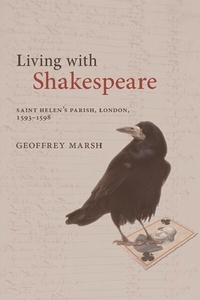
Living with Shakespeare
Description

A microhistory of London's St Helen''s Parish, revealing the lives of Shakespeare's neighbours
In the 1590s, Shakespeare was working with and writing for the Lord Chamberlain's Men at The Theatre, Shoreditch while he was living in the parish of St. Helen''s, Bishopsgate Street. Living with Shakespeare examines his parish, church, locale, neighbours and their potential influences on his writing--from the radical 'Paracelsian' doctors, musicians and public figures--to the international merchants who lived nearby. Packed with new discoveries from difficult-to-access manuscript records this book reveals the parish's complex social, religious, political and neighbourly intersections and influences.
Taking a section of Shakespeare's life, (c. 1593-1598), as he evolved from new 'arriviste' in London to established theatre professional, the book examines the 100 or so families who lived in his parish and demonstrates how their interests, work and connections formed part of the background environment that Shakespeare probably borrowed from as he reworked existing stories. These people form a fascinating story, which sheds new light on the influences that shaped a great writer as he finished Romeo & Juliet, A Midsummer Night's Dream and The Merchant of Venice and began to re-establish his family name, status and reputation.
Marsh's ability to weave primary research and discoveries together with historical narratives, transports readers into Shakespeare's world and allows them a real glimpse into his daily life.
Key Features
- Identifies Shakespeare's home in London during the 1590s
- Presents primary research based on unpublished documents including lay subsidy rolls, leases, indentures, legal records, tithe records, census returns for 'strangers', wills, letters, records of births, marriages and deaths and may more
- Provides compelling evidence of how certain kinds of information was readily available to Shakespeare at a critical juncture in his life
- Demonstrates he lived next door to two Paracelsian doctors trained in Padua and Germany, potentially answering long-asked questions
- Places Shakespeare alongside his immediate neighbours, presenting us with a more complete picture of the ways in which his social circle and level of wealth intersected at this time
- Reveals the interconnections of St. Helen''s - a high status London parish
- Provides significant new interpretation of the evolution of Elizabethean theatre
- Presents a clash over London witchcraft trials c. 1599-1605 with new and significant interpretations
- Identifies the origins of British Empire and spread of English by providing a new perspective from a London parish, where one of the most prestigious addresses in the 1590s was being used c. 1629 for sugar refining
More details
Other editions
Additional editions
Content
- Cover
- Half-title
- Frontispiece
- Title
- Dedication and copyright information
- Contents
- Acknowledgements
- Picture Credits
- Introduction
- PART I 1576, London, the Theatre and Hunting for China
- 1 1576: A Starting Point
- 2 James Burbage Plans His Theatre: The Theatre
- 3 Kick-Starting the British Empire
- PART II The Theatre, 1576-1598
- 4 James Burbage Builds the Theatre
- 5 Trouble at the Theatre
- 6 The Early Years of the Theatre: 1576-1586
- 7 The 1594 Changes at the Theatre and Shakespeare's New Focus
- PART III The Parish of Saint Helen's, Bishopsgate Street
- 8 William Shakespeare and the Parish of Saint Helen's
- 9 Searching for Shakespeare's Lodgings in Saint Helen's
- 10 What Attracted Shakespeare to Saint Helen's?
- PART IV Life, Death and Religion in Saint Helen's
- 11 Saint Helen's Church: The Anchor of the Parish
- 12 A Walk Round the Interior of Saint Helen's Church
- 13 Dreaming of English Exploration, Trade, Wealth, Colonisation and Empire
- PART V Shakespeare's Neighbours in Saint Helen's
- 14 The Radical Doctors of Saint Helen's
- 15 Dr Peter Turner Visits a Patient at the Sign of the Horse Head Inn
- 16 Lawyers, Musicians, an Antiquary and More
- 17 Saint Helen's as a Microcosmos: A Theatre of London
- PART VI Bewitchment in London
- 18 Witchcraft in Thames Street
- 19 Mary Glover is Bewitched in All-Hallows-the-Less, Thames Street
- 20 An Exorcism in Shoreditch
- PART VII Coda: The Advancement of English
- 21 Honey or Cane Sugar?
- Appendix Where Did Shakespeare Live in Saint Helen's and Who Might Have Been His Landlord?
- 1 Introduction
- 2 What Accommodation in Saint Helen's Would Have Appealed to Shakespeare?
- 3 Identifying the Location of Shakespeare's Residence(s)
- 4 When did Shakespeare Leave Saint Helen's?
- 5 Who Was John Pryn, Pryne, Prynne, Pryme, Prymme?
- 6 Who Was John Hatton?
- 7 Who Were Thomas Wrightson, John Harvey and Israel Jorden, Jordan, Jordaine, Jordayne, Jurden?
- 8 Who Were John, Antonia and Katherine Jeffrey?
- 9 Some Other Residents of Saint Helen's in the 1580s and 1590s
- Bibliography
- Index
