

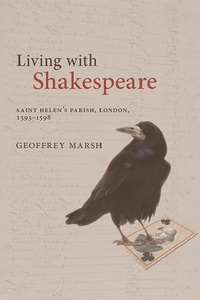
Living with Shakespeare
Saint Helen's Parish, London, 1593-1598
Published on 6. April 2021
Book
Hardback
512 pages
978-1-4744-7972-1 (ISBN)
Description
In the 1590s, Shakespeare was working with and writing for the Lord Chamberlain's Men at The Theatre, Shoreditch while he was living in the parish of St. Helen's, Bishopsgate Street. Living with Shakespeare examines his parish, church, locale, neighbours and their potential influences on his writing--from the radical 'Paracelsian' doctors, musicians and public figures--to the international merchants who lived nearby. Packed with new discoveries from difficult-to-access manuscript records this book reveals the parish's complex social, religious, political and neighbourly intersections and influences.
Taking a section of Shakespeare's life, (c. 1593-1598), as he evolved from new 'arriviste' in London to established theatre professional, the book examines the 100 or so families who lived in his parish and demonstrates how their interests, work and connections formed part of the background environment that Shakespeare probably borrowed from as he reworked existing stories. These people form a fascinating story, which sheds new light on the influences that shaped a great writer as he finished Romeo & Juliet, A Midsummer Night's Dream and The Merchant of Venice and began to re-establish his family name, status and reputation.
Marsh's ability to weave primary research and discoveries together with historical narratives, transports readers into Shakespeare's world and allows them a real glimpse into his daily life.
Taking a section of Shakespeare's life, (c. 1593-1598), as he evolved from new 'arriviste' in London to established theatre professional, the book examines the 100 or so families who lived in his parish and demonstrates how their interests, work and connections formed part of the background environment that Shakespeare probably borrowed from as he reworked existing stories. These people form a fascinating story, which sheds new light on the influences that shaped a great writer as he finished Romeo & Juliet, A Midsummer Night's Dream and The Merchant of Venice and began to re-establish his family name, status and reputation.
Marsh's ability to weave primary research and discoveries together with historical narratives, transports readers into Shakespeare's world and allows them a real glimpse into his daily life.
Reviews / Votes
Marsh wonderfully captures life in Shakespeare's time in his original microhistorical depiction of the author's neighborhood. -- Martin Ravn * Kristeligt Dagblad * Living with Shakespeare is history built up by the accretion of detail, as a way of looking at the bigger theme of the Elizabethan theatre, the beginnings of empire, the treatment of mental illness and the scandal of witchcraft. -- Celia Haddon * Salisbury Review * In so vividly putting Shakespeare among the rich variety of Saint Helen's parish, Marsh has done a service to the history of London and to the history of Shakespeare's life and milieu. -- Gabriel Egan, De Montfort University * The London Journal * This gives us a snapshot of Shakespeare's life and a moment of wider economic change, in which the old structures are shifting. [...] Living with Shakespeare is filled with riches. -- Daniel Swift * The Spectator * I did, however, learn many other things from Living with Shakespeare, and I expect to carry on doing so because the many lavish illustrations, tables, charts and even diagrams make it an absolutely invaluable reference book. -- Lisa Hopkins, Sheffiffield Hallam University * Times Higher Education * There are very few writers who can bring the past to life in such an accessible and easily absorbed fashion. Marsh has a light touch as a writer. His prose is direct but never harsh. It is a real joy to read something so detailed, well-researched, fluent and informative. -- Michael Jecks * WriterlyWitterings * Geoffrey Marsh offers the reader a fascinating, rich slice of London life in the late Elizabethan era. He focuses on lives of the people of the parish of St Helen's, Bishopsgate - which was home to one William Shakespeare for much of the 1590s, a period of transformation for the playwright and for theatre. Always a pleasure to read (but with its scrupulous research detailed in a lengthy Appendix), this beautifully illustrated book does indeed, as the author hopes, open up vistas upon Shakespeare and his world to people who only have a passing knowledge of his life. It will, however, also inform and intrigue Shakespeare scholars and practitioners. -- Anna Beer, Kellogg College, University of Oxford Living with Shakespeare offers a vivid portrait of Elizabethan London, one that brings to life St Helen's parish, Shakespeare's neighbourhood in the mid-1590s. A fascinating, deeply researched and beautifully illustrated study. -- James Shapiro, author of 1599: A Year in the Life of William Shakespeare 'Geoffrey Marsh is a scholar-detective, whose remarkable career at the V & A makes him a contemporary Autolycus, snapping up unconsidered trifles. A perfect sleuth for the investigation of Elizabethan London, his pioneering study of St Helen's Parish, Bishopsgate, brings to life, in the most brilliant and arresting detail, Shakespeare's day-to-day experience during some of his most formative years (1593-8). In the library of Shakespeare studies, there can be few volumes to rival this unique compendium for richness of detail or wealth of vivid contemporary insight. Marsh's attention to the character and humanity of the playwright's neighbours yields many suggestive footnotes to some world-famous lines. This portrait of a great writer's creative milieu is extraordinary and magnicent.' -- Robert McCrum, author of Shakespearean: On Life & Language in Times of Disruption (Picador, 2020) It is absolutely beautifully produced and has the minutiae I love pouring over. So little is known about him, but if you carefully excavate around the places he lived you can glean a great deal. -- Sue Jackson, London Blue Badge Guide and LecturerMore details
Language
English
Place of publication
Edinburgh
United Kingdom
Target group
Professional and scholarly
Illustrations
179 colour illustrations
Dimensions
Height: 217 mm
Width: 278 mm
Thickness: 34 mm
Weight
1912 gr
ISBN-13
978-1-4744-7972-1 (9781474479721)
Copyright in bibliographic data and cover images is held by Nielsen Book Services Limited or by the publishers or by their respective licensors: all rights reserved.
Schweitzer Classification
Other editions
Additional editions
E-Book
03/2021
1st Edition
Edinburgh University Press
€30.49
Available for download
E-Book
03/2021
1st Edition
Edinburgh University Press
€30.49
Available for download
Person
Geoffrey Marsh runs the Theatre and Performing Arts department of the Victoria and Albert Museum in London. He is the co-editor of David Bowie Is and You Say You Want a Revolution: Records and Rebels, 1966-70.
Content
Acknowledgements
Introduction: 1593, The Theatre, Shakespeare, St. Helens, English and You
Part I. 1576, London, The Theatre and hunting for China
1. 1576, a starting point
2. James Burbage plans his theatre - The Theatre
3. Kick-starting the British Empire
Part II. The Theatre 1576-1598
4. Mr. Burbage builds The Theatre
5. Trouble at The Theatre
6. The early years of The Theatre 1576-86
7. The 1594 changes at The Theatre & Shakespeare's new focus
Part III. The parish of St. Helens, Bishopsgate Street
8. William Shakespeare and the parish of St. Helens
9. Searching for Shakespeare's lodgings in St. Helens
10. What attracted Shakespeare to St. Helens?
Part IV. Life, death and religion in St. Helens
11. St. Helens church - the anchor of the parish
12. A walk around the interior of St. Helens church
13. Dreaming of English exploration, trade, wealth, colonisation and empire
Part V. Shakespeare's neighbours in St. Helens
14. The radical doctors of St. Helens
15. Dr. Peter Turner visits a patient at the Sign of The Horse Head Inn
16. Lawyers, musicians, an antiquary and more
17. St. Helens as a micro-cosmos - a theatre of London
Part VI. Bewitchment in London
18. Witchcraft in Thames Street
19. Mary Glover is bewitched in All Hallows-the-Less, Thames Street
20. An exorcism in Shoreditch
Part VII. Coda - the advancement of English
21. Honey or cane sugar?
Appendix. Detailed Documentation: Where did Shakespeare live in St. Helens and who might have been his landlord?
1. Introduction
2. What accommodation in St. Helens would have appealed to Shakespeare?
3. Identifying the location of Shakespeare's residence(s)
4. When did Shakespeare leave St. Helens?
5. Who was John Pryn, Pryne, Prynne, Pryme, Prymme?
6. Who was John Hatton?
7. Three scrivenersand more? Who were Thomas Wrightson, John Harvey and Israel Jorden, Jordan, Jordaine, Jordayne, Jurden?
8. Who were John, Antonia and Katherine Jeffrey - immigrant embroiderers?
9. Some other residents of St. Helens in the 1580s/90s
BibliographyIndex
Introduction: 1593, The Theatre, Shakespeare, St. Helens, English and You
Part I. 1576, London, The Theatre and hunting for China
1. 1576, a starting point
2. James Burbage plans his theatre - The Theatre
3. Kick-starting the British Empire
Part II. The Theatre 1576-1598
4. Mr. Burbage builds The Theatre
5. Trouble at The Theatre
6. The early years of The Theatre 1576-86
7. The 1594 changes at The Theatre & Shakespeare's new focus
Part III. The parish of St. Helens, Bishopsgate Street
8. William Shakespeare and the parish of St. Helens
9. Searching for Shakespeare's lodgings in St. Helens
10. What attracted Shakespeare to St. Helens?
Part IV. Life, death and religion in St. Helens
11. St. Helens church - the anchor of the parish
12. A walk around the interior of St. Helens church
13. Dreaming of English exploration, trade, wealth, colonisation and empire
Part V. Shakespeare's neighbours in St. Helens
14. The radical doctors of St. Helens
15. Dr. Peter Turner visits a patient at the Sign of The Horse Head Inn
16. Lawyers, musicians, an antiquary and more
17. St. Helens as a micro-cosmos - a theatre of London
Part VI. Bewitchment in London
18. Witchcraft in Thames Street
19. Mary Glover is bewitched in All Hallows-the-Less, Thames Street
20. An exorcism in Shoreditch
Part VII. Coda - the advancement of English
21. Honey or cane sugar?
Appendix. Detailed Documentation: Where did Shakespeare live in St. Helens and who might have been his landlord?
1. Introduction
2. What accommodation in St. Helens would have appealed to Shakespeare?
3. Identifying the location of Shakespeare's residence(s)
4. When did Shakespeare leave St. Helens?
5. Who was John Pryn, Pryne, Prynne, Pryme, Prymme?
6. Who was John Hatton?
7. Three scrivenersand more? Who were Thomas Wrightson, John Harvey and Israel Jorden, Jordan, Jordaine, Jordayne, Jurden?
8. Who were John, Antonia and Katherine Jeffrey - immigrant embroiderers?
9. Some other residents of St. Helens in the 1580s/90s
BibliographyIndex