

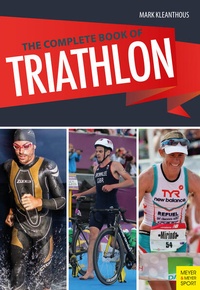
The Complete Book of Triathlon
3rd Edition
Published on 23. May 2016
384 pages
978-1-78255-753-1 (ISBN)
Description

The Complete Book of Triathlon is for all athletes who want to improve in or convert to the fascinating sport of triathlon. It shows among other things how to construct a training program, how to approach a competition and offers an Encyclopedia that covers all aspects of triathlon.
This book shows the triathlete and aspiring triathlete everything they need to know about triathlon, whether a sporting novice or an accomplished athlete in another sport. It tells you how to get started, what equipment to buy, the diet you will need, how to devise a training routine and how to arrange your busy life in order to accommodate it, and then explains how to finish a race, as well as how to recover from it. The Complete Book of Triathlon will tell you how to be the best that you can be in triathlon; not necessarily by training harder, but by training smarter.
Every aspect of your life has the potential to affect your mental and physical performance, and you need to take this into account when devising your training in order to avoid both over-training and under-training. Mark Kleanthous system for monitoring training-stress levels which he has been successfully using for many years is unique to him but is revealed in this book. Use it and you can achieve your optimum performance.
More details
Other editions
Additional editions
Book
04/2016
3rd Edition
Meyer & Meyer Sport (UK) Ltd
€22.95
Shipment within 3-4 weeks
Person
While his first competitive experience was finishing last in a school cross-country race, over the past 30 years Mark has crossed the finish line in over 1,000 races worldwide. Although he once came second in a marathon, his strength has always been in multi-sport events, where his wins have been numerous. He has completed a massive total of 400 triathlons, including 32 Ironman® distance events. He once won one triathlon in the morning and then came second in another in the afternoon.
Mark has won many national triathlon medals and has represented his country as an elite triathlete and now as an age-group competitor. He started coaching in 1998 and has helped triathletes at every level - from first-timers to age-group competitors to elite athletes. He is qualified to British triathlon coaching levels one and two.
Content
- Cover
- Contents
- Foreword - Catriona Morrison
- Section 1 - The First Steps Into the Sport
- Chapter 1: Getting Started
- Equipment
- What type of athlete are you?
- Fitting a training schedule into a busy week
- What is fitness?
- Overcoming initial problems
- Chapter 2: Basic Diet and Nutrition
- Nutritional requirements for a healthy diet
- Maintaining a healthy body
- Hydration
- General points
- Chapter 3: The First Competition
- Nutrition
- Training for your first triathlon
- How to determine your training effort
- 14-week training programme
- Race day
- Self-analysis of your first race
- The recovery
- Preparing a new training programme
- Section 2 - Serious Training
- Chapter 4: Preparing Yourself for Training
- Mental preparation and visualisation
- Time management
- Hydration and nutrition
- Sleep
- Warming up, stretching and cooling down
- Setting goals
- Keeping a diary
- Competing for charity
- Equipment
- Chapter 5: Theory of Training
- The five factors necessary for triathlon fitness
- Training stress
- How to quantify your training stress level (TSL) using the Mark Kleanthous Training Points System
- How to schedule progress
- Training stages
- Chapter 6: Training Regimes
- Technique training - drills
- Other technique sessions
- Base-with-appropriate-pace (BAP) sessions
- Long, slow, distance (LSD) sessions
- Other endurance sessions
- Over-distance training
- Strength training
- Muscular endurance sessions
- Brick sessions
- Back-to-back (B2B) sessions
- Interval training
- Negative-split sessions
- Fartlek sessions
- Speed development
- Threshold sessions
- High-intensity sessions
- Race-pace training
- Anaerobic threshold sessions
- Above-anaerobic threshold sessions
- Chapter 7: The Training Programme
- Training cycles
- Rolling training routine
- The six-minute fitness test
- Stages 1-7
- Open-water swimming
- Triathlon wetsuit information
- Transition training
- Race day nutritional requirements
- Two sessions on the same day
- Times when you can't train
- Alternative sessions
- Missed sessions
- Tiredness
- Overtraining
- Gadget-less training
- Massage
- Section 3 - Preparing for the Race
- Chapter 8: The Run Up to Race Day
- Entering the race
- Home preparation
- Final week - seven days to go
- Arriving at the event - one or two days to go
- The evening before - 14 hours to go
- Chapter 9: Race Day
- Wake up early - 3-4 hours to go
- Arrival - 90 minutes to go
- 50 minutes to go
- 30 minutes to go
- 25-20 minutes to go
- 20-15 minutes to go
- 15 minutes to go
- 8-4 minutes to go
- 30 seconds to go
- Go!
- Transition 1
- Cycling
- 10 minutes to the end of the cycle segment
- Transition 2
- Running
- Feeding stations
- The final 800 m
- The finish
- Chapter 10: Post-race Period
- Recovering from the race
- Post-race nutrition
- Delayed onset of muscle soreness (DOMS)
- Post-race analysis
- The post-competition transitional period
- Section 4 - Full-Distance Triathlon
- Chapter 11: Preparation
- Training philosophy
- Equipment
- Nutrition
- Chapter 12: A General Training Programme
- Full-distance triathlon training
- A 24-week training plan
- Half-distance triathlon 14-week training plan
- Full-distance triathlon 14-week training plan
- Chapter 13: Half-Distance and Full-Distance Races
- Using International Standard distance race information to prepare for a half-distance race
- General guidance for training
- The training programme
- Being race ready
- From half distance to full distance
- Chapter 14: The Race
- Strategy for finishing a full-distance triathlon
- Mood and attitude
- Pre-race schedule
- Race day schedule
- Immediate post-race period
- Gastric problems during the full-distance triathlon
- Chapter 15: The Post-race Period
- Self-analysis of race
- Post-Ironman® blues
- Life after a full-distance triathlon
- Using a triathlon coach
- Training camps
- Ultra-distance triathlons
- The Encyclopaedia Section: A-Z of Triathlon
- Appendix
- Appendix 1 - Suggested weekly nutrition plan
- Appendix 2 - Examples of Mark Kleanthous Training Points System TSL calculations
- Appendix 3 - Sprint and International Standard distance triathlon checklist
- Appendix 4 - Full-distance triathlon checklist
- Appendix 5 - Triathlon race/season review
- Appendix 6.1 - Swim pace guide
- Appendix 6.2 - Cycle pace guide
- Appendix 6.3 - Run pace guide
- Appendix 7 - Spectator's check list
- Appendix 8 - Must-do triathlons around the world
- Index
- Credits
