

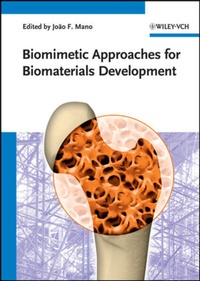
Biomimetic Approaches for Biomaterials Development
1st Edition
Published on 8. February 2013
XXXII, 574 pages
978-3-527-65229-7 (ISBN)
Description

Biomimetics, in general terms, aims at understanding biological principles and applying them for the development of man-made tools
and technologies. This approach is particularly important for the purposeful design of passive as well as functional biomaterials that mimic
physicochemical, mechanical and biological properties of natural materials, making them suitable, for example, for biomedical devices or
as scaffolds for tissue regeneration.
The book comprehensively covers biomimetic approaches to the development of biomaterials, including: an overview of naturally occurring
or nature inspired biomaterials; an in-depth treatment of the surface aspects pivotal for the functionality; synthesis and self-assembly
methods to prepare devices to be used in mineralized tissues such as bone and teeth; and preparation of biomaterials for the controlled/
sustained release of bioactive agents. The last part reviews the applications of bioinspired materials and principles of design in regenerative
medicine such as in-situ grown bone or cartilage as well as the biomimetic techniques for soft tissue engineering.
The comprehensive scope of this book makes it a must-have addition to the bookshelf of everyone in the fields of Materials Science/Engineering, Nanotechnologies / Nanosciences, Medical Sciences, Biochemistry, Polymer Chemistry, and Biomedical Engineering.
and technologies. This approach is particularly important for the purposeful design of passive as well as functional biomaterials that mimic
physicochemical, mechanical and biological properties of natural materials, making them suitable, for example, for biomedical devices or
as scaffolds for tissue regeneration.
The book comprehensively covers biomimetic approaches to the development of biomaterials, including: an overview of naturally occurring
or nature inspired biomaterials; an in-depth treatment of the surface aspects pivotal for the functionality; synthesis and self-assembly
methods to prepare devices to be used in mineralized tissues such as bone and teeth; and preparation of biomaterials for the controlled/
sustained release of bioactive agents. The last part reviews the applications of bioinspired materials and principles of design in regenerative
medicine such as in-situ grown bone or cartilage as well as the biomimetic techniques for soft tissue engineering.
The comprehensive scope of this book makes it a must-have addition to the bookshelf of everyone in the fields of Materials Science/Engineering, Nanotechnologies / Nanosciences, Medical Sciences, Biochemistry, Polymer Chemistry, and Biomedical Engineering.
More details
Other editions
Additional editions
Software
12/2012
Wiley-VCH
€253.12
No shipping information available
Joao F. Mano
Biomimetic Approaches for Biomaterials Development
Book
10/2012
1st Edition
Wiley-VCH
€192.00
Article exhausted; check different version
Person
João F. Mano (CEng, PhD, DSc) is an Associate Professor at the Polymer Engineering Department, University of Minho, Portugal, and principal investigator at the 3B's research group - Biomaterials, Biodegradables and Biomimetics. He is the former director of the Master's Program in Biomedical Engineering at the University of Minho. His current research interests include the development of new materials and concepts for biomedical applications, especially aimed at being used in tissue engineering and in drug delivery systems. In particular, he has been developing biomaterials and surfaces that can react to external stimuli, or biomimetic and nanotechnology approaches to be used in the biomedical area. J.F. Mano authored more than 330 papers in international journals and three patents. He belongs to the editorial boards of 5 well-established international journals. J.F. Mano awarded the 'Stimulus to Excellence' by the Portuguese Minister for Science and Technology in 2005, the 'Materials Science and Technology Prize', attributed by the Federation of European Materials Societies in 2007 and the major 'BES innovation award' in 2010.
Content
PREFACE
PART I: Examples of Natural and Nature-Inspired Materials
BIOMATERIALS FROM MARINE-ORIGIN BIOPOLYMERS
Taking Inspiration from the Sea
Marine-Origin Biopolymers
Marine-Based Tissue Engineering Approaches
Conclusions
HYDROGELS FROM PROTEIN ENGINEERING
Introduction
Principles of Protein Engineering
Structural Diversity and Applications of Protein-Engineered Hydrogels
Development of Biomimetic Protein-Engineered Hydrogels for Tissue Engineering Applications
Conclusions and Future Perspective
COLLAGEN-BASED BIOMATERIALS FOR REGENERATIVE MEDICINE
Introduction
Collagens In Vivo
Collagen In Vitro
Collagen Hydrogels
Collagen Sponges
Multichannel Collagen Scaffolds
What Tissues Do Collagen Biomaterials Mimic? (see Table 3.1)
Concluding Remarks
SILK-BASED BIOMATERIALS
Introduction
Silk Proteins
Mechanical Properties
Biomedical Applications of Silk
Final Remarks
ELASTINLIKE MACROMOLECULES
General Introduction
Materials Engineering - an Overview on Synthetic and Natural Biomaterials
Elastin as a Source of Inspiration for Nature-Inspired Polymers
Nature-Inspired Biosynthetic Elastins
ELRs as Advanced Materials for Biomedical Applications
Conclusions
BIOMIMETIC MOLECULAR RECOGNITION ELEMENTS FOR CHEMICAL SENSING
Introduction
Theory of Molecular Recognition
Molecularly Imprinted Polymers
Supramolecular Chemistry
5 Biomolecular Materials
Summary and Future of Biomimetic-Sensor-Coating Materials
PART II: Surfaces Aspects
BIOLOGY LESSONS FOR ENGINEERING SURFACES FOR CONTROLLING CELL- MATERIAL ADHESION
Introduction
The Extracellular Matrix
Protein Structure
Basics of Protein Adsorption
Kinetics of Protein Adsorption
Cell Communication
Cell Adhesion Background
Integrins and Adhesive Force Generation Overview
Adhesive Interactions in Cell, and Host Responses to Biomaterials
Model Systems for Controlling Integrin-Mediated Cell Adhesion
Self-Assembling Monolayers (SAMs)
Real-World Materials for Medical Applications
Bio-Inspired, Adhesive Materials: New Routes to Promote Tissue Repair and Regeneration
Dynamic Biomaterials
FIBRONECTIN FIBRILLOGENESIS AT THE CELL- MATERIAL INTERFACE
Introduction
Cell-Driven Fibronectin Fibrillogenesis
Cell-Free Assembly of Fibronectin Fibrils
Material-Driven Fibronectin Fibrillogenesis
NANOSCALE CONTROL OF CELL BEHAVIOR IN BIOINTERFACES
Nanoscale Cues in Cell Environment
Biomimetics of Cell Environment Using Interfaces
Cell Responses to Nanostructured Materials
The Road Ahead
SURFACES WITH EXTREME WETTABILITY RANGES FOR BIOMEDICAL APPLICATIONS
Superhydrophobic Surfaces in Nature
Theory of Surface Wettability
Fabrication of Extreme Water-Repellent Surfaces Inspired by Nature
Applications of Surfaces with Extreme Wettability Ranges in the Biomedical Field
Conclusions
BIO-INSPIRED REVERSIBLE ADHESIVES FOR DRY AND WET CONDITIONS
Introduction
Gecko-Like Dry Adhesives
Bioinspired Adhesives for Wet Conditions
The Future of Bio-Inspired Reversible Adhesives
LESSONS FROM SEA ORGANISMS TO PRODUCE NEW BIOMEDICAL ADHESIVES
Introduction
Composition of Natural Adhesives
Recombinant Adhesive Proteins
Production of Bio-Inspired Synthetic Adhesive Polymers
Perspectives
PART III: Hard and Mineralized Systems
INTERFACIAL FORCES AND INTERFACES IN HARD BIOMATERIAL MECHANICS
Introduction
Hard Biological Materials
Bioengineering and Biomimetics
Summary
NACRE-INSPIRED BIOMATERIALS
Introduction
Structure of Nacre
Why Is Nacre So Strong?
Strategies to Produce Nacre-Inspired Biomaterials
Conclusions
SURFACES INDUCING BIOMINERALIZATION
Mineralized Structures in Nature: the Example of Bone
Learning from Nature to the Research Laboratory
Smart Mineralizing Surfaces
In Situ Self-Assembly on Implant Surfaces to Direct Mineralization
Conclusions
BIOACTIVE NANOCOMPOSITES CONTAINING SILICATE PHASES FOR BONE REPLACEMENT AND REGENERATION
Introduction
Nanostructure and Nanofeatures of the Bone
Nanocomposites-Containing Silicate Nanophases
Final Considerations
PART IV: Systems for the Delivery of Bioactive Agents
BIOMIMETIC NANOS
PART I: Examples of Natural and Nature-Inspired Materials
BIOMATERIALS FROM MARINE-ORIGIN BIOPOLYMERS
Taking Inspiration from the Sea
Marine-Origin Biopolymers
Marine-Based Tissue Engineering Approaches
Conclusions
HYDROGELS FROM PROTEIN ENGINEERING
Introduction
Principles of Protein Engineering
Structural Diversity and Applications of Protein-Engineered Hydrogels
Development of Biomimetic Protein-Engineered Hydrogels for Tissue Engineering Applications
Conclusions and Future Perspective
COLLAGEN-BASED BIOMATERIALS FOR REGENERATIVE MEDICINE
Introduction
Collagens In Vivo
Collagen In Vitro
Collagen Hydrogels
Collagen Sponges
Multichannel Collagen Scaffolds
What Tissues Do Collagen Biomaterials Mimic? (see Table 3.1)
Concluding Remarks
SILK-BASED BIOMATERIALS
Introduction
Silk Proteins
Mechanical Properties
Biomedical Applications of Silk
Final Remarks
ELASTINLIKE MACROMOLECULES
General Introduction
Materials Engineering - an Overview on Synthetic and Natural Biomaterials
Elastin as a Source of Inspiration for Nature-Inspired Polymers
Nature-Inspired Biosynthetic Elastins
ELRs as Advanced Materials for Biomedical Applications
Conclusions
BIOMIMETIC MOLECULAR RECOGNITION ELEMENTS FOR CHEMICAL SENSING
Introduction
Theory of Molecular Recognition
Molecularly Imprinted Polymers
Supramolecular Chemistry
5 Biomolecular Materials
Summary and Future of Biomimetic-Sensor-Coating Materials
PART II: Surfaces Aspects
BIOLOGY LESSONS FOR ENGINEERING SURFACES FOR CONTROLLING CELL- MATERIAL ADHESION
Introduction
The Extracellular Matrix
Protein Structure
Basics of Protein Adsorption
Kinetics of Protein Adsorption
Cell Communication
Cell Adhesion Background
Integrins and Adhesive Force Generation Overview
Adhesive Interactions in Cell, and Host Responses to Biomaterials
Model Systems for Controlling Integrin-Mediated Cell Adhesion
Self-Assembling Monolayers (SAMs)
Real-World Materials for Medical Applications
Bio-Inspired, Adhesive Materials: New Routes to Promote Tissue Repair and Regeneration
Dynamic Biomaterials
FIBRONECTIN FIBRILLOGENESIS AT THE CELL- MATERIAL INTERFACE
Introduction
Cell-Driven Fibronectin Fibrillogenesis
Cell-Free Assembly of Fibronectin Fibrils
Material-Driven Fibronectin Fibrillogenesis
NANOSCALE CONTROL OF CELL BEHAVIOR IN BIOINTERFACES
Nanoscale Cues in Cell Environment
Biomimetics of Cell Environment Using Interfaces
Cell Responses to Nanostructured Materials
The Road Ahead
SURFACES WITH EXTREME WETTABILITY RANGES FOR BIOMEDICAL APPLICATIONS
Superhydrophobic Surfaces in Nature
Theory of Surface Wettability
Fabrication of Extreme Water-Repellent Surfaces Inspired by Nature
Applications of Surfaces with Extreme Wettability Ranges in the Biomedical Field
Conclusions
BIO-INSPIRED REVERSIBLE ADHESIVES FOR DRY AND WET CONDITIONS
Introduction
Gecko-Like Dry Adhesives
Bioinspired Adhesives for Wet Conditions
The Future of Bio-Inspired Reversible Adhesives
LESSONS FROM SEA ORGANISMS TO PRODUCE NEW BIOMEDICAL ADHESIVES
Introduction
Composition of Natural Adhesives
Recombinant Adhesive Proteins
Production of Bio-Inspired Synthetic Adhesive Polymers
Perspectives
PART III: Hard and Mineralized Systems
INTERFACIAL FORCES AND INTERFACES IN HARD BIOMATERIAL MECHANICS
Introduction
Hard Biological Materials
Bioengineering and Biomimetics
Summary
NACRE-INSPIRED BIOMATERIALS
Introduction
Structure of Nacre
Why Is Nacre So Strong?
Strategies to Produce Nacre-Inspired Biomaterials
Conclusions
SURFACES INDUCING BIOMINERALIZATION
Mineralized Structures in Nature: the Example of Bone
Learning from Nature to the Research Laboratory
Smart Mineralizing Surfaces
In Situ Self-Assembly on Implant Surfaces to Direct Mineralization
Conclusions
BIOACTIVE NANOCOMPOSITES CONTAINING SILICATE PHASES FOR BONE REPLACEMENT AND REGENERATION
Introduction
Nanostructure and Nanofeatures of the Bone
Nanocomposites-Containing Silicate Nanophases
Final Considerations
PART IV: Systems for the Delivery of Bioactive Agents
BIOMIMETIC NANOS
List of Contributors
Carmen Alvarez-Lorenzo Universidad de Santiago de Compostela Facultad de Farmacia Dept. Farmacia y Tecnologia Farmaceutica 15782 Santiago de Compostela Spain Natália M. Alves University of Minho 3B's Research Group-Biomaterials Biodegradables and Biomimetics Department of Polymer Engineering Headquarters of the European Institute of Excellence on Tissue Engineering and Regenerative Medicine AvePark 4806-909 Caldas das Taipas Guimarães Portugal and ICVS/3B's PT Government Associate Laboratory Braga/Guimarães Portugal Helena S. Azevedo University of Minho 3B's Research Group-Biomaterials Biodegradables and Biomimetics Department of Polymer Engineering Headquarters of the European Institute of Excellence on Tissue Engineering and Regenerative Medicine AvePark 4806-909 Caldas das Taipas Guimarães Portugal and ICVS/3B's PT Government Associate Laboratory Braga/Guimarães Portugal Pierre Becker University of Mons-UMONS Biology of Marine Organisms and Biomimetics 20 Place du Parc 7000 Mons Belgium Aldo R. Boccaccini University of Erlangen-Nuremberg Department of Materials Science and Engineering Institute of Biomaterials Cauerstraße 6 91058 Erlangen Germany Marco Cantini Universitat Politècnica de València Center for Biomaterials and Tissue Engineering Camino de Vera s/n 46022 Valencia Spain E. Ada Cavalcanti-Adam University of Heidelberg Department of Biophysical Chemistry Institute for Physical Chemistry Im Neuenheimer Feld 253 69120 Heidelberg Germany and Max Planck Institute for Intelligent Systems Department of New Materials and Biosystems Heisenbergstr. 3 70569 Stuttgart Germany Angel Concheiro Universidad de Santiago de Compostela Facultad de Farmacia Dept. Farmacia y Tecnologia Farmaceutica 15782 Santiago de Compostela Spain Rui R. Costa University of Minho 3B's Research Group-Biomaterials Biodegradables and Biomimetics Headquarters of the European Institute of Excellence on Tissue Engineering and Regenerative Medicine AvePark 4806-909 Caldas das Taipas Guimarães Portugal and ICVS/3B's PT Government Associate Laboratory Braga/Guimarães Portugal Daniela F. Coutinho Center for Biomedical Engineering Department of Medicine Brigham and Women's Hospital Harvard Medical School 65, Landsdowne street Cambridge, MA 02139 USA and Harvard-MIT dicision of Health Science and Technology Massachussetts Institute of Technology 65 Landsdowne Street Cambridge, MA 02139 USA and University of Minho 3B's Research Group-Biomaterials Biodegradables and Biomimetics Department of Polymer Engineering Headquarters of the European Institute of Excellence on Tissue Engineering and Regenerative Medicine AvePark 4806-909 Caldas das Taipas Guimarães Portugal and ICVS/3B's PT Government Associate Laboratory Braga/Guimarães Portugal Aránzazu del Campo Max-Planck-Institut für Polymerforschung Minerva Group Ackermannweg 10 55128 Mainz Germany Ana R.C. Duarte University of Minho 3B's Research Group-Biomaterials Biodegradables and Biomimetics Department of Polymer Engineering Headquarters of the European Institute of Excellence on Tissue Engineering and Regenerative Medicine AvePark 4806-909 Caldas das Taipas Guimarães Portugal and ICVS/3B's PT Government Associate Laboratory Braga/Guimarães Portugal Devendra K. Dubey Purdue University School of Aeronautics and Astronautics West Lafayette, IN 47907 USA Melek Erol Istanbul Technical University Department of Chemical Engineering Istanbul Technical University Maslak 34469 Istanbul Turkey Juan Pedro Fernández-Blázquez Max-Planck-Institut für Polymerforschung Minerva Group Ackermannweg 10 55128 Mainz Germany Patrick Flammang University of Mons-UMONS Biology of Marine Organisms and Biomimetics 20 Place du Parc 7000 Mons Belgium Andrés J. García Woodruff School of Mechanical Engineering Petit Institute for Bioengineering and Bioscience Georgia Institute of Technology 315 Ferst Drive Atlanta, GA 30332-0363 USA Sílvia Gomes University of Minho 3B's Research Group-Biomaterials Biodegradables and Biomimetics Department of Polymer Engineering Headquarters of the European Institute of Excellence on Tissue Engineering and Regenerative Medicine AvePark 4806-909 Caldas das Taipas Guimarães Portugal and ICVS/3B's PT Government Associate Laboratory Braga/Guimarães Portugal and Tufts University Department of Biomedical Engineering 4 Colby Street Medford, MA 02155 USA Midori Greenwood-Goodwin Stanford University Bioengineering 318 Campus Drive Stanford, CA 94305-5444 USA Sarah C. Heilshorn Stanford University Materials Science and Engineering 476 Lomita Mall Stanford, CA 94305-4045 USA Christophe Helary National University of Ireland Network of Excellence for Functional Biomaterials (NFB) IDA Business Park Newcastle Road Galway Ireland Elise Hennebert University of Mons-UMONS Biology of Marine Organisms and Biomimetics 20 Place du Parc 7000 Mons Belgium Jasmin Hum University of Erlangen-Nuremberg Department of Materials Science and Engineering Institute of Biomaterials Cauerstraße 6 91058 Erlangen Germany Michele Iafisco Alma Mater Studiorum Università di Bologna Dipartimento di Chimica "G. Ciamician" Via Selmi 2 40126 Bologna Italy Eran Ivanir Department of Biomedical Engineering Technion-Israel Institute of Technology Technion City Haifa 32000 Israel Justyn Jaworski Hanyang University Department of Chemical Engineering 222 Wangsimni-ro Seongdong-gu Seoul 133-791 South Korea David L. Kaplan Tufts University Department of Biomedical Engineering 4 Colby Street Medford, MA 02155 USA Ali Khademhosseini Center for Biomedical Engineering Department of...