

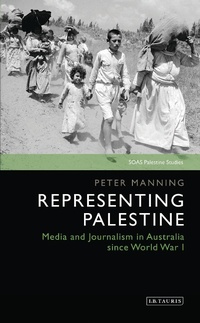
Representing Palestine
Media and Journalism in Australia Since World War I
1st Edition
Published on 30. July 2018
304 pages
978-1-83860-903-0 (ISBN)
Description

After more than half a century, the Israel-Palestine conflict continues to dominate headlines. But how has the coverage of Palestinians by foreign media changed? How did foreign correspondents influence the perception of Palestine amongst their audiences? And why is understanding this so important?
Based on extensive original research in the archives of Australia's oldest newspaper, Peter Manning shows how the Sydney Morning Herald portrayed Palestine during three key periods - the end of World War I (1917-8); the Nakba and the creation of Israel (1947-8); and 9/11 and its aftermath (2000-2). In the process, he takes the reader on a unique journey from the moment information was gathered on the ground in Palestine, through to its final processing and publication. Crucially, when correspondents neglected to write about Palestinians, their perspective never made it to readers and a space emerged for stereotyping and misunderstanding.
Manning reveals how the newspaper reported on key events such as Australian troops in Palestine and the Holocaust, but also how the newspaper failed to cover massacres and forced migrations. Combining close textual analysis of more than 10,000 articles with cutting-edge quantitative research methods, this book is important reading for anyone with an interest in how the print media has portrayed the conflict in Palestine - both in Australia and beyond.
Based on extensive original research in the archives of Australia's oldest newspaper, Peter Manning shows how the Sydney Morning Herald portrayed Palestine during three key periods - the end of World War I (1917-8); the Nakba and the creation of Israel (1947-8); and 9/11 and its aftermath (2000-2). In the process, he takes the reader on a unique journey from the moment information was gathered on the ground in Palestine, through to its final processing and publication. Crucially, when correspondents neglected to write about Palestinians, their perspective never made it to readers and a space emerged for stereotyping and misunderstanding.
Manning reveals how the newspaper reported on key events such as Australian troops in Palestine and the Holocaust, but also how the newspaper failed to cover massacres and forced migrations. Combining close textual analysis of more than 10,000 articles with cutting-edge quantitative research methods, this book is important reading for anyone with an interest in how the print media has portrayed the conflict in Palestine - both in Australia and beyond.
More details
Edition
1. Auflage
Language
English
Place of publication
London
United Kingdom
Publishing group
Bloomsbury Publishing PLC
Target group
Professional and scholarly
Illustrations
Halftones, color; 8 Halftones, black and white
ISBN-13
978-1-83860-903-0 (9781838609030)
Copyright in bibliographic data and cover images is held by Nielsen Book Services Limited or by the publishers or by their respective licensors: all rights reserved.
Schweitzer Classification
Other editions
Additional editions
Book
11/2020
I.B. Tauris
€60.91
Shipment within 10-20 days
Book
07/2018
I.B. Tauris
€126.48
Article exhausted; check different version
Person
Peter Manning is Adjunct Professor at the University of Technology, Sydney, where he also received his PhD in 2014. Before turning to academia, he was an investigative reporter, producer and then executive producer of Four Corners in the 1980s and head of ABC TV News and Current Affairs in the early 1990s, starting Lateline, Foreign Correspondent and Landline. He later went on to be head of Current Affairs at the Seven Network.
Content
- Cover
- Title
- Copyright
- Dedication
- Contents
- List of Illustrations
- Abbreviations
- Foreword to the SOAS Palestine Studies Book Series
- Acknowledgements
- Introduction
- Methodology
- Scholarly Implications
- Roadmap of the Book
- 1. Reporting Palestine in World War I
- Historical Context
- The SMH at War
- Reporting Palestine
- The Holy Land Narrative and Jerusalem
- The Jews and Zionism
- Stories Untold
- War Correspondent in Context
- Conclusion
- 2. Palestine's Competing Narratives after World War II
- Perceptions of the Jewish Emigration to Palestine 1947
- Australia's External Affairs Minister, Dr H.V. Evatt
- The Palestinian Catastrophe (The Nakba) of 1947 - 8
- 3. Words for War and Partition
- Terms of the Chosen Sample
- The 'New' SMH of 1947 - 8
- Reporting Palestine and Israel, 1947 - 8
- 4. The 'Special Correspondent' in Palestine, 1948
- The Journalists' Union New Code of Ethics
- 'Facts' v. 'Opinion', 'News' v. 'Features'
- By-Line Policy: Names, 'Special Correspondent' and 'Staff Correspondent'
- News Reporting from Palestine
- The SMH's 'Special Correspondent' in Palestine
- The Body of Work of the 'Special Correspondent'
- 5. The 'Staff Correspondent' in Palestine, 1948
- The SMH's 'Staff Correspondent' in Palestine
- The Body of Work of the Staff Correspondent
- One Land, Two Reporters: The Special Correspondent and the Staff Correspondent
- 6. Opinion on Palestine: Editors and Specialists
- The Organs of Opinion in the SMH
- Editorials in the SMH, 1947 - 8
- 'News Features' in the SMH, 1947 - 8
- 7. How to Miss the Palestinian Nakba, 1948
- Conclusion Palestinians: From Low to High Visibility
- Notes
- Bibliography
- Index
