

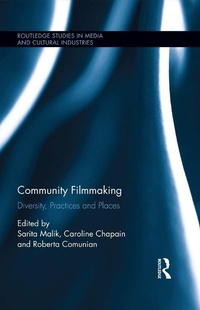
Community Filmmaking
Diversity, Practices and Places
Published on 28. April 2017
304 pages
978-1-317-28387-4 (ISBN)
Description

This book examines the role of community filmmaking in society and its connection with issues of cultural diversity, innovation, policy and practice in various places. Deploying a range of examples from Europe, North America, Australia and Hong Kong, the chapters show that film emerging from outside the mainstream film industries and within community contexts can lead to innovation in terms of both content and processes and a better representation of the cultural diversity of a range of communities and places. The book aims to situate the community filmmaker as the central node in the complex network of relationships between diverse communities, funding bodies, policy and the film industries.
Reviews / Votes
"Community Filmmaking takes up central issues in contemporary media studies, from representational politics and public policy to screen culture and civic engagement, in a unique and productive fashion. Theoretically sophisticated and empirically rich, this volume is a welcome addition to a growing body of scholarship on community, participatory and collaborative media practices." --Kevin Howley, DePauw University, USAMore details
Series
Language
English
Place of publication
London
United Kingdom
Publishing group
Taylor & Francis Ltd
Target group
College/higher education
Illustrations
6 s/w Abbildungen, 1 s/w Tabelle, 3 s/w Photographien bzw. Rasterbilder, 3 s/w Zeichnungen
1 Tables, black and white; 3 Line drawings, black and white; 3 Halftones, black and white; 6 Illustrations, black and white
File size
2,52 MB
ISBN-13
978-1-317-28387-4 (9781317283874)
Copyright in bibliographic data and cover images is held by Nielsen Book Services Limited or by the publishers or by their respective licensors: all rights reserved.
Schweitzer Classification
Other editions
Additional editions
Sarita Malik | Caroline Chapain | Roberta Comunian
Community Filmmaking
Diversity, Practices and Places
Book
12/2019
1st Edition
Routledge
€65.80
Shipment within 15-20 days
Sarita Malik | Caroline Chapain | Roberta Comunian
Community Filmmaking
Diversity, Practices and Places
Book
04/2017
1st Edition
Routledge
€206.80
Shipment within 10-20 days
Persons
Sarita Malik is Professor of Media, Culture and Communications at Brunel University London. Her research explores questions of social change, inequality, communities, and cultural representation. Her publications include Representing Black Britain (Sage 2002) and several article on race, representation and the media, and on diversity and cultural policy.
Caroline Chapain is a Lecturer in Economic Development at the Business School, University of Birmingham, UK. Her research focuses on topics related to the creative industries, creative clusters, innovation, creative citizenship, creative cities and local and regional economic development and policies. In the last ten years she has undertaken research on these topics within the UK and in collaboration with colleagues across Europe.
Roberta Comunian is Lecturer in Cultural and Creative Industries at the Department for Culture, Media and Creative Industries at King's College London, UK. Her research interests include: relationship between public and private investments in the arts, art and cultural regeneration projects, cultural and creative industries, creativity and competitiveness. Her most recent works have been published in Geoforum, Journal of Education and Work,?International Journal of Cultural and Creative Industries, and Cultural Trends.
?
Caroline Chapain is a Lecturer in Economic Development at the Business School, University of Birmingham, UK. Her research focuses on topics related to the creative industries, creative clusters, innovation, creative citizenship, creative cities and local and regional economic development and policies. In the last ten years she has undertaken research on these topics within the UK and in collaboration with colleagues across Europe.
Roberta Comunian is Lecturer in Cultural and Creative Industries at the Department for Culture, Media and Creative Industries at King's College London, UK. Her research interests include: relationship between public and private investments in the arts, art and cultural regeneration projects, cultural and creative industries, creativity and competitiveness. Her most recent works have been published in Geoforum, Journal of Education and Work,?International Journal of Cultural and Creative Industries, and Cultural Trends.
?
Content
Preface
[Yudhishthir Raj Isar]
1. Community Filmmaking and Cultural Diversity: An Introduction
[Sarita Malik, Caroline Chapain and Roberta Comunian]
Part I: Communities, Diversity and Representation: A Short Introduction
Diversity, Representation and Community Filmmaking: A Short Introduction
[Sarita Malik]
2. Digital Stories, Participatory Practices and Life/Britain in a Day: Framing Creativity and Debating Diversity
[Daniel Ashton]
3. Whose Hong Kong? Cellphilming and Civic Engagement with Ethnic Minority Youth
[Casey Burkholder]
4. Representing Scottish Communities on Screen
[Alistair Scott]
Part II: Networks and Intermediaries
Networks and Intermediaries and Community Filmmaking: A Short Introduction
[Roberta Comunian]
5. 52 Tuesdays: Community Cinema in a Global Context
[Virginia Murray and Kath Dooley]
6. The Collaborative Practices of the Authorless Cinema Collective (Colectivo de Cine Sin Autor)
[Asier Aranzubia, Miguel Fernandez Labayen and Aitor Iturriza]
7. Community Media as Social Innovation: Transformation, Agency and Value
[Jonathan Dovey, Shawn Sobers and Emma Agusita]
Part III: Practices in Places and For Places
Practices in Places and For Places: A Short Introduction
[Caroline Chapain]
8. Surfing Multiple Tides: Opportunities and Challenges for Contemporary British and German Community Filmmakers.
[Daniel Mutibwa]
9. Participatory production processes in community filmmaking during urban regeneration in Dublin
[Eileen Leahy]
10. Rewalking the Path: Community Video, Deep Cultural Mapping and Sustainable Canadian Cities
[Sharon Karsten]
Part IV: Engagement and Participation
Engagement and Participation: A Short Introduction
[Sarita Malik, Caroline Chapain, and Roberta Comunian]
11. Heaven is a Place: The politics and poetics of LGBT location in a community dance film
[Roberta Mock, Kayla Parker and Ruth Way]
12. 'One Screening Away From Disaster': Precarity and Commitment in the Radical Film Network's Community Exhibition Sector
[Steve Presence]
13. The filmmakers of tomorrow or the problems of today: Creativity, skills and cultural identity in British youth filmmaking
[Alicia Blum-Ross]
14. "Can We Fast Forward to the Good Bits?:" Working With Film: Revisiting the Field of Practice
[Kate Pahl and Steve Pool]
Conclusion: Embracing the Complexity of Community Filmmaking and Diversity
[Sarita Malik, Caroline Chapain and Roberta Comunian]
[Yudhishthir Raj Isar]
1. Community Filmmaking and Cultural Diversity: An Introduction
[Sarita Malik, Caroline Chapain and Roberta Comunian]
Part I: Communities, Diversity and Representation: A Short Introduction
Diversity, Representation and Community Filmmaking: A Short Introduction
[Sarita Malik]
2. Digital Stories, Participatory Practices and Life/Britain in a Day: Framing Creativity and Debating Diversity
[Daniel Ashton]
3. Whose Hong Kong? Cellphilming and Civic Engagement with Ethnic Minority Youth
[Casey Burkholder]
4. Representing Scottish Communities on Screen
[Alistair Scott]
Part II: Networks and Intermediaries
Networks and Intermediaries and Community Filmmaking: A Short Introduction
[Roberta Comunian]
5. 52 Tuesdays: Community Cinema in a Global Context
[Virginia Murray and Kath Dooley]
6. The Collaborative Practices of the Authorless Cinema Collective (Colectivo de Cine Sin Autor)
[Asier Aranzubia, Miguel Fernandez Labayen and Aitor Iturriza]
7. Community Media as Social Innovation: Transformation, Agency and Value
[Jonathan Dovey, Shawn Sobers and Emma Agusita]
Part III: Practices in Places and For Places
Practices in Places and For Places: A Short Introduction
[Caroline Chapain]
8. Surfing Multiple Tides: Opportunities and Challenges for Contemporary British and German Community Filmmakers.
[Daniel Mutibwa]
9. Participatory production processes in community filmmaking during urban regeneration in Dublin
[Eileen Leahy]
10. Rewalking the Path: Community Video, Deep Cultural Mapping and Sustainable Canadian Cities
[Sharon Karsten]
Part IV: Engagement and Participation
Engagement and Participation: A Short Introduction
[Sarita Malik, Caroline Chapain, and Roberta Comunian]
11. Heaven is a Place: The politics and poetics of LGBT location in a community dance film
[Roberta Mock, Kayla Parker and Ruth Way]
12. 'One Screening Away From Disaster': Precarity and Commitment in the Radical Film Network's Community Exhibition Sector
[Steve Presence]
13. The filmmakers of tomorrow or the problems of today: Creativity, skills and cultural identity in British youth filmmaking
[Alicia Blum-Ross]
14. "Can We Fast Forward to the Good Bits?:" Working With Film: Revisiting the Field of Practice
[Kate Pahl and Steve Pool]
Conclusion: Embracing the Complexity of Community Filmmaking and Diversity
[Sarita Malik, Caroline Chapain and Roberta Comunian]
