

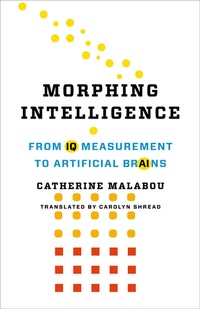
Morphing Intelligence
From IQ Measurement to Artificial Brains
1st Edition
Published on 29. January 2019
224 pages
978-0-231-54723-9 (ISBN)
Description

What is intelligence? The concept crosses and blurs the boundaries between natural and artificial, bridging the human brain and the cybernetic world of AI. In this book, the acclaimed philosopher Catherine Malabou ventures a new approach that emphasizes the intertwined, networked relationships among the biological, the technological, and the symbolic.
Malabou traces the modern metamorphoses of intelligence, seeking to understand how neurobiological and neurotechnological advances have transformed our view. She considers three crucial developments: the notion of intelligence as an empirical, genetically based quality measurable by standardized tests; the shift to the epigenetic paradigm, with its emphasis on neural plasticity; and the dawn of artificial intelligence, with its potential to simulate, replicate, and ultimately surpass the workings of the brain. Malabou concludes that a dialogue between human and cybernetic intelligence offers the best if not the only means to build a democratic future. A strikingly original exploration of our changing notions of intelligence and the human and their far-reaching philosophical and political implications, Morphing Intelligence is an essential analysis of the porous border between symbolic and biological life at a time when once-clear distinctions between mind and machine have become uncertain.
Malabou traces the modern metamorphoses of intelligence, seeking to understand how neurobiological and neurotechnological advances have transformed our view. She considers three crucial developments: the notion of intelligence as an empirical, genetically based quality measurable by standardized tests; the shift to the epigenetic paradigm, with its emphasis on neural plasticity; and the dawn of artificial intelligence, with its potential to simulate, replicate, and ultimately surpass the workings of the brain. Malabou concludes that a dialogue between human and cybernetic intelligence offers the best if not the only means to build a democratic future. A strikingly original exploration of our changing notions of intelligence and the human and their far-reaching philosophical and political implications, Morphing Intelligence is an essential analysis of the porous border between symbolic and biological life at a time when once-clear distinctions between mind and machine have become uncertain.
All prices
More details
Other editions
Additional editions
Book
04/2021
Columbia University Press
€22.27
Shipment within 10-20 days
Book
02/2019
Columbia University Press
€27.24
Shipment within 10-20 days
Persons
Malabou Catherine :
Catherine Malabou (PhD, Philosophy, Ecole normale superieure de Fontenay-St. Cloud) is Professor of Comparative Literature at UC Irvine. She is the author of a number of books, including (translated into English) Before Tomorrow: Epigenesis and Rationality (Polity, 2016), Ontology of the Accident (Polity, 2012), The New Wounded: From Neurosis to Brain Damage (Fordham, 2012), The Heidegger Change: On the Fantastic in Philosophy (SUNY, 2011), Cganging Difference: The Feminine and the Question of Philosophy (Polity, 2011), Plasticity at the Dusk of Writing (Columbia, 2009), What Should We Do with Our Brain? (Fordham, 2008), The Future of Hegel: Plasticity, Temporality, and Dialectic (Routledge, 2004), (with Jacques Derrida) Counterpath (Stanford, 2004), and (with Adrian Johnston) Self and Emotional Life: Philosophy, Psychoanalysis, Neurobiology (Columbia, 2013).Shread Carolyn :
Carolyn Shread (PhD, French University of Massachusetts at Amherst) is a Lecturer in French at Mt. Holyoke College. Her articles have appeared in TTR; NeoHelicon; Palimpsestes; French Literature Series and The Journal of Haitian Studies. In 2012, her article "On Becoming in Translation: Articulating Feminisms in the Translation of Marie Vieux-Chauvet's Les Rapaces" won a national research award, the Florence Howe Award for Outstanding Feminist Scholarship.She has translated ten books, including four by Catherine Malabou.Catherine Malabou is professor of philosophy at the Centre for Research in Modern European Philosophy at Kingston University, London, and of comparative literature at the University of California, Irvine. Her many books include What Should We Do with Our Brain? (2008), Plasticity at the Dusk of Writing (Columbia, 2009), and Before Tomorrow: Epigenesis and Rationality (2016).
Carolyn Shread is lecturer in French at Mount Holyoke College and teaches translation studies at Smith College. Her translations include several works by Catherine Malabou.
Catherine Malabou (PhD, Philosophy, Ecole normale superieure de Fontenay-St. Cloud) is Professor of Comparative Literature at UC Irvine. She is the author of a number of books, including (translated into English) Before Tomorrow: Epigenesis and Rationality (Polity, 2016), Ontology of the Accident (Polity, 2012), The New Wounded: From Neurosis to Brain Damage (Fordham, 2012), The Heidegger Change: On the Fantastic in Philosophy (SUNY, 2011), Cganging Difference: The Feminine and the Question of Philosophy (Polity, 2011), Plasticity at the Dusk of Writing (Columbia, 2009), What Should We Do with Our Brain? (Fordham, 2008), The Future of Hegel: Plasticity, Temporality, and Dialectic (Routledge, 2004), (with Jacques Derrida) Counterpath (Stanford, 2004), and (with Adrian Johnston) Self and Emotional Life: Philosophy, Psychoanalysis, Neurobiology (Columbia, 2013).Shread Carolyn :
Carolyn Shread (PhD, French University of Massachusetts at Amherst) is a Lecturer in French at Mt. Holyoke College. Her articles have appeared in TTR; NeoHelicon; Palimpsestes; French Literature Series and The Journal of Haitian Studies. In 2012, her article "On Becoming in Translation: Articulating Feminisms in the Translation of Marie Vieux-Chauvet's Les Rapaces" won a national research award, the Florence Howe Award for Outstanding Feminist Scholarship.She has translated ten books, including four by Catherine Malabou.Catherine Malabou is professor of philosophy at the Centre for Research in Modern European Philosophy at Kingston University, London, and of comparative literature at the University of California, Irvine. Her many books include What Should We Do with Our Brain? (2008), Plasticity at the Dusk of Writing (Columbia, 2009), and Before Tomorrow: Epigenesis and Rationality (2016).
Carolyn Shread is lecturer in French at Mount Holyoke College and teaches translation studies at Smith College. Her translations include several works by Catherine Malabou.
Content
Translator's Foreword: Why I Translate So Intelligently: Translation Mètis in the Era of Google Translate
Acknowledgments
Preface
Introduction
1. g: Intelligence and Genetic Fate
2. The "Blue Brain"
3. Like a Pollock Painting
Conclusion
Postscript to the English Translation. Artificial Intelligence: The Fourth Blow to Our Narcissism
Notes
Index
Acknowledgments
Preface
Introduction
1. g: Intelligence and Genetic Fate
2. The "Blue Brain"
3. Like a Pollock Painting
Conclusion
Postscript to the English Translation. Artificial Intelligence: The Fourth Blow to Our Narcissism
Notes
Index

