

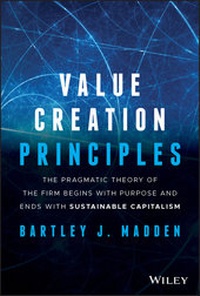
Value Creation Principles
Description

"In Value Creation Principles, Madden introduces the Pragmatic Theory of the Firm that positions the firm as a system fueled by human capital, innovation, and, at a deeper level, imagination. He challenges us to understand how we know what we think we know in order to better discover faulty assumptions that often are camouflaged by language. His knowledge building loop offers guideposts to design experiments and organize feedback to facilitate early adaptation to a changed environment and to avoid being mired in ways of thinking rooted in 'knowledge' of what worked well in the past--a context far different from the context of today. His book explains a way of being that enables those who work for, or invest in, business firms to see beyond accounting silos and short-term quarterly earnings and to focus on capabilities instrumental for creating long-term future and sustainable value for the firm's stakeholders. I can't recommend this astounding book enough especially given its deep and timely insights for our world today."
--John Seely Brown, former Chief Scientist for Xerox Corp and Director of its Palo Alto Research Center (PARC); co-author with Ann Pendleton-Jullian of Design Unbound: Designing for Emergence in a White Water World
"In contrast to existing abstract theories of the firm, Madden's pragmatic theory of the firm connects management's decisions in a practical way to a firm's life cycle and market valuation. The book promotes a firm's knowledge building proficiency, relative to competitors, as the fundamental driver of a firm's long-term performance, which leads to insights about organizational capabilities, intangible assets, and excess shareholder returns. Value Creation Principles is ideally suited to facilitate progress in the New Economy by opening up the process by which firms build knowledge and create value, which is a needed step in revising how neoclassical economics treats the firm."
--Tyler Cowen, Professor of Economics, George Mason University; co-author of the popular economics blog Marginal Revolution
"Bartley Madden rightfully points out that both textbook and more advanced economic theories of the firm fail to address the concerns of top management and boards of directors. He offers a tantalizing pragmatic alternative that directly connects to quantitative changes in the firm's market value. His framework gives recognition to the importance of intangible assets, and his pragmatic approach is quite complementary to the Dynamic Capabilities framework that strategic managers implicitly and sometimes explicitly employ."
--David J. Teece, Thomas W. Tusher Professor in Global Business, Faculty Director, Tusher Center for the Management of Intellectual Capital, Haas School of Business, University of California, Berkeley
More details
Other editions
Additional editions
Person
Content
I A Firm's Role in Society
1 Overview of the Pragmatic Theory of the Firm 3
The Nucleus of the Pragmatic Theory of the Firm 4
The Evolution of Thinking about the Theory of the Firm 7
Kindred Spirits for the Pragmatic Theory of the Firm 10
Innovation and Economic Growth 16
The Purpose of the Firm 24
The Pragmatic Theory of the Firm 30
2 Knowledge Building and Firm Performance 33
The Knowledge-Building Path to Improved Performance 34
The Knowledge-Building Loop 35
Human Behavior, Culture, and Firm Performance 44
Elegant, Parsimonious, and Reliable Theories 48
3 Work, Innovation, and Resource Allocation 53
Lean Thinking--"No Problem is a Problem" 55
The Theory of Constraints 60
Ontological/Phenomenological Model 64
Innovation 69
Resource Allocation 71
The Key Constraint in Sustaining a Knowledge-Building Culture 75
II The Pragmatic Theory of the Firm Connects Innovation and Valuation
4 Life-Cycle Performance and Firm Risk 81
The Firm's Competitive Life Cycle 84
A Paranoid Optimist Restructures Nokia 90
A Case Study of Innovation--Amazon 93
The Life-Cycle Valuation Model 96
What Does a Stock Price Say about a Firm's Future Investments? 99
Forward-Looking, Market-Implied Discount Rate 101
The Roots of Modern Finance 103
Firm Risk Offers a Different Mindset 106
Summary of Key Ideas 110
A Research Methodology for Advancing the Life-Cycle Framework 111
Better Estimates of the investor Discount Rate 116
5 Intangible Assets, Brands, and Shareholder Returns 121
The New Economy and Connectivity-Enabled Business
Models 123
Empirical Evidence about Intangible Assets 126
Brands Impact a Firm's Market Value 129
A Conceptual Roadmap for Handling Intangible Assets 133
Integrated Reports, Life-Cycle Reviews, and Intangibles 139
Expect More Than Coffee--Starbucks 143
Costco Starts by Caring for Its Employees 145
Ringing Doorbells and Changing Times--Avon 148
Why Did Illumina Outperform the Stock Market 18-Fold from 2004 to 2014? 150
The Efficient Market Hypothesis and the Factor Zoo 153
Excess Shareholder Returns and Three Levels of Cause-and-Effect Logic 157
Useful Ideas for Investors, Managements, and Academic Researchers 164
Investors 164
Managements 166
Academic Researchers 167
System Principles and Effective Language 168
III Value Creation
6 Life-Cycle Position, Adaptability, and Organizational Structure 181
Life-Cycle Guideposts 182
Focused Execution of an Innovative Business Model--Netflix 183
Innovation in the Operating Room--Intuitive Surgical 188
Nothing Runs Like a Deere 191
Smith Corona and NCR 194
The ABCs of Organizational Structure 198
Organizational Experimentation at the Haier Group 204
Value Creators Drive Dynamism in China 209
7 Achieving Progress Through Knowledge Building and Value Creation 213
The New Economy and the Pragmatic Theory of the Firm 214
Life-Cycle Track Records are a Scorecard and a Learning Tool 222
Politics and the Greater Good 224
Progress Studies 230
About the Author 239
Index 241
PREFACE AND OVERVIEW
I strongly believe that a firm's long-term performance is a direct result of its knowledge-building proficiency. That belief is the result of my work in two research areas that normally are not connected-finance and knowledge building. First, by way of background, my career in finance began with the startup of the boutique research firm Callard Madden & Associates in 1969. Our primary mission was to understand levels and changes in stock prices worldwide and provide practical insights to enable portfolio managers to make better investment decisions. We devoted considerable effort analyzing management decision-making in the context of a firm's long-term financial performance quantified as life-cycle track records. Over many years I have been fortunate to work with talented colleagues at Callard Madden and later at HOLT Value Associates. Our research addressed a never-ending stream of problems in connecting a firm's accounting-based performance to its market valuation.
While this finance work was progressing, I got hooked on a second research area dealing with how we know what we think we know, which remains my ongoing intellectual passion.1 The more I learned about the knowledge-building process, the clearer it became that knowledge building and value creation are opposite sides of the same coin. The more I analyzed management tasks such as strategy, innovation, employee engagement, development of new capabilities, etc., the more I realized that the root cause of a firm's long-term performance and returns to its shareholders is the firm's knowledge-building proficiency relative to competitors. This book makes what I believe is a strong case that a new holistic theory of the firm, built upon this foundational importance of a firm's knowledge-building proficiency, will improve thinking about the role of firms in society. Moreover, this new theory of the firm is labeled "pragmatic" because it facilitates systems thinking to analyze practical problems thereby leading to improved decision-making for managements, boards, and investors.
Theories of the firm tend to be narrow in scope and ignore how firm performance connects to market valuation. A notable advantage of the pragmatic theory is its explanation of what drives a firm's long-term financial performance and its returns to shareholders. The more one understands long-term stock prices, the better one appreciates the mutual interests of shareholders and other stakeholders.
As to understanding levels and changes in market valuations, my early research at Callard Madden was instrumental in developing the CFROI (cash flow return on investment) valuation model and related global database.2 The CFROI research program is rooted in economically sound principles applied to the construction of long-term, life-cycle track records of a firm's financial performance; the forecasting of a firm's long-term net cash receipts; the calculation of warranted market valuations; and the decoding of investor expectations implied in stock prices. This unique research program was further advanced by HOLT Value Associates, which was acquired by Credit Suisse in 2002. A highly skilled team at Credit Suisse HOLT continues to advance the CFROI valuation framework as part of the Credit Suisse HOLT global database, which is used worldwide by many large money management organizations.
The seven chapters in the book can be distilled into the following fourteen key ideas:
- Purpose of the firm-The pragmatic theory includes a statement of the firm's four-part purpose, as detailed in Chapter 1, which answers the questions: Why does a firm deserve the commitment and support of its stakeholders, and what unchanging principles will guide management's actions? Maximizing shareholder value is best viewed as the result of a firm successfully achieving its purpose.
- History of the theory of the firm-The pragmatic theory is more comprehensive than other theories of the firm and treats the firm as a holistic system. As discussed in Chapter 1, this leads to insights that are otherwise unobtainable. The pragmatic theory integrates the firm as the critical unit of economic growth, thereby expanding upon the key ideas of Paul Romer, Robert Gordon, Joel Mokyr, and Edmund Phelps, as reviewed in Chapter 1.
- Knowledge building-A firm's knowledge-building proficiency is the primary determinant of its long-term performance. Chapter 2 explains the knowledge-building process, including the subtle yet important impact of language.
- Performance improvement-Chapter 3 uses knowledge building as a framework to explain the similarities and differences among three important approaches to improving the performance of firms: (1) Lean Thinking pioneered by Toyota; (2) the Theory of Constraints developed by Eli Goldratt; and (3) the recent work of Werner Erhard and Michael Jensen on an ontological/phenomenological model. By focusing on the knowledge-building components-purposes, worldview, perceptions, actions and consequences, and feedback-any proposed performance-improvement program can be analyzed for its likely impact.
- Life-cycle framework-Chapter 4 illustrates how the four stages of the life-cycle framework (high innovation, competitive fade, mature, and failing business model), which are typical of the long-term histories of firms, fit into the pragmatic theory. Instead of beginning with a model of risk and return and elegant mathematics tied to equilibrium, the life-cycle framework focuses on an individual firm delivering economic returns and reinvestment rates over its life cycle, thereby generating net cash receipts that drive market valuation.
- Excess shareholder returns-Excess shareholder returns (positive/negative) result from life-cycle performance that deviates (better/worse) from initial expectations. The life-cycle valuation model helps to generate insights about a firm's historical performance and to improve forecasts of future financial performance, particularly when such forecasts are benchmarked against the firm's and its competitors' track records. In addition, the model helps gauge the implied expectations of investors embedded in a stock price at a specific time.
- Alternative view of risk-The Capital Asset Pricing Model (CAPM) and related models define investor risk for an equilibrium setting in the context of the investor's portfolio. Research to advance these models is based on empirically tested factors (as proxies for risk) that seek to explain excess shareholder returns. CAPM equates higher average returns with higher risk. Managements can easily embrace the CAPM view of risk because it facilitates the calculation of a cost of capital. An alternative, although complementary, view of risk is presented in order to facilitate sharper thinking and improve decision making. Firm risk can differ from investor risk. Firm risk is about obstacles management faces that interfere with achieving the firm's purpose. Firm risk increases (decreases) in lockstep with changes that degrade (improve) the likelihood of achieving the firm's purpose. An increase in firm risk, all else equal, means a greater likelihood for a firm to generate lower future financial performance. In the early stage of an increase in firm risk, management may choose to disregard the warning signs, but nevertheless those inside the firm have superior information compared to investors relying on public information. The key insight here is that there can be a substantial time lag between a significant change in firm risk and investor perception of this change. As such, an increase in firm risk will eventually be understood by investors and, all else equal, this adjustment process will cause a decline in the firm's market valuation. How does this adjustment process connect to models of investor risk like CAPM? The stock price declines in order to provide a high enough expected investor return to adequately compensate investors for the increased likelihood of future shortfalls in the firm's financial performance.
- Systems view-A strong advantage of the pragmatic theory is its systems view of the firm which aids in dealing with complex problems like intangibles (e.g., brands), which dominate value creation and economic growth in the New Economy. The intangibles measurement problem impacts accounting-based performance measures, resource allocation, and market valuation. My blueprint, described in Chapter 5, for handling intangibles indicates that capitalization and amortization are warranted when the duration of expected benefits (economic lives) can be reasonably approximated. This improves the accuracy of economic returns and reinvestment rates, yielding more insightful track records. If economic lives are too speculative to estimate, the benefits from intangibles can be incorporated via more favorable long-term forecasts of competitive fade rates for economic returns and reinvestment rates.
- New research methodology-A new way to conceptualize research about shareholder returns is presented in Chapter 5 with three levels of cause-and-effect logic: (1) correlation studies using financial variables as potential factors to better model risk and return; (2) targeted causes of excess returns such as intangibles, culture, and ESG (environmental, social, and governance) initiatives; and (3) utilization of a firm's knowledge-building proficiency as the preponderant cause of long-term value creation and...
