

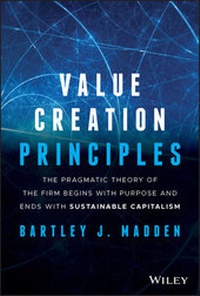
Value Creation Principles
The Pragmatic Theory of the Firm Begins with Purpose and Ends with Sustainable Capitalism
1st Edition
Published on 10. June 2020
Book
Hardback
272 pages
978-1-119-70662-5 (ISBN)
Description
Bartley J. Madden's Value Creation Principles specifies that a firm's knowledge-building proficiency is the fundamental cause of a firm's survival and prosperity as well as a pathway to significant improvements across a firm's typically siloed activities. This theory is about connectedness among the firm's purpose, its major activities, and its long-term overall performance, with attention to long-term financial performance. Madden argues that employees improve their knowledge-building proficiency with experience in traversing the knowledge-building loop, whether alone or preferably with a mentor. Success in understanding cause and effect, using that virtuous cycle of learning, reveals faulty or obsolete assumptions and leads to new assumptions whose reliability is then verified. Language matters and employees' knowledge-building proficiency improves with a habitual concern for questioning assumptions underpinning words describing the firm's activities. Attention to language can help guide experiments (similar to Intuit's experimentation culture) having the potential to negate "knowledge" which is now obsolete possibly due to a changed environment.
A firm's knowledge-building proficiency depends upon top management developing and sustaining an organizational culture that accomplishes two objectives. First, employees are rewarded for productive work enabled by their continual learning and related proficiency in knowledge building, which results in process improvements and occasional breakthrough ideas. Second, the culture promotes collaboration both inside and outside the firm and sharing local knowledge across the firm's business units so that firm-wide knowledge becomes a significant, value-creating intangible asset.
A pragmatic theory of the firm offers a more insightful thinking template compared to existing theories of the firm. It reflects the following tenets about knowledge building and firm performance:
* The fundamental cause of a firm's long-term performance is its knowledge-building proficiency versus competitors.
* Although competitive advantage is typically ascribed to a firm's capabilities, intangible assets, and the like, the source of these advantages is the firm's knowledge-building proficiency.
* A firm's performance--distilled into long-term, life-cycle track records of economic returns and reinvestment rates--offers insights about firm performance helpful to investors and other stakeholders and can improve management's resource allocation decisions.
* Job satisfaction and retention of key employees improves as knowledge-building is made an integral part of employees' jobs.
* Innovation, whether in products, processes, or strategy, improves as more employees (including management) are engaged in knowledge-building experiences with the potential to discover faulty assumptions and generate insights.
* Enterprise risk is best conceptualized as impediments to achieving a firm's purpose.
* Sustained shortfalls in profitability are typically assigned to changes in the external environment. But the real cause is a combination of inferior knowledge building (feedback and questioning of core business assumptions) and lack of managerial skill and determination to effectively restructure the firm.
More details
Other editions
Additional editions
Bartley J. Madden
Value Creation Principles
The Pragmatic Theory of the Firm Begins with Purpose and Ends with Sustainable Capitalism
E-Book
06/2020
1st Edition
Polity
€19.99
Available for download
Bartley J. Madden
Value Creation Principles
The Pragmatic Theory of the Firm Begins with Purpose and Ends with Sustainable Capitalism
E-Book
06/2020
1st Edition
Wiley
€19.99
Available for download
Content
Preface and Overview
Part I A Firm's Role in Society
Chapter 1 Overview of the Pragmatic Theory of the Firm
The nucleus of the pragmatic theory of the firm
The evolution of thinking about the theory of the firm
Kindred spirits for the pragmatic theory
Innovation and economic growth
The purpose of the firm
The pragmatic theory of the firm
Chapter 2 Knowledge Building and Firm Performance
The knowledge-building path to improved performance
The knowledge-building loop
Human behavior, culture, and firm performance
Elegant, parsimonious, and reliable theories
Chapter 3 Work, Innovation, and Resource Allocation
Lean Thinking-- "No problem is a problem"
The Theory of Constraints
Ontological/phenomenological model
Knowledge building and innovation
Resource allocation
The key constraint in sustaining a knowledge-building culture
Part II The Pragmatic Theory of the Firm Connects Innovation and Valuation
Chapter 4 Life-cycle Performance and Firm Risk
The firm's competitive life cycle
A paranoid optimist successfully restructures Nokia
A case study of innovation--Amazon
The life-cycle valuation model
What does a stock price say about a firm's future investments?
Forward-looking, market-derived discount rate
The roots of modern finance
Firm risk offers a different mindset
Summary of key ideas
A research methodology for advancing the life-cycle framework
Chapter 5 Intangible Assets, Brands, and Shareholder Returns
The New Economy and connectivity-enabled business models
Empirical evidence about intangible assets
Brands impact a firm's market value
A conceptual roadmap for handling intangible assets
Integrated Reports, Life-cycle Reviews, and intangibles
Expect more than coffee--Starbucks
Costco starts by caring for its employees
Ringing doorbells and changing times--Avon
Why did Illumina outperform the stock market 18-fold from 2004 to 2014?
The efficient market hypothesis and the factor zoo
Excess shareholder returns and three levels of cause-and-effect logic
Useful ideas for investors, management, and academic researchers
System principles and effective language
Part III Value Creation
Chapter 6 Life-cycle Position, Key Managerial Tasks, and Organizational Structure
Life-cycle guideposts
Focused execution of an innovative business model--Netflix
Innovation in the operating room--Intuitive Surgical
Nothing runs like a Deere
Smith Corona and NCR
The ABCs of organizational structure
Organizational experimentation at Haier Group
Value creators drive Chinese dynamism
Chapter 7 Achieving Progress through Knowledge Building and Value Creation
The New Economy and the pragmatic theory of the firm
Life-cycle track records are a scorecard and a learning tool
Politics and the greater good
Progress Studies
About the Author
Index