

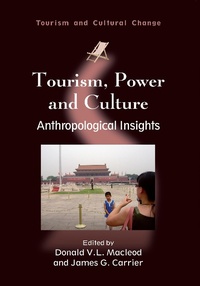
Tourism, Power and Culture
Anthropological Insights
Published on 23. December 2009
232 pages
978-1-84541-186-2 (ISBN)
Description

Tourism as an experience and an industry is infused by culture in its various dimensions, and influenced throughout by relationships of power; this is particularly apparent at the destination site. Anthropological investigations give rich insights into power and culture through ethnographic fieldwork, comparative analysis and theoretical explanation. Within this timely and groundbreaking book case studies come from Latin America, the Caribbean, Europe, Africa, Australia and South East Asia. It is divided into two sections dealing with tourism and the power struggle for resources; and tourism and culture: presentation, promotion and the manipulation of image. Chapters explore issues as diverse as terrorism, ethnicity and World Heritage Sites, and the role of the analysis of power in tourism studies. They illustrate how culture shapes tourism development, is commodified, and becomes a tool in political and economic strategies and struggles.
Reviews / Votes
This book is something of a landmark in the tourism literature by strengthening the sometimes tenuous links between tourism and anthropology through a series of fascinating cases. It focuses on issues of power but also demonstrates the power of fieldwork in getting nuanced responses to the sometimes fractious relationships between hosts and guests. * Peter Burns, Director, Centre for Tourism Policy Studies University of Brighton, UK * This rich volume of case studies will be of use to those interested in the study of tourism as well as social and cultural anthropology. It will likely be of most benefit as a reference text to specialist researchers and in advanced undergraduate and postgraduate teaching...Tourism, Power and Culture: Anthropological Insights is a valuable contribution to the expanding knowledge base concerning issues of power as they intertwine with tourism, and with its addition of culture as a level of analysis, it should be well received. * Scott Cohen, Bournemouth University, UK in International Journal of Tourism Research, 12, 2010 * It is always a pleasure to review a tourism text written or edited by anthropologists, as it is inevitably fascinating and deals with some of the most poignant issues in tourism studies. The work also tends to be thoroughly researched and well-written. This book is no exception and provides a very enjoyable but challenging read, as it deals with some difficult and disturbing issues relating to the subject of power. * Melanie Smith, Budapest Business School in Tourism Recreation Research Vol. 36, No. 3, 2011 *More details
Series
Language
English
Place of publication
Bristol
United Kingdom
Publishing group
Channel View Publications Ltd
Target group
Professional and scholarly
ISBN-13
978-1-84541-186-2 (9781845411862)
Copyright in bibliographic data and cover images is held by Nielsen Book Services Limited or by the publishers or by their respective licensors: all rights reserved.
Schweitzer Classification
Other editions
Additional editions
Book
12/2009
Channel View Publications
€47.90
Shipment within 10-20 days
Persons
Donald Macleod trained in anthropology at Oxford University and is a Senior Lecturer at the University of Glasgow where he has run two research centres. He has researched in the Caribbean, the Canary Islands and Scotland, and published widely on tourism impacts, cultural change, globalisation, identity, sustainable tourism development and heritage. His books include Tourism, Globalisation and Cultural Change (2004), Niche Tourism In Question (2003 - editor), Tourists and Tourism (1997 - co-editor).
James G. Carrier began studying tourism, environmental conservation and economy in Jamaica and the Caribbean in the middle of the 1990s. He has supervised or co-supervised projects dealing with these topics in Montego Bay, Negril and Port Antonio, all in Jamaica. He is currently Senior Research Associate at Oxford Brookes University, and Adjunct Professor of Anthropology at the University of Indiana.
James G. Carrier began studying tourism, environmental conservation and economy in Jamaica and the Caribbean in the middle of the 1990s. He has supervised or co-supervised projects dealing with these topics in Montego Bay, Negril and Port Antonio, all in Jamaica. He is currently Senior Research Associate at Oxford Brookes University, and Adjunct Professor of Anthropology at the University of Indiana.
Content
1. Tourism, Power and Culture: Insights from Anthropology - Donald Macleod and James G. Carrier
Part I Tourism and the Power Struggle for Resources - Donald Macleod
2. Water Sports: A Tug-of War over the River - Veronica Strang
3. Heritage and Tourism: Contested Discourses in Djenne, a World Heritage Site in Mali - Charlotte Joy
4. Power, Culture and the Production of Heritage - Donald Macleod
5. Cultural Perspectives on Tourism and Terrorism - Michael Hitchcock and I Nyoman Darma Putra
Part II Tourism and Culture: Presentation, Promotion and the Manipulation of Image - James G. Carrier
6. Tourism in the Political Economy of Indigeneity: The Case of Embera Cultural Presentations in Panama - Dimitrios Theodossopoulos
7. On 'Black Culture' and 'Black Bodies': State Discourses, Tourism and Public Policies in Salvador da Bahia, Brazil - Elena Calvo-Gonzalez and Luciana Duccini
8. Tourism and the Making of Ethnic Citizenship in Belize - J. Teresa Holmes
9. Tourism and its Others: Tourists, Traders and Fishers in Jamaica - Gunilla Sommer and James G. Carrier
Epilogue
10. Power in Tourism: Tourism in Power - C. Michael Hall
Part I Tourism and the Power Struggle for Resources - Donald Macleod
2. Water Sports: A Tug-of War over the River - Veronica Strang
3. Heritage and Tourism: Contested Discourses in Djenne, a World Heritage Site in Mali - Charlotte Joy
4. Power, Culture and the Production of Heritage - Donald Macleod
5. Cultural Perspectives on Tourism and Terrorism - Michael Hitchcock and I Nyoman Darma Putra
Part II Tourism and Culture: Presentation, Promotion and the Manipulation of Image - James G. Carrier
6. Tourism in the Political Economy of Indigeneity: The Case of Embera Cultural Presentations in Panama - Dimitrios Theodossopoulos
7. On 'Black Culture' and 'Black Bodies': State Discourses, Tourism and Public Policies in Salvador da Bahia, Brazil - Elena Calvo-Gonzalez and Luciana Duccini
8. Tourism and the Making of Ethnic Citizenship in Belize - J. Teresa Holmes
9. Tourism and its Others: Tourists, Traders and Fishers in Jamaica - Gunilla Sommer and James G. Carrier
Epilogue
10. Power in Tourism: Tourism in Power - C. Michael Hall
